Feeds:
Posts
Comments

Archive for the ‘religion’ Category


By Mike Edwards

Belief in a loving God can provide meaning and purpose in life. A belief in a God who loves us can be a valuable source for support and comfort. What is the harm in telling our children there is a God or there is a heaven after death even if we can’t know for sure? We promise our kids all the time we will keep them safe. When asked if their house will burn down, you say it won’t happen to us. You don’t know that. Such a belief isn’t a false belief. As children are older parents can share more why they believe in a God.   

We must be careful what you claim God is like 

Many make claims about God according to the Bible, but biblical scholars who have a deep respect for Scriptures don’t agree what the Bible says about gays, women, hell, and other moral issues. See here.  See here.  See here.  To claim the “Bible says” is frankly a little naive. Besides, even if we agreed on interpretation, we can’t prove God controlled the thoughts and writing of the writers of the Bible in conveying a perfect view of what God was like. If I had it to do over, I would stick to claiming about God certain universal absolutes such as the evil of physical or sexual abuse. Focus on God’s loving nature and desire for the golden rule in relationships. 

What can we be certain is true of God? 

Atheists and believers agree. The only God worth believing in is a perfect God. It is only intuitive that a Creator loves the ways their creations ought to love one another. Many of us are into God but many of us left the institutional church because claims about God’s character was contrary to our deepest moral intuitions. Why believe in a God you can’t respect. We may not always know what perfect love entails but we seem to know the question we ought to ask ourselves – am I loving others like I want to be loved? Perfect Godly love surely is the same as perfect human love.

How do we answer about suffering and evil? 

Perhaps the hardest question to answer as a parent, as children get older, is why there is so much evil and suffering in the world if God truly exist. Lack of certainty doesn’t mean there aren’t plausible reasons how a loving God can exist in such a world. Well-meaning people passionate about God often say things like “it’s all part of God’s plan” or “everything happens for a reason.” It implies evil is some grand scheme by God. How is a God, who supposedly can prevent evil, any different than a parent who stands by and watches their child being physically or sexually abused? Evil and suffering in the world may be because God cannot intervene single-handedly while respecting freedom. God can’t interfere in evil without human help. See here.

Faith is between your child and God 

I wrote here  suggesting parents can relax that their child’s eternal life depends on certain beliefs. Parents can go about having a normal relationship with their child when it comes to “God” matters. Just be an open book when children want to talk about God. As children age and less natural conversation happen, you don’t need to schedule outings or trips in hopes the God-conversation comes up. I get with my children and friends to enjoy one another. When they hurt, I want to be there for them. When they want to talk about God, I am there. Personally, I love talking about God as much as others like talking about their favorite hobby. But, don’t push your agenda. Enjoy your children. Relax. Encourage them. When they are treating others like dirt, show and tell them what true love is like. Trust God will speak to your child as they age when they want to listen.

How Do We Parent A Child In Faith?

MikeEdwardsprofilepic125

Mike Edwards has been writing for Done with Religion for some time and has been a great addition to the site. Mike also has his own site where he writes that can be found at What God May Really Be Like  He can be contacted by email at: medwar2@gmail.com
Read Full Post »

By Mike Edwards

I am writing another Post out of frustration. See here.  I am not angry. I just wish my grown kids asked my advice more about things that matter in life – how do you have a better marriage, what are key actions to parent, you can’t prove God exist so why do you care? When younger kids just need to be feed and loved. My kids are in their thirties. Maybe you as I do have a decent relationship with your kids, and I am not a control freak because of the way I was parented. I married up for sure! My kids still visit or yours may visit if we screw up less than we succeed. Maybe actions matter more than words!

Don’t judge least you be judged 

Maybe we need to look in the mirror. Okay, maybe I need to look in the mirror. How many times have I reached out to older men for relational advice. It wasn’t that I knew it all. I was in the counseling profession and thrive on hearing and sharing feelings. I can count on one hand how many times I have reached out for advice. Lately, I am focused on trying to age graceful. This getting old sucks and I probably could use some pointers. I had a person in mind and he passed away. I never reached out. I suppose there are many reasons we or our kids don’t reach out.

Would all be great if God gave advice in person?

Okay, if God already speaks to you audibly why are you bothering reading spiritual blogs? The truth is that even if God spoke to us in person, God can’t tell you if your partner won’t end up betraying you or your new job won’t end up being phased out. God joins us in an unknown future. See here.  In relationships, overzealous advice can lead to feeling controlled, thus rejecting what is best for one’s own good. The personal road traveled of learning, reflecting, and not being pressured may best lead to lasting convictions and more meaningful relationships. Maybe, it’s  all about the relationship, not advice, as one travel on their own journey.

Actions speak louder than words 

Influences in our life don’t have to be audible. My parents aren’t alive, but I still sense their influence – good or bad. God can’t tell us either that our decisions will work out, but I am convinced I benefit from God’s silent influence. I am convinced God influences me how to be a better partner, parent, or friend we desire to be deep down. I sense God’s encouragement to continually strive to make the best decisions I know at the time. God isn’t as hidden as we might think and it may be for our own good. Maybe that is how a parent-relationship works.

MikeEdwardsprofilepic125

Mike Edwards has been writing for Done with Religion for some time and has been a great addition to the site. Mike also has his own site where he writes that can be found at What God May Really Be Like  He can be contacted by email at: medwar2@gmail.com

Read Full Post »

By Mike Edwards

Let’s stop with the excuses! Certain actions are immoral regardless of whether you claim faith in God or no faith at all. I am bias that a belief in a moral, loving God can be a tremendous influence on one’s behavior, but nations are not doomed because of lack of belief in God. There are moral atheists and friends who don’t wear God on their sleeves that put to shame us people of faith. Faith is an individual choice!

God never intended to force belief

God created freedom for a reason. Forced love is an oxymoron. Without freedom we could accuse God of not creating the very best world where only true, authentic relationships can develop. Freedom allows human to develop qualities of moral character that cannot be created initially.  True love doesn’t insist on its own way (I Cor 13:5). We are dependent on our children for intimate relationships. God is dependent on us. God would only give us uncontrolled freedom if seeking a partnership and friendship with us.

Can right be determined from wrong without God or religion? 

No religion can claim right from wrong according to their revered book. Many claim to be certain about God according to the Bible, but biblical scholars who have a deep respect for Scriptures don’t agree what the Bible says about gays or women rights.  See here.  See here.  Supposed right interpretations or that God agreed with what was recorded has led to many abuses. Are we really claiming those who never had a Bible didn’t know right from wrong? Whether you believe in a Creator or not, most rational people agree on many moral actions. Perfect rights or laws are those that demonstrate loving others like we want to be love. Freedom to debate such actions is essential. 

Our rights don’t come from other human beings 

I believe the Declaration of Independence and Constitution makes the U.S. unique from most other countries. They declare we all have “unalienable rights” such as freedom to speak. See here. No Government or Dictator can take such rights away. Our Democracy allows representation through voting, though certain individual rights must be safeguarded. There must be true debate of differing opinions to possibly arrive at the most caring decision.

How do we create a more loving Nation?

I am bias. Many positives can result from a belief in a divine Lover. Such a Being can empower and inspire us in our relationships with others. Regardless though of your faith, most rational beings agree on many universal moral values (murder, stealing).  And no – climate control, immigration, taxes, health care, are not universal laws! Freedom to discuss contrary opinions can lead to the most caring decisions. Ideally, good ideas win the debate. Opinions about the Covid vaccines were squashed and we were mandated to get the shot to protect Grandma, but it turns the shots didn’t prevent infection or transmission.  Until we all ask ourselves “am I acting toward others like I want to be treated,” we seem destined to fail.

Is a Godless Nation An Immoral Nation?

MikeEdwardsprofilepic125

Mike Edwards has been writing for Done with Religion for some time and has been a great addition to the site. Mike also has his own site where he writes that can be found at What God May Really Be Like  He can be contacted by email at: medwar2@gmail.com

Read Full Post »

Yes, but not for us

by Jim Gordon

It seems when I mention that my wife and I left the organized church, people assume something happened to hurt us or make us mad.

Just to be clear on this subject, neither one of us have ever been abused by the church. Neither one of us are mad about some event or some person at church. Unfortunately, abuse does happen in the church system and many people are hurt by others, but that was not the case with us.

After nearly sixty years in the organization, and after the last ten or so of those years feeling that something is not right with the system, we made the decision to leave and follow Christ outside the walls of religion. To be clear, that is our decision and we certainly do not expect everyone to agree and do the same thing. Many people are part of the organized religious system we know as church, and they truly love God and want to serve God.

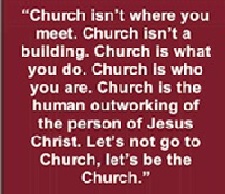
We believe the Church is a community of people and not a building nor a service held one day each week with paid professionals leading the service. We believe the Church is each of us who follow the example of Jesus and see Christ as the head of his body. We are the temple of the Holy Spirit and each of us are equally functioning members making up the body of Christ.

We believe that forsake not the assembling of yourselves means we need one another. We live each day having fellowship with those God brings together, no matter where it happens. We never truly found real fellowship when we sat in an organized service for an hour looking at the back of the head of the person in front of us. We believe true fellowship is not just sitting together with other people in a room, but it is daily loving, encouraging and praying for one another and meeting the needs of those we are able to help.

The temple in the Old Testament was only a shadow of what was to come in the New Testament. God now lives in us, and we are the temple. God is our leader rather than another human being we call pastor. There is no hierarchy in the Church today. Each of us are equally important parts of the body and able to teach, encourage, build up and pray for one another. It is truly a priesthood of all believers, not a one man or woman show.

Those with specific gifts for helping the Church are not better or more spiritual than the rest. They are brothers and sisters who walk along beside those who need encouragement. They are those who have learned a spiritual lesson and are there to help those who are still learning. They are servants and friends rather than spiritual authorities.

So, when I say that we have left the church, it is only the building and organization I am talking about. We left, not because we were mad or hurt but because we believe the religious system most people call church is far from what God is building. God is building a group of people who will daily follow the leading of the Spirit outside the walls of religion, loving God with all their heart, loving their neighbor and accepting all they meet along the way.

Jim Gordon and his wife left the institutional church after spending over fifty years within the system. Jim wanted a way to express his thoughts and concerns about the religious system and why he and his wife decided to leave the institution but not their faith in God. Jim can be contacted by email at: jimgordon731@gmail.com

Read Full Post »

by Michael Donahoe

Many people talk about the problems we have in the schools today. Often we hear the reason being that God and prayer have been removed from our schools.

Actually, this could not be further from the truth. God and prayer have never been removed from our schools. As believers, the Spirit of God lives within us and is available to hear our prayer anytime, anywhere.

What has been removed from schools is a set, standardized prayer by a teacher or someone leading the whole class. And quite frankly, this type of prayer should have been removed from our schools. Our public schools are made up of children from many beliefs, many faiths and many religions. We cannot nor should we force one religion’s views on everyone.

As Christians, we believe that through the Spirit we have the presence of God with us always and we can pray anytime we feel like it. Prayer can be done silently and internally, so no one needs to be distracted or forced to listen.

God and prayer cannot be removed from any place. We just need to remember the fact that the Spirit of God is within us and available to us each and every day.

Michael Donahoe was added as a writer as his views fit perfectly with those of Done with Religion. He also writes on Substack at https://myopinionblog.substack.com/

Read Full Post »

By Mike Edwards

When a death happens because of a tragedy, often well-meaning God folks will say “God took them in God’s time.” Does this mean that God caused or allowed one but not another to be killed by a drunk driver? I cringed when I read “by the grace of God there was a doctor running by at that exact moment and started CPR and the guy survived.” Was God ungraceful when there was no Doctor in other situations to save a life?

Does everything really happen for a reason?

Well-meaning people passionate about God often say things like “it’s all part of God’s plan” or “everything happens for a reason.” It implies evil is some grand scheme by God. How is a God, who supposedly can prevent evil, any different than a parent who stands by and watches their child being physically or sexually abused? Evil and suffering in the world may be because God cannot intervene single-handedly. God can’t interfere in evil without human help. See here.

What bother to pray then?

See here.

God’s uncontrolling love can be freeing 

Can there be true freedom if everyone’s future is determined or known? Even God can’t know a unknowable future. God isn’t hiding a “known” future for important decisions. God joins us in an open future. God wants us to feel free to pursue our own dreams without strings attached, unlike some earthly parents. God only desires to influence us to do all the good we can, in all the places we can, at all the times we can, to all the people we can, as long as we can. The future is open to God as well. God joins us in a true friendship by sharing our joys and sorrows in our journey. 

Please stop rationalizations 

Are you dissatisfied with answers to your questions such as: “God wants to make you stronger;” “God’s ways are not our ways;” “You didn’t have enough faith.” If evil is some grand scheme God can control, why then does the Bible says God hates evil so much? Does God hate God sometimes? See Thomas Oord’s book GOD CAN’T for further insight about God, evil, and suffering.

Imagine the perfect friend – that is God! 

God loves like how you wished you loved others. God hates when prayers can’t be answered. God feels the same pain you are experiencing. God shares the dreams you have for your future.  Conventional thinkers don’t like to suggest God has feelings of vulnerability, but they don’t mind talking about God’s wrath. If a God can be angry, a God can be sad. God hates when we are suffering. A truly loving God, like a friend, hurts when you hurt. We may wish God would just intervene but there may be legitimate reasons why God can’t. But God is with you each step of the way as we reach out to others for help as well.

Can We Stop Saying Our Rights As A Nation Come From God? 

Can We Stop Saying “Biblical Worldview”?

Can We Stop Saying “Everything Happens For A Reason”!

Can We Stop Saying “Love The Sinner, Hate The Sin”!

MikeEdwardsprofilepic125

Mike Edwards has been writing for Done with Religion for some time and has been a great addition to the site. Mike also has his own site where he writes that can be found at What God May Really Be Like  He can be contacted by email at: medwar2@gmail.com

Read Full Post »

By Mike Edwards

I hope some readers can relate to my experience and journey with a best friend for decades. Many of us are done with religion but not God. We have stopped going to the institutional church for many reasons such as we just can’t agree with the God being preached. But we still love discussing God with others. Those not into God may assume believers have a hidden agenda to change their beliefs. But shouldn’t we be able to at least talk to God-interested friends?

History of friendship can be a problem

I wrote here My Story – Spiritual Journey. My parents were into God and for whatever reason I never rejected such a belief. I continued to attend church until I was about fifty. I became somewhat of a prophetiser in my twenties and thirties. I suppose being taught that unbelievers were going to burn in Hell forever after death didn’t help. Turned out a literal Hell is doubtful according to the Bible. See here.  My passionate and dogmatic ways carried over with my children. When one kid mentioned evolution as a way humans came into existence, I wasn’t exactly the most open-minded Dad. I have apologized, but I am not sure my friend or children believe I have changed when it comes to discussing God.

One challenge is discussions about God can undermine one’s faith

I should share my best friend and I use to have the same beliefs about God. I believe my best friend avoids discussion about God because it may create doubts in their own faith. To question what one has heard in church all their life can lead to uncertainties about God. When challenged if Hell is real though taught all your life Hell is real, it can create anxiety what else taught may be in question. Speaking to a questioner like me isn’t always comforting. One reason I left the church was because I felt my skepticism was divisive for newcomers who came because of what leadership taught. It didn’t help that leadership didn’t exactly invite differing opinions of what God may really be like. 

Another potential reason conversations are difficult

We must examine if we control our emotions when discussing our beliefs. I think I do now. Do you? I mentioned some friends may not enjoy a discussion about God as much as we do, as challenges to one’s belief can cause anxiety. Another challenge is if the culture supports discussing diverse opinions.  Are those with differing beliefs than the common narrative shut down and labelled conspiracists? The Church often labels those with different opinions of God as heretics. When only one political or religious opinion is presented, many are quick to consider their friends conspiracists or heretics – not exactly a conversation help with your best friend or any friend.

Can a friendship continue with important conversation challenges?

I have shared what I think are the main reasons for a stalemate with my best friend. The reader may want to explore their own personal reasons. I consider myself NOW an open-minded person, but legitimate reasons may exist for discussing differing opinions between two friends. Discussing God for some may be the same as discussing politics. The differences are just too far apart. My friend and I have found it is best to agree to disagree, but somehow we still have an a great relationship. It could even be better though. We share other interests. Personally, I still hope someday we can discuss the most important thing in our lives – a relationship with God.

Why Can’t Two God-Believing Friends Discuss God?

MikeEdwardsprofilepic125

 Mike Edwards has been writing for Done with Religion for some time and has been a great addition to the site. Mike also has his own site where he writes that can be found at What God May Really Be Like  He can be contacted by email at: medwar2@gmail.com

Read Full Post »

By Mike Edwards

Christian leaders and companies use the term “biblical truths,” but these same leaders criticize those who dogmatically claim “the science says.” The truth is that it isn’t science if there isn’t debate. What we may think is science today may be updated in a year. Biblical truth, according to one’s interpretation, is also debatable. Both Christian leaders and government health officials must engage in healthy debate. Religion and science play God (Superior) in the lives of others by claiming they know the truth and we are too stupid to decide for ourselves! 

Christian leaders claim certainty concerning “biblical truths”

The Bible as literature has to be interpreted. Many claim to be certain about God according to the Bible, but biblical scholars who have a deep respect for Scriptures don’t agree what the Bible says about gays, women, and hell, and other moral issues. See here.  See here.  See here.  Besides, even if we agreed on interpretation, we can’t prove God controlled the thoughts of the writers of the Bible in conveying a perfect view of what God was like. The Bible is still valuable as recorded history of God with the Israelites, challenging us to think about what God is really like.

Christian leaders though accuse Government officials of claiming certainty

Many Christians leaders accuse the current government Administration and health officials of misleading by maintaining their interpretation is scientific truth. They argue it isn’t science without debate. Well, it isn’t biblical truth because you say it is according to your interpretation. It is true science is fluent. Drugs are often approved initially, only to be pulled from the shelves later after causing death. It is also true we can’t prove God exist much less that our view of what God is like is correct. ‘Uncertainty” falls both ways – religion and science.

How to live in a land of uncertainty 

Certain absolutes are universal and obvious to all rational beings, whether it is found in the Bible or science.  Does anyone reading this not believe physical or sexual abuse is wrong? All agree we shouldn’t be lied to. Adultery only isn’t wrong in the eyes of the betrayer. Christian leaders must admit uncertainty in the arena of non-universal, biblical beliefs. Christian leaders then can rightly demand debate when it involves responding to a pandemic, taxes, climate change, or immigration. 

How Leaders Can Proceed

It is not right to claim certainty when you may be wrong. When universal agreement doesn’t exist, it should be obvious that one must be allowed to form their own opinions since uncertainty exists. We must stop being so damn certain of our understanding of God according to the Bible, especially when our interpretations are contrary to our moral intuitions. The central message about God in the Bible seems to be to strive to love others like you want to be love. I will debate anyone who thinks a loving God, by Jesus’ example, encourages treating others like shit. We can stop labeling those who disagree with our biblical interpretations as heretics. We can stop calling those who disagree with our views of science as conspiracists. We must fight for freedom to debate opinions!

How Christian Leaders Are Hypocrites In The “Truth” War!

MikeEdwardsprofilepic125

Mike Edwards has been writing for Done with Religion for some time and has been a great addition to the site. Mike also has his own site where he writes that can be found at What God May Really Be Like  He can be contacted by email at: medwar2@gmail.com

Read Full Post »

By Mike Edwards

We must respect the opinions of rational people whether the topic is religion, science, or politics. It is not easy to discern people’s motives for shutting down discussion. Sometimes you can only look at the results of their actions, such as what gains are made by refusing debates. We reject controlling behaviors in our marriage or friendships, for they often lead to domestic violence or bullying. Church and public leaders must be held accountable to not always presume certainty. See the Sin of Certainty

“When you tear out a man’s tongue, you are not proving him a liar, you’re only telling the world that you fear what he might say.” – George R. R. Martin

Any opinion must have the right to debate  

I believe judging one by the color of their skin than character is racist and immoral. But we must allow freedom to voice opinions, as long as one isn’t clearly promoting physical harm to others. I rather one’s racism be out in the open. Racism must be defeated in the battle of ideas and discussions. I like my chances! Did you know it is debatable if the covid vaccines have more benefits than risks? Do you know it is debatable whether God condemns gays according the Bible?  I question one’s motives when unwilling to debate their beliefs. Personally, I desire to convince naysayers in something I am convinced I’m right about and feel strongly about.  

Certainty rather than uncertainty helps individuals avoid anxiety 

I wrote here  how individuals avoid anxiety by not discussing their beliefs with others who believe differently. Individuals also prefer certainty from Leaders to avoid anxiety. I imagine most Leaders prefer being seen as knowing (certain) than “not knowing.” Most humans desire to integrate with a group, get along with its members, and benefit from them. Both disagreeing with the popular science narrative or disagreeing with church leadership about God’s character puts us in the land of uncertainty. Leaders though may have other motives than to just avoid anxiety.

Leaders fear lack of security 

The most benign explanation for quashing the opinions of others is not necessarily the fear of losing power as much as the fear of losing security (one’s livelihood). In my counseling career, I often questioned the narrative concerning psychotropic medications. A client is owed a discussion of both the risks and benefits of such an intervention for mental healthiness. I didn’t always share my opinion with psychiatrists in charge. I don’t fear conflict. But I am sure I feared potential loss of a job because I was in the minority and low on the totem pole. In politics losing the perceived popular opinion might not lead to reelection. Pastors risk being kicked out of the pulpit.

Leaders fear losing power 

The most evil explanation for quashing the opinions of others is one’s desire for control and power over others – whether motive is profit, etc.  When only one side is presented, control and power often advance for a time at least. Control and power flourish when others are not allowed to discuss alternative opinions in the public arena. The only way we can judge if this is one’s motive is by demanding answers as to why one is refusing debate. Religion and science are playing God (Superior) in the lives of others by claiming they know the truth and we are too stupid to decide for ourselves!

It doesn’t matter if you think you are right!

You may be wrong! When universal agreement doesn’t exist, it should be obvious that one must be allowed to form their own opinions. Let’s stop labeling those who disagree with our biblical interpretations as heretics. Let’s stop calling those who disagree with our views of science as conspiracists. The bedrock of science use to be considered an educated guess based on the information we have currently have and could change in the future. Religious folks hide behind their interpretation of a Book. We don’t all agree if the Bible opposes women priests or preachers or condemns gays. Canceling the opinions of others must be stood up against and defeated!

Why Do Leaders Cancel Others’ Opinions?

MikeEdwardsprofilepic125

Mike Edwards has been writing for Done with Religion for some time and has been a great addition to the site. Mike also has his own site where he writes that can be found at What God May Really Be Like  He can be contacted by email at: medwar2@gmail.com

Read Full Post »

by Jim Gordon

What do people think of when they hear the word Christian? With some of the discriminatory and hateful happenings recently with extreme groups who claim to be Christian and with the rise of Christian Nationalism, I feel it is getting a little confusing what the real meaning is.

My wife and I have seriously questioned whether we should continue to use the word Christian to identify us or not. Basically, it all boils down to what we mean by Christian.

If being a Christian is being part of a religion that meets in a building on a particular day and follows set doctrines based on what denomination we belong to, then no, we are not Christians. If being a Christian is considered being part of a group that follows various spiritual beliefs such as Jews, Muslims, Hindu, Baptists, Methodists, Charismatics and others, then no, we are not Christians. If being a Christian is being part of a group that is opposed to all other religions and only accepts those who believe like they do, then no, we are not Christians. If being a Christian has anything to do with religion, political power, hatred, exclusion, discrimination and such, then no, we are not Christians.

In Acts 11:26, the disciples were first called Christians by people in Antioch. They were called Christians because they were acting like Christ. The people there were calling them little Christ’s because of the way they showed the love and power of Jesus. Now, if that is what is meant by being a Christian, then we are all in.

There are many ways we can described ourselves…believers, Christ followers, disciples of Jesus, people of faith, people of the way or even Christians. Yet, the name itself does not really matter. What matters is how we live our lives. Is Christ preeminent? Are we living as one with him? Are we allowing the love of Christ to live through us, accepting others, loving others, including others and being little Christ’s to all we meet? If not, the name itself really makes no difference because we are not being like Christ.

We should not worry so much about the name we use, but by the way we live. When people see us, they should see Jesus. He lives within us and we should be known for the love we have for him and for our fellow man. We are to let Christ live through us each and every day to everyone we meet.

Jim Gordon and his wife left the institutional church after spending over fifty years within the system. Jim wanted a way to express his thoughts and concerns about the religious system and why he and his wife decided to leave the institution but not their faith in God. Jim can be contacted by email at: jimgordon731@gmail.com

Read Full Post »

« Newer Posts - Older Posts »