Feeds:
Posts
Comments

Archive for the ‘The church’ Category

by Jim Gordon

Unfortunately, we know many people have been treated wrong within the church system. Some more severe that others, but none of it is good.

I think one of the groups that seem to be affected most by this are those who are LGBTQ. I have seen this group of people treated rudely and like second class citizens in many churches where they should find love and acceptance more than anywhere else. God said to love our neighbors, he did not say to love only those with whom we agree.

Even in the churches that are actually welcoming, LGBTQ people are often not accepted and allowed to participate fully within the organization or hold certain positions. They are welcome to come in and sit and listen so hopefully the church can change them, but they are not welcome to come in and participate in any way within the church program.

Christian people will deny rights and services to LGBTQ people based on their Christian beliefs, unfortunately even including fellow Christians who are LGBTQ. Even government office holders can refuse certain services and basically get away with it because they say it goes against their Christian morals. As a Christian, I say these things should not be. This is nothing like the example of Jesus.

Labels are placed on many people, gay/straight, black/white, male/female, christian/atheist, American/foreign/immigrant. Yet behind those labels are human beings who were created in the image of God. They are loved and accepted by God and we are told as followers of Christ to be known for our love for one another.

I feel for those who are LGBTQ. It hurts to see people who were created and loved by God be rejected and abused by those who claim Christianity. I think it is time to look past the labels, look past personal feelings and accept people just the way they are, because they are created and loved by God.

Jim Gordon and his wife left the institutional church after spending over fifty years within the system. Jim wanted a way to express his thoughts and concerns about the religious system and why he and his wife decided to leave the institution but not their faith in God. Jim can be contacted by email at: jimgordon731@gmail.com

Read Full Post »

By Mike Edwards

Is your experience similar to mine? I enjoy talking about God for spiritual health reasons without any hidden agenda to convert others, but I begin blogging years ago about God because few want to discuss what role God plays in their life. Church can be one place to discuss God, but many of us discovered our contrarian questions weren’t always welcomed in such a setting so we moved on. We discuss family and work relationships. Why not our relationship with God?

Differences of opinions can be uncomfortable

Spiritual topics, like politics, can be touchy. There are diverse opinions in the spiritual arena which might lead to avoiding potential conflict. Groupthink is just human nature. Most humans desire to integrate with a group, get along with its members, and benefit from them. Discussing opposing beliefs can be uncomfortable and can lead to questioning our own beliefs thus creating anxiety.

Christians tend to have an “agenda” reputation

Conversations with God followers often feels like them trying to change your beliefs. We all hate when our partner doesn’t listen and just wants to give advice. I hate to admit I use to have an agenda with those outside the institutional church. I was taught God’s good news was saving people from Hell so they could get into Heaven. I was wrong according to Jesus. See here.   The ship may have sailed others trusting us to have open conversations. All I know to do is to focus on a life where actions speak louder than words in case others want to pursue convos about God.

Claims made about God stifle conversations 

Many of us are into God but many of us left the institutional church because claims about God’s character was contrary to our deepest moral intuitions. Why believe in a God you can’t respect. It is only intuitive that a Creator loves the ways their creations ought to love one another. Beliefs about God’s love that don’t match how you know you ought to love your neighbor may be amiss. Don’t believe everything you hear about God! See here.

Some don’t want to give up stuff or change

Spiritual folks are too quick to assume people don’t discuss God to avoid self-reflection. I suppose many may believe there is a God but don’t pursue because it may require changing some habits, but I doubt that is a main reason for most people. If you know what you are doing is harming others and you don’t care, that is on you. But if struggling with habits that you know are hurting you and others, God doesn’t have a list for you to conquer before getting to know God. Conversation can be stifled when we make assumptions about others and why they may not believe in God.

Believing what we can’t prove is normal 

Faith in God isn’t much different than faith in a lot of life. We still get on an airplane or sit in a chair, not because we know but have reason to believe it is safe. No religion can be proven beyond some doubt, but that doesn’t make faith unreasonable. Maybe we can’t reconcile why God doesn’t intervene more with evil and suffering in the world. Lack of certainty doesn’t mean there aren’t plausible reasons how a loving God can exist in such a world. If you have an inclination there is a Creator, consider initiating such conversations. Many God-folks enjoy such conversations.

Why Is It So Awkward To Talk About God With Others?

MikeEdwardsprofilepic125

Mike Edwards has been writing for Done with Religion for some time and has been a great addition to the site. Mike also has his own site where he writes that can be found at What God May Really Be Like  He can be contacted by email at: medwar2@gmail.com

Read Full Post »

by Jim Gordon

After all the years I spent in church and being taught the various Bible stories, I always thought I had everything about God figured out. I thought I knew everything there was to know to have fellowship with God and do what was “right” for a Christian to do.

I have found this to be a common feeling among many Christian people. We think by listening to the pastor and doing some Bible reading, we have all the answers and do not need to seek out any other ways of looking at things.

Yet, as time went by, I began having some questions on things that did not make sense to me. I would notice now and then that I would even have some doubts. Of course, I did not pursue any of these questions or doubts because a ‘good’ Christian does not do that. To question or doubt was the fastest way to show you had very little faith.

As the years went by, I became a little more open to seriously wondering about some of the things I was taught in church. I started reading some books by others who felt the same way. I came to the conclusion that God was big enough to handle my questions and doubts, so I no longer felt guilty about having them. More and more people are coming to this same conclusion and are beginning to question and challenge some of the things they were taught.

I notice that some people begin to ask questions, but quickly feel guilty for doing so and go back to their old way of keeping quiet and not asking questions. Others begin to doubt and question and end up completely leaving their faith. It is sad when that happens, but everyone is certainly entitled to follow what they feel is right for them. Still others, such as me, started learning new things, found new interpretations, changed their way of thinking, changed some of their basic doctrinal beliefs and left the institutional church but did not leave their faith in God.

I soon realized I was participating in something I came to know as deconstruction. I did not know there was an actual term for what I was going through. This is common now and there is certainly nothing wrong with it. Basically, it is questioning your faith and what you were taught over the years, throwing out some things, changing your mind on some things and then starting to see some things in a new way.

The more I think about it, I think that doubts, questions, deconstruction and reconstruction will be something that never ends. I think this will be the norm for the rest of my earthly life. I personally think if we stop wondering and stop questioning, we will become stagnant in our faith. God is so much bigger than we realize, and there are so many more things to learn than what we have been taught throughout our time in church. If you are having some questions and doubts about your faith, do not feel guilty about it. Follow them and trust the Holy Spirit within you to guide you into more truth. Never stop seeking to grow in the grace and knowledge of the love of God.

Jim Gordon and his wife left the institutional church after spending over fifty years within the system. Jim wanted a way to express his thoughts and concerns about the religious system and why he and his wife decided to leave the institution but not their faith in God. Jim can be contacted by email at: jimgordon731@gmail.com

Read Full Post »

Yes, but not for us

by Jim Gordon

It seems when I mention that my wife and I left the organized church, people assume something happened to hurt us or make us mad.

Just to be clear on this subject, neither one of us have ever been abused by the church. Neither one of us are mad about some event or some person at church. Unfortunately, abuse does happen in the church system and many people are hurt by others, but that was not the case with us.

After nearly sixty years in the organization, and after the last ten or so of those years feeling that something is not right with the system, we made the decision to leave and follow Christ outside the walls of religion. To be clear, that is our decision and we certainly do not expect everyone to agree and do the same thing. Many people are part of the organized religious system we know as church, and they truly love God and want to serve God.

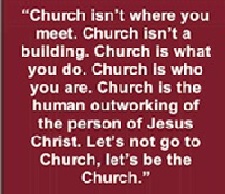
We believe the Church is a community of people and not a building nor a service held one day each week with paid professionals leading the service. We believe the Church is each of us who follow the example of Jesus and see Christ as the head of his body. We are the temple of the Holy Spirit and each of us are equally functioning members making up the body of Christ.

We believe that forsake not the assembling of yourselves means we need one another. We live each day having fellowship with those God brings together, no matter where it happens. We never truly found real fellowship when we sat in an organized service for an hour looking at the back of the head of the person in front of us. We believe true fellowship is not just sitting together with other people in a room, but it is daily loving, encouraging and praying for one another and meeting the needs of those we are able to help.

The temple in the Old Testament was only a shadow of what was to come in the New Testament. God now lives in us, and we are the temple. God is our leader rather than another human being we call pastor. There is no hierarchy in the Church today. Each of us are equally important parts of the body and able to teach, encourage, build up and pray for one another. It is truly a priesthood of all believers, not a one man or woman show.

Those with specific gifts for helping the Church are not better or more spiritual than the rest. They are brothers and sisters who walk along beside those who need encouragement. They are those who have learned a spiritual lesson and are there to help those who are still learning. They are servants and friends rather than spiritual authorities.

So, when I say that we have left the church, it is only the building and organization I am talking about. We left, not because we were mad or hurt but because we believe the religious system most people call church is far from what God is building. God is building a group of people who will daily follow the leading of the Spirit outside the walls of religion, loving God with all their heart, loving their neighbor and accepting all they meet along the way.

Jim Gordon and his wife left the institutional church after spending over fifty years within the system. Jim wanted a way to express his thoughts and concerns about the religious system and why he and his wife decided to leave the institution but not their faith in God. Jim can be contacted by email at: jimgordon731@gmail.com

Read Full Post »

by Jim Gordon

As someone who has grown up in organized religion and spending many years in the traditional church, I can honestly say that the institutional church has fallen way off course. What we call church today seems more like a large corporation run by a CEO and executive board.

We seem to be more focused on our programs, building bigger buildings, having a bigger and better worship band, getting on radio or TV and being a step ahead of the church down the street.

Our churches today are so divided by denominations, doctrines and biblical interpretations that it seems we fight among ourselves more than anything. In many cities, there is literally a church building every mile or two from each other yet we cannot come together to share the love of God with others. As we worry about our buildings, doctrines and organizations, our world continues to get worse and worse.

It amazes me how upset and defensive people can get when you mention that going to church is not a requirement. They seem to forget that the Church is not a building nor a place we go, but is the body of believers. The first verse that is quoted when we talk about not going to church is Hebrews 10:25, not forsaking our own assembling together. Nowhere does this verse say that we have to assemble in a building on a certain day at a certain time. Nowhere does it say we have to have a pastor to teach us, or a worship band to lead us in praise and worship. It does say that we need one another for fellowship, encouragement and godly love.

I feel that sometimes we Christians want to go to church to be entertained and told what to believe, then go home feeling satisfied that we have fulfilled our duty until next Sunday. We have become lazy and do not want to spend the time with God, studying, meditating and allowing the Holy Spirit to teach us. After all, we really do not need a pastor to teach us. It states in 1 John 2:27 that the anointing which you received from Jesus abides in you through the Holy Spirit, and you have no need for anyone to teach you; but as Christ’s anointing teaches you about all things and is true and is not a lie, just as it has taught you, you abide in Christ. Abiding in Christ is a daily way of life, not once a week in a building.

Jesus said where two or three are gathered together in my name, there I am in the midst of them. That can be in a restaurant, in a home, in a park or any place believers join together. Many people put more emphasis on where we meet and not enough emphasis on spending time with the one we love. Why is it we feel the need to go to a building anyway? God said we are the house of God. We are the temple of the Holy Spirit and God is always with us.

Going to an organized religious building is not wrong, but we should call it what it is. The church building that people go to is a place where the body or members of the Church get together with like-minded people. It should be a time of encouragement, uplifting one another and praising God. It should be a place that when we come together, each one has a song, has a lesson, has a revelation, has a tongue, has an interpretation. Each one of us participating in these things for the strengthening of one another. Sadly, most often in the traditional church building, it is a planned service directed by a select few while everyone else sits and listens.

The true Church are those of us who are saved through faith in Christ. It is not a building nor an organization. We Christians seem to get more involved with the things about Christ, the services, the meetings, the up-keep of a building and the money to keep the bills paid, that we lose sight of our first love, who is Jesus. Jesus is the head of the Church and is to have the preeminence. We should be putting our focus on Christ, loving God with all our heart, soul, strength and mind and loving others.

We need to stop the arguing over different interpretations, denominational doctrines and when and where to meet, and start loving others even with our differences. We can attend a building to meet with others if we desire, or we can stay home, go for a walk, have dinner with friends or whatever helps us have meaningful fellowship with God.

Fellowship with God and with one another, encouraging one another, uplifting one another and truly loving one another with a godly love, will show the world that we are disciples, they will see a difference in the way we live as Christians, and hopefully they will come to share in the love of God.

Jim Gordon and his wife left the institutional church after spending over fifty years within the system. Jim wanted a way to express his thoughts and concerns about the religious system and why he and his wife decided to leave the institution but not their faith in God. Jim can be contacted by email at: jimgordon731@gmail.com

Read Full Post »

By Mike Edwards

It is hard for many to wrap their brain around that a Supreme Being exists. Others are inclined to believe there is a Creator. I am convinced the Bible is a main reason many don’t have more of a relationship with a Creator they believe in. I wrote here other reasons people don’t pursue a closer relationship with the God they believe in. Many wouldn’t hold certain beliefs about God unless claimed true by authority figures – according to the Bible. Answers to questions according to the Bible, contrary to our moral intuitions of a loving God, may be the problem!

The Bible, Gays, and Hell 

I believe there are two main beliefs claimed about God because of the Bible that drive others away from God. Many may be unaware biblical scholars who respect the Bible don’t believe Scriptures condemn gay monogamous relationships. See hereIt doesn’t make moral sense why God would condemn gays when they can no more chose who they love than straights can. Ask them! Why would anyone choose to be gay based on the condemnation and bigotry they face?

One would only imagine a loving God creating a literal Hell because of one’s interpretation of a Book.  A loving God wouldn’t torture anyone forever since such pain serves no lasting purpose. Humans wouldn’t even create such a place for their worst enemies. Hitler tortured millions of Jews; God is said to torture billions forever. A moral God can’t be a hellish, sadistic, torturer! We can’t prove God controlled the thoughts of writers to always portray God accurately, but scholars don’t even agree that a literal Hell is a reality in the Bible. See here.

The Bible, talking snakes, and evolution

No one was there in the beginning. You don’t have to believe in magical trees and talking snakes. Those could be a literary device to discuss a relationship between God and humans. Many insist on a literal interpretation of Genesis, that Adam was a literal than representative of the first human. I can believe God did or didn’t use evolution in the creative process – humans evolved over time into a more complex form. See https://biologos.org/

The Bible and God’s violence rationalized

Many notice passages like I Sam. 15:3 where God orders: “Now go, attack the Amalekites and totally destroy all that belongs to them. Do not spare them: put to death men and women, children and infants, cattle and sheep, camels and donkeys.” If you don’t think this is morally shocking, how would you react if reading this same command in the Koran? God is said to order killing boys and non-virgin women but sparing virgins (Num. 31:18). Did God really expect young woman to watch their mothers, sisters, and brothers murdered by men who one day may expect marriage or sex? Biblical scholars are rightly questioning if the authors always depicted what God is truly like. 

So, what is God really like? 

Faith in God or what God is truly like isn’t much different than faith in general. We still get on an airplane, not because we know but have reason to believe it is safe. We can’t always be certain. Surely a loving Creator would love the way we were created to love. Somehow, I know what a true friend or perfect God must be like. A God worth believing in surely desires to inspire and encourage you to become the person deep down you want to become. Choose biblical interpretations and understandings of God that make moral sense, regardless of what others claim the Bible teaches. I have decided a journey of faith with such a God is worth living.

What May Be The Main Reason People Aren’t Closer To God?

MikeEdwardsprofilepic125

Mike Edwards has been writing for Done with Religion for some time and has been a great addition to the site. Mike also has his own site where he writes that can be found at What God May Really Be Like  He can be contacted by email at: medwar2@gmail.com

Read Full Post »

By Mike Edwards

Some are inclined to believe in a Creator and others are not. I don’t wish to judge the latter. Those who lean toward thinking there is a God, there seem to be two types of “DONES” and they are often confused. One group is not done with God, just religion or the institutional church as a place to be with God. Another DONE group may be those who once called themselves believers in God, but are now agnostic or atheist.  It is this group that I am thinking of below. Why might some stop believing in God at all if inclined initially? 

Drop the myth that all who stop believing in God are denying reality! 

The first chapter of Romans in the Bible is used to accuse those who deny God to justify their evil ways. I suppose some deny there is a God to avoid feeling guilty for treating others like shit, but I don’t know any such people. Hopefully, you don’t think you are more enlighten or moral than others as to why you have enough faith to keep believing that an invisible, inaudible God exist. I just never discovered a reason to not believe in God, and I hope I never do. Let’s not accuse those who believe in a God as needing a crutch or accuse those who question the reality of an invisible God as being wicked and ignorant of their feelings. 

One reason to stop believing when told the Bible is contrary to our moral intuitions 

It is claimed God condemns gays though who would intentionally choose a lifestyle that invites condemnation and discrimination. We are told God doesn’t want women fulfilling supposed “manly” roles though that only leads to favoritism and abuse. Men don’t need reasons for behaviors that often come naturally. We are told God is a hellish, sadistic torturer according to beliefs while here on earth, but even humans wouldn’t create such a place for their worse enemies. Many claim to be so certain about God according to the Bible, but biblical scholars who have a deep respect for Scriptures don’t agree what the Bible says about gays, women, and hell, and other moral issues. See here.  See here.  See here

Another reason to stop believing when told God allows evil and suffering for a greater good

It is understandable why many can’t believe in a supposedly, all-powerful God who standbys while one is being raped, tortured, murder, abuse, etc. That often leads to unbelief, not deeper belief in God. What kind of parent or God stands by and not intervene when they could prevent such suffering? Maybe a perfect, loving God can’t be controlling just as they can’t be manipulative. Evil and suffering in the world may be because God cannot intervene single-handedly without human help. See here.

How do we love one another in our spiritual journeys?

Many are inclined to believe in a God, but then they are given legitimate reasons to stop believing in God. We must stop being so damn certain of our understanding of God according to the Bible, especially when our interpretations are contrary to our moral intuitions. We must stop claiming what one must believe to follow God. The central message about God in the Bible seems to be to strive to love others like you want to be love. I will debate anyone who thinks a loving God, by Jesus’ example, encourages treating others like shit. Why can’t we have open conversations while trusting God is capable of influencing each in their own spiritual journey?

What Reasons Do We Give Others To Be Done With God?

MikeEdwardsprofilepic125

Mike Edwards has been writing for Done with Religion for some time and has been a great addition to the site. Mike also has his own site where he writes that can be found at What God May Really Be Like  He can be contacted by email at: medwar2@gmail.com


Read Full Post »

by Michael Donahoe

Have you noticed how many people seem to only include their preferred group? They only include people who think like them, have similar interests and likes. If you think differently or have different views and opinions, people feel you should stay in your own group with like-minded people, but leave the other group alone.

We seem to find this attitude in every walk of life, but within organized religion or institutional church it seems even worse. We all should be accepting of people in general in our daily lives. Yet, we see this so often within Christianity with the wide variety of denominations and interpretations of the Bible.

When it comes to including people who we see as completely different from us, African-American, Native-American, White, LGBTQ, Atheist, Muslim, Jew and so on, we tend to want to keep each group separate. We think as believers in God we need to separate ourselves and not associate with those who see things differently. Why is it the word inclusion seems to make so many Christian people cringe?

Really, behind all the labels we put on people we are all basically the same, so why not associate and get to know people who we feel are different from us? We can learn from one another, get to know one another and find that we really are not all that different.

We see Jesus do this all the time when reading the gospels in the Bible. He did not differentiate people based on their religion, belief, lifestyle, sexuality or nationality. He did not separate himself from those who thought, believed and lived differently. He loved and accepted all people and showed them the love of God.

Obviously loving and accepting people does not mean total agreement, nor are we going to always get along in life and live happily ever after. Yet I believe it does mean treating others the same, with respect, kindness, acceptance and with the love of God through the power of the Spirit within.

Inclusion is not a bad word. It is not a bad or unholy way to live. Inclusion is about ALL of us. Inclusion is about living full lives – about learning to live together. It makes the world our classroom for a full life. Inclusion treasures diversity and builds community. It is about our abilities – our gifts and how to share them. Inclusion is the way of God and the way of showing the love of God to all we meet.

***

Michael Donahoe was added as a writer as his views fit perfectly with those of Done with Religion. He also writes on Substack at https://myopinionblog.substack.com/

Read Full Post »

By Mike Edwards

I wrote the below for my children a couple of years ago. It is much longer than my usual Posts. I am sharing here in case you can relate and maybe be encouraged that changing your views of God can be a wonderful and worthwhile journey.

What I remember growing up was being made to go to church all dressed up. We often as a family went to church three times a week – Sunday morning, Sunday night, and Wednesday. (My kids would have killed me). I hated going to church so much! Though I wasn’t close to my Dad and Mom, I do give them credit for introducing me to my Creator. They were very much traditionalists or old-fashioned and not easy to get close to.

Looking back, it is surprising I was into God as much as I was after I left home and headed to college. I am still into God to this day for whatever reason. It certainly isn’t because I am more moral than others. I just think each has their own journey with God – it is neither a sign of strength or weakness. I still haven’t figured out why some are inclined to believe there is a Creator and what some aren’t. If inclined to believe there is a Creator, I don’t know why some pursue a closer relationship with God and others don’t.

I wore my beliefs on my sleeves beginning in college. I am sure I offended a few. I felt compelled to inspire them to have a relationship with God. I assume that was partly because of what I was taught about heaven and hell growing up. It didn’t take me long to no longer believe in a literal Hell. Jesus didn’t come to earth to save us from being tortured forever. 

I graduated from college in 1980 and got married in 1982. I was born in 1957 in case wondering. The best thing that happened to me going to college, though my parents made me go or live on the streets, was meeting my wife. One reason we married was because we shared the importance of having a relationship with God. We still have that connection, though my beliefs about God have changed a lot. I can’t stop the questions in my head about what God is really like. My wife accepts more what she has been taught and I must confess – she is more like Jesus than I probably am. Okay, maybe 60-40!

We took our children to a church on Sundays when they were young. We encouraged them to attend smaller meetings within the building with people their own age, but they mostly chose to hang with their parents in the big room where adult sang and listen to preaching. We let our children when older decide whether to go to church on Sunday.

I am not sure if I went to church out of guilt all those years, but not going to church didn’t feel like a choice. The institution of church worked for me for years and continues to work for many, but people need to feel free than obligated to pursue God on their own terms. Obligatory relationships are seldom life transforming. I am convinced the Bible doesn’t mandate followers must go to a church building once a week. The “church” in the New Testament actually refers to those individuals who choose to follow Jesus. The church (individual) doesn’t go to a church. The church seeks to encourage one another. In the NT this tended to happen in homes of followers. 

We attended Church until I was around fifty or maybe sooner. My views about God begin changing shortly after graduating from college in 1980 and getting married in 1982. Attending Seminary for a year in 1981 was an important year in my life. I became exposed to different beliefs about God than what I had been taught growing up going to church. I was so impacted that professors were open to teaching and admitting different opinions existed. I will never forget being impressed that three professors at Trinity wrote a book together on the end-times. They all had different views and that was okay. In my early years I was never introduced to the possibility of different views than what being taught. I had to learn that on my own.

I can remember a pastor I respected greatly telling me a sign of leadership was being certain about what one believes and teach that to others. I know though they went to seminary and surely read biblical scholars that didn’t always agree what the Bible teaches about God. I think leadership is letting others know there are many possible views according to the Bible on a matter. One must be allowed their own journey in deciding what they believe about God, unless their God encourages beheading due to unbelief.   

The reason I eventually decided to stop going to church was because when I opened my mouth, I would offend leadership.  There was not a lot of open dialogue in the building when it came to discussing different views of God. I am not one to keep quiet when I don’t agree, but I knew it wasn’t healthy to always be divisive. I simply got tired of trying to fit in. I couldn’t pretend my beliefs weren’t changing. I couldn’t pretend that I didn’t think certain beliefs being taught actually lead people away from God than toward God.

I doubt I will go back to church. I haven’t found a church that allows honest, open dialogue different from their own beliefs. They seem to assume unity requires agreement. My wife would like to find a church we both could attend, but I doubt such a church exist that we could co-exist. I still dig the woman though! I believe God simply encourages us to find others to encourage us in our spiritual journey. That doesn’t have to be on Sundays in a building.

I begin writing about my changing views about God in my twenties. That seem bizarre to me looking back because I am not a good writer and had not written much before. But I loved sitting and writing down my thoughts of what I thought God was really like contrary to what I had been taught. I suppose it was a form of communication about God that I couldn’t have with others.  Church buildings are uncomfortable talking about beliefs different than theirs. I hated that people may be tuning out God for the wrong reasons. Blogging my thoughts became my outlet.

I begin to question if Hell was real, if God condemned gays though that question came later, whether God really favored men over women for leadership roles, if the Bible really was somehow magically infallible or inspired by God though not dictated. I doubted Jesus died because God was pissed at us for sinning and we were going to Hell if not believing in Jesus as our Savior. See here for my main beliefs about God  http://what-god-may-really-be-like.com/what-i-believe/

In my twenties I weirdly wrote a 100-page paper opposing Calvinism (God chooses who goes to heaven) and no one was requiring such a paper. I wrote a lot about God’s views of women and that I didn’t believe God thought women should be submission to men any different than men should be submissive to women. It probably had something to do that I was married to a strong woman and I had two daughters that I didn’t want to be at a disadvantage to men. I sure as hell knew men weren’t smarter than women.

Eventually, a friend Tim helped me to create a website/blog around 2008. I called it https://what-god-may-really-be-like.com/ I also begin blogging at  https://donewithreligion.com/  in 2018. I named my blog as such because I wasn’t claiming I was right about God, though I feel strongly about my beliefs, but I wanted to encourage open dialogue that I never experienced being in church and still don’t to this day with friends who are into God. They grew up with beliefs about God that I have left but they haven’t. 

I am not sure why I am not lonelier concerning my spiritual journey. I am very much isolated from family and friends in my beliefs about God. Family and friends who are into God have beliefs that I felt compelled to leave beginning in my twenties. I don’t bring up God much with them because I have experienced discussing my beliefs are discouraging to them. I just don’t feel a freedom or openness to believe as I do as opposed to what they have been taught growing in the institutional church. I don’t sense the institutional church encourages individuals to develop their own beliefs as I try to encourage others to do.

Then, I have friends who simply aren’t into God all that much. They aren’t looking to have spiritual conversations, and I don’t wish to push such an agenda if they aren’t interested. I would definitely attend a group who desired having open dialogues about God, but I have not found such a group at this time. I am also open to leading such a group should such an opportunity present itself. Most those who want to have spiritual conversations attend institutional churches, and when I share my beliefs I find myself being more divisive than encouraging.

This is my spiritual journey. I am now retired for 6 years and still love reading, talking, and writing about God. I try to write a Post on both above blogs once a week. I used to write more often but once a week seems right for now. I can’t stop the questions about God popping in my head. I can only hope the questions I ask online are others’ questions and it may help them in their journey.

My Spiritual Journey These Past Six Decades

MikeEdwardsprofilepic125

Mike Edwards has been writing for Done with Religion for some time and has been a great addition to the site. Mike also has his own site where he writes that can be found at What God May Really Be Like  He can be contacted by email at: medwar2@gmail.com


Read Full Post »

By Mike Edwards

National polls suggest the majority of people believe there is a God. I am not wanting to be judgmental, but I sense a large part of that majority don’t necessarily pursue a daily close relationship with God. I am not saying they don’t score higher on the moral scale than me, though I typically have daily silent conversations with God. I just am convinced an ongoing relationship with God can make us a better person and nation.   

Claims made about God keep some from pursuing God 

Many of us are into God but many of us left the institutional church because claims about God’s character was contrary to our deepest moral intuitions. Why believe in a God you can’t respect. It is only intuitive that a Creator loves the ways their creations ought to love one another. Beliefs about God’s love that don’t match how you know you ought to love your neighbor may be amiss. Don’t believe everything you hear about God! See here.

Hidden agenda in relationships keep some from pursuing God

Conversations with God followers often feels like them trying to change your beliefs. That can stifle exploration. I hate to admit I use to have an agenda with those outside the institutional church. I was taught God’s good news was saving people from Hell so they could get into Heaven. I was wrong according to Jesus. See here.   The ship may have sailed others trusting us to have open conversations. All I know to do is to focus on a life where actions speak louder than words in case others want to pursue God. 

Some don’t want to give up stuff or change

I suppose many may believe there is a God but don’t pursue because it would may require they consider changing some habits. If you know what you are doing is harming others and you don’t care, that is on you. But if struggling with habits that you know are hurting you and others, God doesn’t have a list for you to conquer before getting to know God.

Bible, church, prayer, etc.

Christians may suggest if you aren’t reading your Bible, going to church, praying daily, etc. that you can’t be close to God. Don’t buy it. If the Bible isn’t fun to read or leading to positive changes, put it on the shelf. If interested read blogs or books that get you thinking about God.  Not interested in attending the institutional church for whatever reason. Okay! See if can find relationships that share your beliefs through other means. It isn’t easy but worth a try. God doesn’t have a list of traditions to adhere to. God is willing to have a relationship on your terms.

Other reasons to not pursue God

I wrote on this topic a few months ago. See here  I suggested additional challenges to pursuing God more intently:  

  • Maybe because you can’t reconcile why God doesn’t intervene more with evil and suffering in the world
  • Maybe because of some trauma in your life
  • Maybe because God-followers as a group are poor role models

Do you want to think more about God daily? 

Find something that works for you – reading, writing, a brief prayer daily, whatever. Discover what works for you that gets you more on the path you want to be. I am a better person than I would be because of God’s influence in my life. I don’t always return anger with anger, sometimes I forgive when asked, sometimes I hold doors, or go the extra mile to be nice. Don’t believe everything others claim about God. I am convinced seeking God’s help in loving others is a life worth living.

Why Do Many Believe In God But Don’t Pursue A Close Relationship?

MikeEdwardsprofilepic125

Mike Edwards has been writing for Done with Religion for some time and has been a great addition to the site. Mike also has his own site where he writes that can be found at What God May Really Be Like  He can be contacted by email at: medwar2@gmail.com

Read Full Post »

« Newer Posts - Older Posts »