Feeds:
Posts
Comments

Posts Tagged ‘church’

by Jim Gordon

We often talk about being like Jesus, or living a Christ-like life. What does that really entail?

My first thought is being like Jesus does not necessarily mean imitating Jesus. I think that is something that is close but a little different. Imitating, according to the dictionary means to mimic; impersonate; to make a copy of; to have or assume the appearance of. Some of this can be understood to be good, but I feel it takes away from our own identity and the way we were made as individuals.

I do not think being Christ-like means we are going to do everything we read in the gospels just like Jesus. It may mean we do things that are not popular or accepted by everyone, but we do them as the Spirit leads us, not because we are imitating exactly what Jesus did.

Most of us probably will not go to a Jewish synagogue and overturn tables. We may not walk all over the country healing people and raising the dead. We may never face being stoned and we may not have to deal directly with the spiritual or political leaders of our day.

What it might mean is, some of us may leave the church system because it is man-controlled with its doctrines and various interpretations of the bible. This will cause us to walk in the wilderness outside the walls of religion. It may mean being shunned by those still within the system. Yet we still have the Spirit living within us and who will never leave us.

Some of us may disassociate ourselves from politics. In the U.S.A. many people think being christian means being republican. Jesus did not seem to associate himself with any political party of his time. He respected them by saying give to Caesar the things that are Caesar’s and to God the things that are God’s. Yet, Jesus goals and purposes were far beyond anything political.

Some may join an LGBTQ organization to show support, or work with race, gender or nationality relations. It may mean participating with and helping people that others would rather ignore. We want to help provide understanding and acceptance among people no matter what label they wear. Doing so may be misunderstood by others and may cause us to be cut off from friends or family who see things differently.

No matter how the Spirit leads us, I believe being like Jesus will be going about the Father’s business. That is to show love and not judgment and condemnation. It is encouraging, loving, building up and accepting people just as they are. Jesus came to our world to show us that God is not a God of hate, condemnation, murder and exclusiveness. God is love and a god of acceptance, inclusiveness and a god that walks side by side with us through everything we go through in this world.

We are all different. We each have our own personality, interests and special ways of living life. I think being like Jesus will be different as God works in the uniqueness of us. Being like Jesus will be different things to different people, but it will all be done by following the Spirit of Christ from within us. It will be a life of love for God and love for people each and every day.

Read Full Post »

by Jim Gordon

In the organized church system we are taught that the pastor is head of the church. He has all the answers and so much more knowledge than anyone else in the church. I mention the pastor as a ‘he’ because when I was young and growing up it was unheard of to have a woman pastor. It is sad that this is still the case in so many churches today. Women are still looked down upon and not given the full acceptance they should have.

I remember scheduling meetings with the pastor so I could ask him questions and find out all the answers to Christian living. It almost floored me one time when I asked the pastor a question and he actually said he did not know the answer.

Looking back, I can see that I certainly looked to the pastor rather than looking to the Spirit. I was putting my hope in a man who I thought could tell me everything about God, yet I was not seeking to know God himself.

Next in line were the board of elders. I thought each of them were so much more holy than I or anyone else in the church. If they were not they certainly would not be in that position of authority. Boy was I wrong. I have a friend who thinks prayers have more authority when she goes to the board of elders and has them pray.

Questioning Christian Leadership

The longer I was in the church the more I began to wonder about things. Of course, I did not dare ask the questions I had since people would start questioning my faith or think I was questioning the pastor.

When I read that Christ was the head of His church, I wondered why the pastor seemed to get credit for that position.

I read that we should call no one father (or pastor) other than God, and I again wondered why people in position of leadership and authority in the church wanted to be called pastor or apostle or elder.

We are told that the Holy Spirit is our guide and teacher and we do not need anyone other than him. Yet, we look to the pastor or an elder or some big name evangelist to find all the answers to our questions.

I began getting dissatisfied with having these questions and not letting them surface enough to come out and be asked. I began to realize I had more and more questions and less and less answers.

I finally started coming across books and websites of people who seemed to be in the same boat. They were wondering and questioning and being open with their questions. Some of them seemed to actually come up with some answers that made sense to me.

The more I thought, questioned and read the more I began to realize that our traditional church system is really not what God intended for the church. I also realized that questioning is not a lack of faith. God can handle our questioning, in fact, most of the time Jesus taught more with questions than answers. He wanted people to question and reason over things.

True Christian Leadership

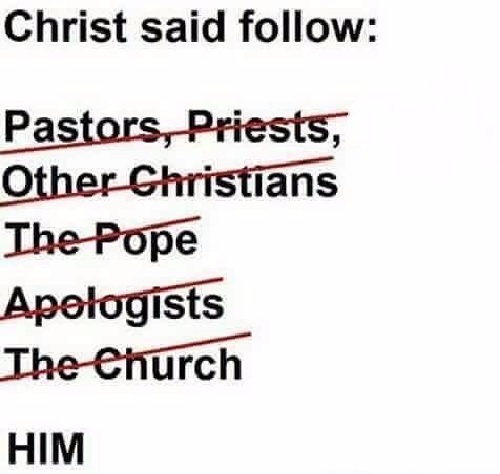
The true Church that Jesus is building is not a brick and mortar place. The head of the Church that Jesus is building is not a pastor, pope, elder or apostle. In fact, the head is not a man or woman at all.

Leadership in the Church of Jesus is not what we have always thought of either. When we realize Christ is the head and leader of his Church, we begin to realize that man has no business demanding or expecting people to follow them and put them in the place of Christ.

True Christian leadership is not an office of authority. It is not a place for only a few who are specially trained at a man-made Bible school. True Christian leadership is for all of us who are members of the Church God is building. We are all kings and priests, we are all holy and righteous because of Christ. To be clear, when I say Church I am not talking about any denomination or physical building. The true Church is a community of people who are following Christ and He is our head. All the rest of us, men and women alike, are equally functioning body parts of his Church.

No person has a place of authority over another. That is the world’s way of doing things. That is the business way of doing things. Needless to say, there are a lot of churches and religious organizations that are acting like big business with their presidents and CEO’s, but that is not how it should be.

Christian Leadership as God intended is the Spirit working through the different body parts, leading by example. Leaders are those who encourage and teach from a place of love and experience, not a place of authority and power. Each of us are leaders at one time or another in the sense of leading by example, experience and love. We come in contact with those who need encouragement or a little guidance, not from someone who thinks they know it all but from someone who has been there. A person who, out of love, wants to see the best for everyone.

True Christian leaders will not demand your loyalty. They will not want your allegiance to them. They will not rule over you with authority and expect you to follow them no matter what. True leaders will want to lead you to the head and true leader of the Church, Jesus. It is time we stop looking to men and women as our main guides and leaders and look to Jesus. We need to listen for the leading, guidance and teaching of the Holy Spirit who is actually God within us, rather than seeking the knowledge and wisdom of mere men.

Read Full Post »

by Jim Gordon

As a person that has grown up in organized religion, I can honestly say that the church today has fallen way off course. What we call church today many times seems more like a large corporation. We seem to be more focused on our programs, building bigger buildings, having a bigger and better worship band, getting on radio or TV and being a step ahead of the church down the street.

Our churches today are so divided by denominations and doctrines that it makes me think of Heinz 57 Varieties. It seems like there is a church building every mile or two from each other, yet they cannot seem to come together in unity. We are all brothers and sisters in Christ, yet we continually divide ourselves and fight and argue amongst ourselves. Those outside the church can only look on and laugh.

It amazes me how upset and defensive people can get when you mention that going to church is not a requirement. They seem to forget that the church is not a building and is not a place we go too. The Church is the body of believers no matter when and where they get together.

Usually the first verse that is quoted when we talk about not going to church is Hebrews 10:25 – not forsaking our own assembling together, as is the habit of some, but encouraging one another; and all the more as you see the day drawing near. Nowhere does this verse say that we have to assemble in a building on a certain day at a certain time. Nowhere does it say we have to have a pastor to teach us, or a worship band to lead us in praise and worship.

I feel so often that we christians want to be entertained and told what to believe, then go home feeling satisfied that we have fulfilled our duty until next Sunday. We have become lazy and do not want to spend the time hearing the Holy Spirit teach us. As 1 John 2:23 states, as for you, the anointing which you received from Him (talking about the Holy Spirit) abides in you and you have no need for anyone to teach you; but as His anointing teaches you about all things, and is true and is not a lie, and just as it has taught you, you abide in Him.

Jesus said where two or three are gathered together in my name, there I am in the midst of them. That can be in a restaurant, in a home, in a park or anywhere. So many people put more emphasis on where we meet and not enough emphasis on spending time with the one we love. Why is it we feel the need to go to a building anyway? God said we are the temple of the Holy Spirit. God told us that He is always with us. So why is it people say they are going to the house of God to meet with Him. We are the house of God, and He lives within us.

Going to a building to meet with other believers is not wrong, but let’s start calling it what it is. The building that people go to on Sunday morning is only a place where the members of the Church sometimes get together. The Church are those of us who are following the example of Christ, and that is done on a daily basis not a one-day event.

How many times do people get more involved with the things about Christ, the services, the meetings, the up-keep of a building and the money to keep the bills paid, that they lose sight of their first love Jesus. He is to have the preeminence.

We are to follow the example of Christ by loving God and loving others as ourselves. Let’s be clear that we are to love all people, not just those who believe like us, agree with us, look like us or are of the same faith.

Stop the arguing over different interpretations and denominational doctrines. Stop the judging and condemnation of people and start loving others no matter what. It is then that the world will know we are His disciples and see a difference in the way we live as Christians.

Read Full Post »

by Jim Gordon

Growing up in the christian church, we were told a lot about sharing our faith. We were told that if we did not tell others about Jesus they would never know anything about him. It seemed to make a lot of sense at the time.

We were told if we did not share our faith with everyone we met we were not doing our duty as a christian. This has led to a lot of guilt over the years.

To make things worse, we were told if we did not tell them about Jesus and the possibility of going to hell if they did not accept him that their blood would be on our hands.

I truly believe we were taught wrong. There is certainly nothing wrong with sharing your faith, but to do so under pressure and out of guilt is another story. I believe our commitment is to love God and love others. The Holy Spirit will convict and draw people to the God of love. He may even use us at times, but it will be done naturally and as he leads in love. It will not be forced or due to obligation.

I also believe when we live by guilt and pressure to witness to others, this can lead to friendship with ulterior motives (1). We are nice and friendly to others with the hope we will get to talk to them about God. We get so busy trying to force the conversation so we can do our required duty that we forget to just be unconditional friends.

In 1 Thessalonians 4:11-12 it says to “make it your ambition to lead a quiet life: You should mind your own business and work with your hands, just as we told you so that your daily life may win the respect of outsiders and so that you will not be dependent on anybody”.

To me this makes more sense, to live daily in a way that wins the respect of others. Anyone can say words, but living a life being friendly, caring and accepting makes much more of a difference. I have personally seen people who were very bold in their words. They could talk to anyone, anywhere about God and tell them they need to turn their life over to God. Yet when they were done talking, they lived a life that is completely different from the words they just spoke. People look at that and do not want anything to do with the god they were just told about.

I personally do not believe we are to be forcing our views on others. We should not feel obligated or forced to share our faith with anyone. We are to live our lives as we know best in a way that is pleasing to God. Then let that love be a natural by-product that others will see and be drawn to God without us saying a word.

When we live our lives out of love for God and love for others, telling others, whether by word or deed will be natural, unforced and without obligation. It will be out of sincere love and usually because others ask about the love they see in us.

  1. Friendship with Ulterior Motives

Read Full Post »

by Jim Gordon

Is it me, or do you find that some of the teachings we have grown up with in modern day religion may be wrong? It could be a simple misinterpretation or it could be people purposefully trying to force others into their way of thinking.

Do you ever grow tired of reading all the different views and opinions, interpretations and doctrines? Do you get aggravated when people argue over their beliefs, yet God has told us to love one another?

It can get pretty discouraging seeing all the postings on Facebook and other social media where people argue, and sometimes heatedly, over their views and interpretations. Sometimes they are basic views we have grown up accepting as gospel truth, yet now we question whether they are gospel or man’s wrong interpretation.

No matter how you interpret the scriptures, no matter how much you believe your way of thinking on spiritual matters, someone else will have a completely different view. Even those who are followers of Christ cannot agree on everything. We all have a different view on the bible and spiritual matters.

I wonder why we cannot accept each other no matter what our interpretation. Truthfully, none of us can prove most of what we believe, whether it is faith in God, heaven, hell, satan and a number of other topics. It is all by faith that we believe what we believe. We cannot prove or disprove anything.

I think we should ask the Spirit daily for His guidance into truth. Hold to what you believe, but be open enough to change when God (not some other person) gives a clearer view of the truth. When someone has a different way of looking at things, accept them. You do not have to agree with them. Who knows, they might be right. Friendly discussion of each others views can be helpful.

I do not think any of us can say without a doubt who is completely right or wrong in our interpretations. We should seek God for truth through the Spirit and let everyone have their right to do the same. Quit fighting and arguing over who is right and who is wrong.

We should remember that unity comes only in Christ. It is not through religion, doctrines, denominations or bible versions but through Christ alone. Unity through Christ looks beyond religion, doctrines, denominations, race, sexual orientation and nationality.

God is love and he lives within us. By allowing his love to flow out of us we can look beyond our differences and accept one another even when we disagree.

One thought comes to mind in all this, ‘Jesus loves me this I know, for the bible tells me so’. The most basic and simple song we learned long ago seems to be the one thing on which we can all agree.

Read Full Post »

by Jordan Hathcock

“That’s the thing about friendship, it’s a lot rarer than love because there’s nothing in it for anybody.”

It’s hard to imagine not experiencing the amazing journey of friendship. We all can become a little oblivious when it comes to the incredible gift of what relationship truly is. Let’s not forget, many individuals don’t even get to experience genuine friendship throughout their lives. As study shows, more and more people are not developing meaningful friendships and thus, not able to create healthy communities that are able to thrive.

From the American Christian context, we can see this type of loneliness is also causing an abandonment of healthy church experiences. People become isolated due to the abundant number of rules and regulations pressed upon congregates. When it becomes more of an exclusive club instead of an inclusive party, things can get desolate pretty fast.

Here are some examples of how church communities create loneliness and isolation:

  • People don’t feel safe enough to connect (LGBTQ people for example)
  • Churches make groups with walls and the walls need to come down
  • People with unseen illnesses cannot always attend church services, which makes it hard to connect with others
  • People who have less feel like they are the only ones
  • Some people are not extroverts. But they still need connection.

These are just few on the many issues that the church at large is producing when it comes to isolation and loneliness. What gives? What can we do to counter this onslaught? Well, many have left these churches and have found freedom and friendship outside the religious walls. Out of these groups, you still have Christ participants and others not so much. I get it. When people have been burned by the religious institution, what we call church, it’s hard to come back to some type of faith.

The nones and dones are finding healthy friendships and that’s awesome. But, some are not. On top of that, some are still wanting that communal community to embrace. I think for those disenfranchised, the Body of Christ (i.e., a loving community) can still play a role in bringing about healthy friendships that in turn create healthy communities. It really boils down to effort and time. Let’s look at this verse from the Christian scriptures:

“This is my commandment, that you love one another as I have loved you. No one has greater love than this, to lay down one’s life for one’s friends. You are my friends if you do what I command you. I do not call you servants any longer, because the servant does not know what the master is doing; but I have called you friends, because I have made known to you everything that I have heard from my Father. You did not choose me but I chose you. And I appointed you to go and bear fruit, fruit that will last, so that the Father will give you whatever you ask him in my name. I am giving you these commands so that you may love one another.”

A lot of directions we can go with this. Like did Jesus really consider his disciples slaves (more accurate translation of servant)? Or, did he truly make known everything about God to them? But the direction I want to go with this is the whole context of this verse is showing that the thing that lasts is LOVE (no greater than by laying down one’s life for a friend). Yes, love is always the default message throughout Jesus’ teachings: “This is my command, love one another as I have loved you”.

To become a people of true friendships, we must come to the realization that love is the only action to bring us into this reality. Duh, right? Yes, love is getting the final word nowadays and that’s good! But, agape love is different then a love that is a two-way street transaction. It is unconditional. People have a hard time grasping that, I know I do. It’s no easy task! It’s fucken hard! The question is: do we want to take it there to a systemic level? Hard to say. But isolated loneliness is a very difficult place to find oneself in and to claw out of.

There are many avenues and connections that need to be accomplished to combat this issue. From Jesus’ perspective, friendship is the place he seems to trust in to find the reality of the call: Earth as it is in Heaven. We cannot see the New Creation come into full reality unless we heed to this call of authentic camaraderie…

“Friendship is unnecessary like Philosophy, like Art it has no survival value rather it is one of those things that give value to survival”- C.S. Lewis

Read Full Post »

by Rocky Glenn

Distractions keep us from being present and enjoying the moments we live. For the churchboy, the greatest distraction is attempting to live up to a set of expectations. An expectation is a belief or anticipation of how someone should or will respond. Churchboys have many expectations they chase after: their own expectations, expectations of God, expectations of the church, and expectations of others. Quite often these get intertwined and create a web of confusion which is difficult to break free of and leaves one unable to ever enjoy the moment. Disapproval from friends, family, and fellow church members is felt when expectations are not met and long held beliefs and practices are questioned. This disapproval gives way to separation and alienation from those once held close as peace is found more and more in uncertainty rather than simply accepting clear-cut, placating answers to the tough issues of life and conforming to perceived expectations. It is in this journey toward uncertainty the recovering churchboy wakes up to Truth as the scales of expectations begin to fall slowly from his eyes. In my previous post, I discussed how both the prodigal son and his older brother fell victim to the distraction of regret. If you are perhaps unfamiliar with the story, allow me to share below:

The tale opens with the younger of the father’s two sons going to his father asking for his share of his father’s estate. Immediately after the request we are told the father divided his estate between the two brothers. Within a short time, the younger son packed all his belongings and left home and, before long, wasted his entire fortune. To further compound the situation, a famine hit the land and the only employment he could find was feeding pigs. As hunger drove him to the point of desiring the slop he was feeding the animals, he woke up to the idea of his father’s servants being better cared for and receiving three meals a day while he was starving to death. At this point, he decides to return home and beg to be accepted as a servant.

Imagine the confusion of the younger son as he is returning home and, just as he can barely distinguish the silhouette of his father’s home in the distance, he notices a cloud of dust gaining momentum moving towards him on the dirt road only to realize the catalyst for the dust storm is his Father running to him with open arms. Pushing his father away, he begins his rehearsed speech of what a failure and let down he truly is and has become. The father interrupts as he wraps him in his arms all the tighter and shouts to all around, “Bring him some fresh clothes, shoes, and jewelry! Get him cleaned up! It’s time to celebrate and party! My boy has come home! Once thought lost and dead, he is now found and alive!”

During the younger son’s celebrated return home, his older brother was working in the fields and unaware of his brother’s return and the party being thrown in his honor. As he approached home after the day’s work and learned of the celebration and its cause, the story records him as refusing to enter the party and storming off sulking in anger. Being approached by his father for an explanation, he states his case rather emphatically, “I’ve worked for all these years. I’ve never brought you any shame and always done everything you ask. You’ve never held a party in my honor, yet this fool returns home after wasting away all his money and you throw a feast for him as a reward!”

Just as the father’s heart was overflowing with joy upon the return of his younger son, I can imagine sorrow pricked his heart to hear the words of the older brother. How heart-breaking it must have been to look at his oldest son and say, “Don’t you get it. You’ve worked for me all these years and never once realized all I have is already yours.”

The story of the prodigal son is one of the most well-loved and well-known stories Jesus ever used to illustrate the Father’s love. Taking a closer look at the story of the prodigal we can also see examples of how distractions of expectations rob each of them of enjoying the moment just as it does the churchboy.

Expectations of the Younger Son: The Internal Churchboy

As the story opens, the younger son’s request reveals his unhappiness and dissatisfaction with his current life as he is distracted by it not meeting his expectations of what life truly should be. He sets about spending all his time, energy, and resources in attempts of achieving and acquiring all he ever wanted. However, as his bankroll runs thin and his energy is spent, he is forced to face the reality we all must come to realize. Life has no “supposed to be.” Once distracted by his own personal expectations, the distraction of regret has become his close personal companion as he finds himself weary, lost, and alone with no other choice but to return home ashamed and groveling expecting rejection.

Though they would never admit it or exhibit it externally, churchboys often view themselves as the eternal prodigal. Convinced and conditioned to believe the problems of their lives are simply a result of their own selfishness and pride leading them astray, they live their life feeling unworthy to be called a son and seek solace in simply being known as a servant. They anticipate being turned away in displeasure as they return to the Father week after week, Sunday after Sunday confessing their failures of living up to the Father’s perceived expectations: “I didn’t pray enough this week. I didn’t spend any time reading my Bible. I spent more time watching TV and on social media than I did with you. I lost my temper, said things I should have never said, and hurt those I love. I’m sorry. Although I don’t deserve it, please forgive me. I’m so unworthy.” Churchboys beg and plead for the Father’s forgiveness to simply feel accepted once again. Their expectations of the Father are tainted with the fear of rejection and anticipation of being turned away as a result of their image of themselves and how they perceive the Father views them.

The prodigal’s return home is a beautiful illustration of waking up to the true unconditional acceptance of grace for the first time. The cocoon of shame and unworthiness from missing the father’s perceived expectations slowly begins to crack as unconditional love breaks through and the son slowly begins to realize there is nothing he could ever do to not be considered a son. When I was first presented the gospel of grace and acceptance after many years of living the weekly cycle of the prodigal, I was just as perplexed as I’m sure the younger son was being wrapped in his father’s arms and celebrated for returning home. To realize the Father has no expectations in being considered a son is the path to recovery for the internal churchboy.

Expectations of the Older Brother: The External Churchboy

The older brother’s response is reflective of the churchboy’s outward life. Much like the older brother, churchboys make public displays of all they do to please God. They expect to be rewarded for their service and are serving for the reward of acceptance. Their security and trust lie in their years of service rather than in who they are. Because of their track record and accomplishments, they view themselves in higher regard than others. Blinded from the true definition of sonship, their expectations are to be accepted based on the good they’ve done, as well as the evil they’ve not done.

Such is the way of the churchboy, constantly working to obtain what he already has access to. He believes the only way he will ever hear, “Well done, thou good and faithful servant,” is by working more, doing more, saying Jesus more, and outshining those around him. As long as he feels someone is closer to the Father than himself or there is something greater he must do, the churchboy will continue working to reside in a place he doesn’t realize he already exists in and can never escape, the Father’s love.

The perceived expectations the older brother has of the father are really no different than his younger sibling’s, but they go about meeting those expectations in different manners: the former through working to achieve and avoid, the latter begging and pleading. Until they release their expectations neither brother, nor the churchboy, can enjoy the moment they are in. For the brothers, that moment is a moment of love, acceptance, and celebration of being with their father. For the churchboy, it’s the same.

Expectations distract from us enjoying the moment and being present where we are. Our minds become so entangled with what’s supposed to be, what’s required, and anticipated outcomes we become blinded to the expectations we’ve placed on ourselves, on others, and on our God. Let us rejoice in the unconditional love and acceptance of the Father and pay the Father’s love forward in unconditional love and acceptance of others.

Rocky

More posts in the Enjoying the Moment series:

Read Full Post »

by Jim Gordon

Does it not seem strange that in the christian church world we are told we are to love others, yet when we come to a difference of opinion or a change in views in our beliefs, christians can be the first to throw a stone?

We hear about fairly well-known individuals within the church system say they have changed their views and no longer accept some of the teachings they grew up with in the church. They are not necessarily saying they are walking away from God but they are walking away from many things they have been told about God they no longer accept.

When this happens, usually other christians are the first to judge and condemn these individuals rather than try to accept them and find out exactly what is going on. Their first thought is they are leaving their complete belief and faith in God.

Many times, this is not what the person is saying anyway. Leaving religious teachings of the church is not leaving God. In fact, many times leaving some of these teachings behind is just the beginning of a deeper walk with God.

I grew up in the traditional church setting and I had many good times there. I met a lot of nice people and learned many things about God. The thing is the church as we know it was never what God intended. Church is not a place or an organization, it is the people who love God and love, support and encourage one another.

The church today seems more like a corporation with the CEO and board of directors. I know there are a lot of good people within the church system. They love God and want to live their life for him. Yet for my wife and I, we became disenchanted with the religious system and felt there was a better way for us to live for God, which was outside the walls of religion and the human-led system of church each week.

We felt that since the Spirit lives within us there is no need for a middle-man (pastor) to lead and teach us. If the Spirit of God actually lives within us, why do we so often depend on a human being to lead and teach us?

I certainly do not want to make anyone feel bad if they are still a part of the institutional church. They are like I used to be and feel that was the best way to show love for God and learn about God. I would not tell anyone they should leave the system, although for my wife and I we certainly do believe it was the best thing for us.

Whether you are in the church system, questioning the church system or have left it, the main focus should be to love God and love one another. Doing so fulfills all the law and the prophets (as Matthew 22:35-40 explains). Of course, we know that the law no longer needs to be fulfilled but at the time Jesus taught this he was living under the law. Now that grace has been applied, we no longer live by the law but by love.

Leaving the institutional church or changing and deconstructing your religious views and interpretations do not mean you are leaving God. Rather than jump on board with those who judge and condemn, take a little bit and find out more about what is going on. Then remember we are all at a different place on the path as we follow Jesus. Pray for one another, encourage and support one another but do not beat one another up as we each try to follow Jesus as we feel led.

Read Full Post »

by Jim Gordon

Looking back over the postings of Done with Religion, we started with a few posts in May of 2010 and another in February 2011. Not until July of 2011 did we start regular and continual postings on this site. Since then we have had eight years of continual writing at Done with Religion. The time has sure flown by but it has been fun learning and meeting new people along the way.

Over the years I have seen a change in my views, beliefs and interpretations of what I believe the bible says and what God meant for the Church. Church being the body of Christ, not a building or an organization.

My views and beliefs changed a little over time while growing up in the organized church. Yet after my wife and I walked away from the organization I have seen even more changes since being outside the walls of religion.

I think it is easy to get set in our ways, to live within the box of organized religion and stop thinking for ourselves.

I believe that the Spirit of Christ lives within us and we will do much better to focus on hearing directly from the Spirit rather than the many different voices of men and women trying to tell us what God wants us to do. There is nothing wrong with getting ideas and opinions from others, but never put your full trust into people. We have the Spirit living within us and we should be constantly listening for that still, small voice to guide us in our life.

I believe we will be constantly changing and adjusting our beliefs in this world. Living for God is something that is alive and constantly changing as the Spirit reveals new truths to us as we are able to accept them.

Over these eight years we have seen changes in views and beliefs as well as changes in writers. Two new regular writers and one guest blogger have been added and they have made a very good addition to the views, insights and writing styles of Done with Religion. I look forward to the next eight years and I think it will be interesting to look back at that point and see what God has taught us and how he changed us as we seek to show his love, grace and freedom to others.

Read Full Post »

by PK LANGLEY, Guest Blogger
https://www.patheos.com/blogs/frustratedgrace/2019/07/quit-church/

I Would Quit Again

I’m not going to church anymore, I quit. God told me I don’t have to go and I listened. If you think God told you to go, then I suggest you go. I’m pretty happy about the fact that God released me. My life has been a lot less complicated since I stopped going. What happened to me after I stopped going to church was part of my deconstruction. It has been a wild ride, but one that I would take again gladly if given the opportunity.

I Was Afraid

The first thing that happened to me when I quit church was fear. My heart was afraid that God would be mad at me. I was afraid of falling back into sin like those who stayed behind told me I would. There was a fear of losing community. My loneliness from not being in active church life cemented those fears. Part of me was terrified I had made a mistake. I had taken a bite out of the un-churched apple. I had left, and had sealed my fate.

Where The New Covenant Lead

I quit the church initially because my eyes were opened to the New Covenant. Picture a step like that of Indiana Jones in “The Last Crusade” move, when he took a “leap of faith” across a great chasm, to find his aim; the cup of Christ. He stood there overlooking a plunge to certain death and put his foot out, leg straight and true, fully intending to take a step when he could not see where his foot would land. When his foot was stopped by a bridge he had not seen, he sighed with relief at finding his footing.

In the same way, leaving the church felt like that fearful step into the unknown. My family of forty years would not go with me. In fact, they would all turn their back on me with the “left foot of fellowship”. I was alone, but the spirit of God would show me that I could depend on our union.

I Tried To Find A Church

At first, after I quit my “home church”, I looked for a church that believed as I did. It’s no different than someone who chooses Baptist over non-denominational. When your eyes are open to the fact that tithing is complete bullshit, you can’t sit and listen as someone fleeces the sheep. There were other doctrinal issues that had pushed me out to try to find someone, anyone, who was walking in truth.

The further I went out, the more pillars began to crumble in the institutional church building. While hoping to find a body of believers that knew the truth and were walking in it, there were understandings breaking through my heart every day. Every church I tried to connect with was a complete disappointment. I couldn’t eat what they were serving anymore, my appetite had totally changed for the better. I felt like I had unplugged from the matrix and there was no turning back.

Church Came To Me

God was with me, and even though I had quit going to church, church started coming to me. I was living in an apartment and the smoke detector went off, leading me to call maintenance. A man showed up with his son to take care of fixing the smoke detector and the son noticed my guitar. One thing led to another and the young man ended up weeping and crying as I witnessed the love of God to him. We had experienced marvelous encounters, and none of them were inside a building.

The Wind In My Sails

A week later after the smoke detector surprise, three gay men who did not live at our complex, came in late at night to use the swimming pool. We went down for an evening swim, and we started talking with them. The love of God poured out between us, and there were tears. Every time I looked for God outside of the confines of a church relationship, I was not let down.

When I would start missing the fellowship that I had become so accustomed to inside the building, there would be a beautiful spontaneous expression that would be like a wind catching my faith sails. Whenever I was weary, God moments breathed upon my soul and I kept going.

The Ties That Bound, Loosed

Every time I had another epiphany about God outside of the church, I would become stronger. At times, it felt like learning to walk all over again. I always felt God with me, in me and through me. No longer did I need a pastor to show me how to live, I was spirit led all by myself and thriving. I began to find others that had left the church and were doing fine. Some of them were like me, trying to find their footing after thirty years of service. My life lost its co-dependencies and I started really walking in a spirit led life. My life was evidence of a spirit led life outside of the church building.

Demanding God?

That’s what’s scary for people. When you go to church, it pacifies some guilt that is embedded systematically by religion. It’s those twisted scriptures that really don’t mean what they say they do that twist the proverbial guilt blade. The, “Don’t forsake the fellowship of the brethren” verse is a good one. Other verses are used by the modern church as tools to keep people coming. If you told people they didn’t have to go to church, would they stay home? Today, where we battle for every second of time we can get, who wouldn’t stay home if they realized God wasn’t demanding their attendance?

They Did “Church” Different

When we go back to the beginning, you know that place around the time when Jesus rounded up a bunch of misfits; there was no building. At that time, there were no pastor’s in pulpits or apostles claiming they were more important than the seated pastors. There were no congregations, no tithe demands backed up by promises that God blesses the cheerful giver. Believers came together, loving God and each other in simplicity. People were going “from house to house” in spontaneous fellowship. That was what Jesus asked them to do, wasn’t it? Today, we have complicated and mechanized that beautiful relationship that Jesus perpetuated while he walked the earth. Puppeteers tell parishioners that “their reasonable sacrifice” is to attend church, and they not only believe it, they promote it defiantly as well.

I Was A True Building Disciple(r)

I promoted the institutional church agenda for thirty years and I know how we convince ourselves that “it’s true”. We parrot the same verbiage that we have swallowed. When someone refuses to listen, it becomes pointless to try to convince them of anything other than their truth. My life in ministry demanded that I was hard-nosed and defiant to anything that “threatened MY truth”. Now that I am on the other side of having my ears washed out with the soap of reality beyond religion, I look at those I have left behind with sadness and a desire to ask them to listen. It is for my brother’s and sister’s still in captivity that I write about life outside of institutionalism. Those who want to quit but are afraid.

Ask Yourself Ask yourself if you have ever wanted to sleep in. Have you ever heard the alarm go off on a Sunday morning and wished you could stay in bed another hour? Was there a time when you felt God nudge you in a direction, one that you excitedly shared with “leadership”, to find that they wouldn’t support you? Have you ever allowed yourself to question whether we are doing church right? Have you wanted to change church the way it is currently done? Did you want to quit? Questions lead to answers, if we allow ourselves to explore them. Religion is afraid of those who will ask questions, and are brave enough to discover the answers. My answer was to leave the institution and it was the right answer, for me. Can you be brave and admit that you have questions like I did?

Read Full Post »

« Newer Posts - Older Posts »