Feeds:
Posts
Comments

Posts Tagged ‘communication’

By Mike Edwards

Countries ruled by Dictators where there is no personal choice have failed miserably. Human nature cries out for freedom and to not be led like sheep. Democratic nations or those who have some assemblance of freedom are fortunate if able to fight for their rights. Politics, religion, and science/health practices have something in common that is dividing our country and families. We easily recognize this destroyer in our family/personal relationships but not in public arenas.

Certainty leads to close-mindedness and refusal to discuss differences 

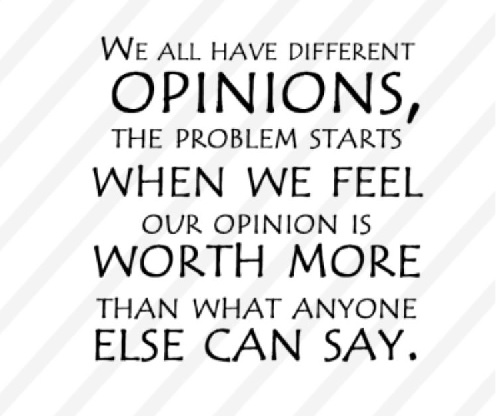
If you find one rational person that has a difference of opinion from your own, you cannot be certain of your opinion. I don’t care if it concerns the safety of vaccines, climate solutions, or if God condemns gays. There are rational or rights to opinions on both sides. Couples who claim certainty are headed toward divorce or a sucky relationship. God-followers and religious leaders seem hell-bent in telling people what they must believe about God according to their understanding and interpretation of the Bible. Politicians who refuse debate of their policies are no different. You can spot destructiveness or evil a mile away – those who censor other opinions. Leaders play God (Superior) in the lives of others by claiming to know the truth and we can’t decide for ourselves.

Why can’t we be more openminded? 

Certainty rather than uncertainty is more comforting psychologically. One may believe what seems to be the popular narrative because unknowing can create confusion or anxiety. Anxiety is avoided by not discussing one’s beliefs with others who believe differently. For one to question a main belief they have been taught in church all their life, such as if Hell is real, can cause one to question other beliefs they have been taught. Questioning if the Covid shots are safe in the long-run, if we have gotten the shots, can raise anxiety about our health. What if we pushed others to get the shots and we end up wrong? Trusting authority always can sometimes be misguided.

The most benign explanation for denying freedom of choice is one who believes they are doing the best for all concerned. This denies uncertainty. The more evil explanation for censoring the opinions of others is one’s desire for control which leads to power over others, intentional or not. Control and power often lead to security (jobs). Control and power flourish when others are not allowed to discuss alternative opinions in the public arena. It isn’t science or theology if there isn’t debate. That is why we often change our mind when able to participate in discussions. One way to judge one’s motive is to question why they fear debating others if they are so sure they are right.

How can we know what is true 

Certainty is an illusion unless talking about universal moral sins such as rape or incest. Adultery isn’t only wrong in the eyes of the betrayer. Most decisions are not black and white and require open debate by those in authority. One must have the freedom to decide what is the best decision for themselves, or the powerful rule the powerless. Those fortunate enough to live in a democratic society must accept the vote of the majority when comes to law setting. You can still defend your position in hopes of a future vote. May the best, most common-sense position win.

I am convinced all know how a loving human should act, whether they never had a Bible (majority born in this world) or don’t believe in God. Christians leaders often claim we must be guided by biblical principles. They assume their interpretation is correct. It is common to hear one argue “The Bible says” without adding “according to my understanding.” The truth is contrary biblical interpretations exist for many moral issues. Hell, we can’t be sure if there is a literal Hell according to the Bible.  See here.

What is God so hidden?

Religious people may ask why God doesn’t make truth more obvious. God may not speak to us demonstratively out of love. Just because earthly parents sometime know and advise what is best for their older child, such advice doesn’t always work out. In fact, overzealousness can lead to feeling controlled, thus rejecting what is best for one’s own good. God’s awing or overwhelming presence may only lead to fearful obligations to obey. The road traveled of learning, reflecting, and not being pressured may best lead to lasting convictions and more meaningful relationships. Maybe God speaks to us in non-dramatic ways (influence) out of love!

The path forward to save a Nation

  • We must first stop claiming our views are morally superior to those we disagree with unless speaking of universal accepted moral truths
  • We must handle differences with physical and emotional civility
  • We must begin conversations by looking for areas we agree
  • We must discuss differences by defending our reasoning, respecting the opinions of others, and commit to growing in understanding
  • We must be openminded. Consider why you are afraid to defend your belief if you supposedly know the “truth”
  • We must protect one’s freedom to choose when the possibility exists we could be wrong
  • We must stop censoring or labeling others as heretics or conspiracists that we disagree with
  • We must stop supporting politicians who advocate censorship or label those who disagree with them as mis-informers. Why believe their view if they can’t defend their views for the supposed good of the world?
  • We must use language that conveys respecting one’s right to believe in a Creator or not

What Is The Greatest Destroyer Of A Nation?

MikeEdwardsprofilepic125

Mike Edwards has been writing for Done with Religion for some time and has been a great addition to the site. He couldn’t find enough people to discuss God openly so he started blogging years ago. Mike also has his own site where he writes that can be found at What God May Really Be Like  He can be contacted by email at: medwar2@gmail.com

Read Full Post »

By Mike Edwards

This is a previous Post. I thought I would repost with some minor changes, to follow up my Post last week – How The Heck Do You Parent Well?

I’m no expert but one who is anxious for others to avoid my failures. I can assure you my marriage hasn’t lasted 41 years so far because I am some saint. Divorce can happen and doesn’t doom one as a failure for life. Relationships aren’t that complicated, just hard. Many marriages can succeed when both partners adhere to a few essential attitudes and actions to better relate. I am going to keep this less than a five-minute read to hopefully provoke more readings about marriage here or elsewhere if struggling. Success isn’t an exact path. We all have a chance if strive to treat our partner like a best friend!

The Right Attitude – Accepting Differences 

Good luck finding a partner that always agree. Marriage is about living happily incompatible. There are no perfect matches. Relationships often start off well because reality hasn’t set in – sharing closets, bathrooms, in-laws, children, etc. You still have in common why you began the relationship, but now you have to work out your differences. Other friendships don’t have the 24/7 challenges. Naively, I assumed in the beginning I would be happily married 100% of the time. Now, I realize being pleased 75% of the time is a pretty good marriage. Strive to treat your partner like you want to be treated when not agreeing. Marriage isn’t agreeing but learning to disagree. 

The Right Actions – Fighting Fair 

After accepting we don’t have a right to expect everything we desire, we still must solve differences to live peacefully together. When handling differences in other relationships it usually is out in public with others around eyeballing your actions. In a 24/7 relationship differences can happen more in private. There is less accountability to behave. Kids, we know the rules in solving differences – keep your hands to yourself, don’t raise your voice, stop interrupting, etc. When such rules are violated, give each other permission to stop and restart when acting more civilly. Couples who say they are no longer in love have stopped treating each other in loving ways. Happy couples expect problems and solve differences in a positive manner so solutions can be discovered. 

Identify A Specific Plan And Persist 

As you strive for the right attitude and actions – develop specific steps each can take, evaluate success in a time limited fashion, and do it all over again. Keep trying until finding what works. Judge the relationship not on feelings that depend on circumstance but judge the relationship on specific actions that can bring about desired feelings.  Couples often give up too soon because they attempt a “hit and miss” approach to their problems. Couples often argue, “they have tried everything.” Develop your own list of habits such as below:

  • During conflict both ideally ask “what can I do differently” not “why can’t you”
  • Assume good will of you partner unless you married the devil
  • Focus on solutions than problems
  • Persist unless one partner is being abusive
  • Run from temptations such as drugs or affairs that can set you up for failure
  • Get third party help after remaining stuck
  • Try doing what you would tell your friend if they asked for advise
  • Identify 2 or 1 thing you wish each would do differently once a day that is observable and you can acknowledge genuine appreciation when it happens
  • Focus on you being the right person rather than your partner
  • Happy couples’ ratio of encouraging than criticizing is at least 6:1

Spiritual help can be invaluable in marriage

Maybe you are just a good person without any help. Personally, I need help being the best version of myself for the sake of my partner. I need to be willing to say sorry. I need to recognize I am being selfish. I need to be willing to forgive when my partner takes responsibility for their actions. Great marriages aren’t about being good enough or not as bad as other partners. The best goal of marriage or any relationship is aiming for perfection. My view of God inspires me to pursue perfection in my relationships without being paralyzed by guilt when failing. I have the “want to” to be perfect. I believe that motivation comes from God!

John and Julie Gottman, who have researched marriage relationships for years to identify important factors that lead to success, state something so true: “Every marriage has perpetual issues – conflicts based on personality differences or lifestyle differences that never go away. Common examples include how much intimacy there should be in a marriage, as well as disagreements over money and household chores. But as longtime marriage therapists, we’ve found that partners can live peacefully with perpetual issues as long as they talk about them in a open, productive way.”

How The Heck Do You Have A Good Marriage?

MikeEdwardsprofilepic125

Mike Edwards has been writing for Done with Religion for some time and has been a great addition to the site. Mike also has his own site where he writes that can be found at What God May Really Be Like  He can be contacted by email at: medwar2@gmail.com

Read Full Post »

It Can Cause Much Hatred

by Michael Donahoe

I have watched with displeasure at times the discussions and comments on Social Media. This is a common way of communication these days and it is very easy to be bold and argumentative while using it. We express our thoughts and feelings in a much meaner way than we would if we were face to face.

I think most people find that sitting in front of a computer screen gives a sense of boldness and openness to express themselves in ways that are not always a good thing. I think there is something about not being in the presence of someone or seeing their facial expressions that emboldens us and allows our mean side to come out.

To me it is the same feeling you can get when you get behind the wheel of a car. All of a sudden we seem to be in attack mode. We blow our horn at others, yell and curse and flip people off, yet if we walked by them on the street we would probably smile and say hello.

There is something about face to face communication that usually changes the way we talk to and treat others. Face to face communication seems to take away the meanness we usually find with social media communication. Looking someone in the face, being in their presence seems to soften the way we talk and respond.

Why is it we cannot see the human being behind the computer screen? Why is it we feel the meanness, and an emboldened power to treat others with contempt? Remember Jesus said to love not only those who love you, but to love your enemies, bless them that curse you, do good to them that hate you, and pray for them which despitefully use you and persecute you.

There is nothing wrong with social media and communicating through it. Just keep in mind that there is another human being on the other end, and even though we are not in their physical presence the things we say and the way we react has an impact on them. Let us make it a point to have a positive, encouraging impact when we communicate with others.

The way of Jesus is the way of love. Whether it be online or in person we are to love our neighbors. In our world today living in love is becoming rare. Yet by doing so, it will be noticed and it will make a difference in the lives of those who are hurting and so desperately looking for love and acceptance from their fellow human beings.

——-

Michael Donahoe was added as a writer as his views fit perfectly with those of Done with Religion. He also writes on Substack at https://personalmeanderings.substack.com/

Read Full Post »

by Norman Mitchell
https://thewildfrontier.wordpress.com/

I’ve struggled a lot with the apparent withdrawal of God from the world. The old testament is full of stories about God interacting with people, having conversations with them, walking with them, befriending them. Then we get to the new testament, and God appears in the flesh. After that there are a few years where the disciples perform miracles, then… nothing.

The last two thousand years have been years of silence. At least that’s how it seems to me. To be sure, there have been followers of The Way during that time who have had some incredible insights and done some amazing things. But there is no more, “thus saith the Lord”-type of communication. Mostly what I see is people regurgitating the biblical writings and arguing about what they mean.

The easy answer is to conclude that God does not exist—that He is simply a figment of the collective human imagination. It would be easy to chalk all the old stories up to superstition and imagination. It would be easy to conclude that people who were relatively naive about the physical sciences such as molecular biology, orbital mechanics, and advanced chemistry simply attributed natural phenomenon that they didn’t understand to divine intervention. Maybe they were just telling a bunch of morality tales.

But I think there’s a better explanation. To understand, it might be helpful to first look at the politics of the Roman Empire.

As I understand it, the terms evangelist and gospel were Roman terms. Whenever a new Caesar ascended to the throne, the political overlords decided that the masses needed a unifying narrative that would promote stability and maintain everyone’s places in the established hierarchy. The old Caesar was ostensibly descended from the gods and generally had the loyalty of the populace. Because the new Caesar was not a descendent of the old one, the people might be inclined to doubt that he had a divine right to rule and question his legitimacy; and that would be disastrous. Why, the people might revolt, and where would that leave the ruling class?

So the political establishment crafted a narrative that would explain how the new Caesar had descended from the gods, why he had the right to rule, and why the people owed him their allegiance. Then the emperor would send out evangelists who would proclaim the gospel—the good news that there was a new king.

And that is precisely what the new testament writers did when they wrote the books of the new testament, only they were writing about Jesus.

Jesus did not come to start a religion. He never promoted himself as the head of a movement. He came as a servant, but he also came as a king. A humble king to be sure, but a king nonetheless. He came as a king of a completely new kingdom. A transcendent kingdom that looks nothing like the artificial kingdoms of this world. An authentic kingdom that is higher than all other kingdoms.

The gospel is not that Jesus died on the cross to appease an angry God so He would forgive us for being sinners and let us live in heaven when we die. The gospel is not that you need to admit that you are a sinner and pledge mental assent to a set of religious tenets, and then thou shalt have thy sins forgiven and live forever in heaven, the end. The gospel is that the builder from Nazareth was the son of God who arrived on earth and is now the king of the highest kingdom and is the one to whom we owe our highest allegiance.

The gospel of Christ is a call to a discipline. Following the King is a practice. It is a journey, and we face the choice every day to either continue or abandon the journey. Following the King is both an individual pursuit and a corporate expression of Divinity in the world. And that is what God intended from the beginning. His intention was for his presence to be expressed in the physical world, yet Adam failed, Noah failed, and the Israelite nation failed in this endeavor.

God now intends for his image, his presence to be expressed corporately through his followers who are joined together with Christ as the head. And I believe that the reason it seams that God has withdrawn from human society is because the Body of Christ has ensconced itself in an institution that stifles it, inhibits its growth, and creates artificial barriers between the various parts of the body. The institution has obscured the gospel message. Those who benefit from the institution, either by seeking safety within it or by attaining social status from it, have twisted the gospel and turned it into a warped counterfeit of the gospel of the Kingdom. They have used the institution to hide the good news behind a wall of religious dogma.

I believe that we do not see God in the world today because His body is fragmented, disjointed, functionally useless.

Sometimes, I look at the world around me and see things that are so horrible that they are almost unbearable, and I feel as if all I can do is raise my voice to the heavens and demand, “God, do you see?!?”

What I hear in response is Him gently returning the question to me: “do you see?”

It seems that throughout human history, God has been guiding humanity toward a point where we would be willing to allow His life to live through us. But, you might ask, what if the ekklesia fails, just like the others? One reason to hope is that we have the spirit of Christ indwelling us. When Jesus left the earth in physical form, his spirit transferred to his followers.

This is not a rehashing of the new agey teaching that “god is within all of us.” Notice that I said the spirit of Christ indwells us. That’s “us” as a unified whole, not as a loose aggregation of individuals. None of Christ’s followers possesses the full spirit of Christ, but we each have part of it. When we are joined together as a body with Christ as the head, that is when the kingdom of heaven is revealed on the earth—just as God has intended from the beginning.

Several of the new testament authors foresaw a time when God would, once again, interact directly with humanity. Until then, I think He expects us to carry out our assigned mission: to follow the true King and join together as a body under the King’s leadership to reveal his presence in the world. Perhaps if we did that, then people would be able to see God again.

Read Full Post »

by Jim Gordon

It is amazing to me how many different voices there are in the ‘Christian’ world vying for our attention.

Everyone has their own thoughts and interpretations. I think we can learn something from everyone. Whether it is something new, a better way of doing things, a different way of thinking, or just realizing we do not agree with what we heard and it bolsters our own view.

Since everyone has an opinion, how do we know who is right and who is wrong? I really do not believe we can narrow it down to one way of right or wrong. God works in each of us in different ways, and what may be right for one person is not right for another.

We need to seek the guidance of the Holy Spirit each day, and ask for the Spirit’s guidance into truth. We need to remember that that truth can be seen in different ways as the Spirit relates it to our individual life and personalities.

Our relationship with the Father is a day-by-day lifestyle. What we know and understand today may be completely different from what we believed when we were younger. What we believe today will probably change in the future. God leads us into His truth in His timing, as we are ready and open to it.

Our goal is to daily seek God’s guidance through the Spirit, and seek His truth. We need to focus on Christ. So many of us want to put our focus on a man, a popular evangelist, a pastor, a politician or political party. Obviously, we can learn from listening to others views and opinions, but when we focus on people, we can get off track and confused very easily.

Everyone has a different opinion. You can listen to one person or group and hear what they think is the truth, then find another person or group who has a completely different take on the same subject.

The only way to get past all the different views and opinions is to focus on Christ. He will teach us and lead us into the truth. That is not to say we are all going to think and feel the same way on everything. God deals with us personally and in different ways. The problem is when we are shown something or led in a particular way, we expect everyone to see it our way and believe the same thing.

It is time we become what we say we are, followers of Christ. Stop being followers of men. Nothing wrong with listening and hearing others views, but take it as that. It is their opinion. Only Christ is the one to follow. Only Christ is to be our everything. Listen to the Spirit within and live accordingly, but do not force your view on everyone else. The Spirit can lead and guide each one of us in the way that is best.

Jim Gordon and his wife left the institutional church after spending over fifty years within the system. Jim wanted a way to express his thoughts and concerns about the religious system and why he and his wife decided to leave the institution but not their faith in God. Jim can be contacted by email at: jimgordon731@gmail.com

Read Full Post »

by Mike Edwards

I am close to my grown kids and still living by the way, but they don’t always seek out in-person advice. But are we always knocking down doors to get in-person advice about life decisions? Lasting convictions often are best caught not taught. We all seem to value space. The road traveled of learning and reflecting in our own time, without any direct pressure, may best lead to lasting convictions. Influence, not direct communication, may often be the preferred and best megaphone. 

Does God have to be visible to influence? 

It is true God is never visibly present in our lives, but then neither are our parents when they pass away. If we were close to our parents, we still benefit from their wisdom by their influence. Could it be loving on God’s part to allow human parents to guide us in the beginning, rather than a visible God, who we may be overwhelmed by and not able to relate to as much? God’s or a parent’s presence or voice doesn’t always have to be visible or audible to be the most powerful. The example a parent sets, and our mental image of God, can be a guiding force.

God may communicate more than given credit for.

Moral knowledge isn’t hidden. Universal moral outrage over murder, lying, stealing, etc. and an inborn desire to treat others like we want to be treated hints of a Creator’s influence through our moral intuitions. Criminals don’t defend but deny their actions. It is only natural to think a Creator would love us in the same way we wished to be loved by our parents. God has revealed themselves. God’s image is a perfect, loving Parent!

We know that murder or adultery is wrong. What about less obvious decisions? God can’t always give us answers to life’s complications even if visibly present. Should we go through with divorce or give our partner another chance? Is our partner’s promise to change and asking for forgiveness one more time sincere or not? Many issues don’t have clear answers but involve making the wisest decision we know at the time. We or God can’t peer into the future to know how things turn out.

God, even if in person, can’t advise about future outcomes. 

It is natural to think an all-knowing, power God has special insights into future outcomes to avoid problems. To say God knows the future suggests a predetermined future making freedom nonsensical. God can’t tell you if the person you want to marry won’t end up betraying you or the job you take won’t end up being phased out. God joins us in an open future. We surely have God’s blessing choosing the wisest path at the time based on past experiences, current circumstances, and future aspirations. It turns out God, as loving parents, is uncontrolling.  

Is it God’s fault the Bible isn’t clearer?

Interpretation is still required even if God dictated the Bible. It is often said we best know God according to “biblical truths.” The truth is contrary biblical interpretations exist for many moral issues. See here.   What we do with the communication we have, then lack of communication, may be the bigger challenge. Open discussions can steer us away from demanding “supposed truths.” Jesus had a 24-7 relationship with twelve men, yet they struggled to believe His words in person. Jesus’ influence seemed greater after He left this world.

God may speak to us in non-dramatic ways out of love!

God’s awing or overpowering presence may only lead to consuming guilt or fearful obligations to obey. When parents push their agendas even if in their child’s best interest, they may resent or rebel against coercion and never turn back. If God communicates in less demonstrative ways, this may allow for heartfelt choices. God’s interference and presence might prevent a superior world from emerging as a result of limiting the moral development and improvement of free creatures to make independent choices. Finally, relationships that require more faith and trust due to the unknown may reach great heights. Is our love in relationships greater when we have to trust than know for certain what the future holds together?  


MikeEdwardsprofilepic125

Mike Edwards has been writing for Done with Religion for some time and has been a great addition to the site. Mike also has his own site where he writes that can be found at What God May Really Be Like  He can be contacted by email at: medwar2@gmail.com
Read Full Post »

by Jim Gordon

I imagine we all have been in a relationship with a family member or close friend where we had some misunderstandings and miscommunications. These can often cause hurt feelings and arguments. That is bad enough but there are times when we get treated downright unfairly by others.

I know there are people who are just an acquaintance and we really do not know them. When they treat us badly, we can move on with no real concern. Yet the people who are close friends, relatives, siblings and parents can be just as mean at times. For me, I have always believed in treating all people respectfully and kindly, but those who are close are the people we really do not want to allow the unfair and unkind treatment to continue.

I have seen it many times over the years. People you love and respect seem to take you for granted and do things that are unkind, disrespectful and demeaning. When it first begins to happen, our usual response is to ignore it. We think they did not mean it or they were just in a bad mood at the time.

This may be the case. Often times it can be a simple misunderstanding. Yet if it goes on and on and it happens time after time, it will eventually start to be a major problem. Good communication is key at this point. You need to think enough of yourself and the relationship to speak up. This does not have to be done in a mean or hateful way. Just a calm private talk explaining what is going on and how you are feeling can put an end to such treatment.

I have personally seen a few people who were treated disrespectfully and taken for granted time after time, month after month, year after year. So much that eventually they gave up on the person and the relationship was damaged. When we continue to accept being treated badly, we are not only damaging the relationship but we are destroying our spirit. As we continue to accept such treatment we begin to think less and less of ourselves.

Very often the way people treat others is done out of ignorance. They may not even realize how they come across. Again, good communication and standing up for yourself can straighten things out. The main thing is do not allow yourself to accept this kind of treatment. Think of yourself more highly than to take whatever bad treatment people dish out.

When people are treated with such disrespect and taken for granted the best thing to do is (for you Andy Griffith fans) pull a Barney Fife…. nip it, nip it in the bud.  When we allow others to treat us unkindly year after year after year, it eventually takes a toll on us and we come to a point where the relationship is lost. Stand up now, speak up now. Do not allow this kind of treatment to continue for the sake of maintaining a good relationship with someone you care about.

Read Full Post »

by Mike Edwards

If God would only prove themselves visibly or audibly, would it be easier to believe and follow God? Are there compassionate reasons that God isn’t more visible or audible, or is God just indifferent, selfish, purposely mysterious, etc.? I will leave it to the reader if the below are just rationalizations. If not, don’t let negative assumptions about God’s hiddenness hinder you from exploring more of a relationship with God.

God being visible and audible may not always be in our best interest.  

God’s awing or overpowering presence may only lead to fearful obligations to obey. When parents push their agendas, even if in their children best interests, they may resent or rebel against coercion and never turn back. If God communicates in less demonstrative ways, this may allow for heartfelt choices. The road traveled of learning, reflecting, and non-coerced choices may best lead to lasting convictions.

For the life of me I can’t figure out why my grown kids don’t seek out my advice more often to avoid problems in life. We have a close relationship. I am a counselor by profession so geez – I have a few relational skills. Heck, I announced when teenagers my role was changing to being more of a mentor than authority figure. What teenager doesn’t dig that? Well, my grown kids – old enough to get over any resentments – aren’t runny to catch honey from my lips. Then again, I am not knocking down doors for advice from others. We may all need to travel the journey toward wisdom at our own pace without any pressure.   

If God was communicative in the Old Testament why the change?   

It is recorded in the OT thousands of time: “God said…” Was God always speaking audibly as if dictating to the writer, or was the writer simply conveying figuratively an inner conviction or impression they felt God was revealing to them? One can read many passages and understand “God said” as a figure of speech: “But the Lord said to me, ‘Do not say, ‘I am too young.’ You must go to everyone I send you to and say whatever I commend you.” (Jeremiah 1:8) I doubt that Jeremiah always waited for God’s audible voice before speaking for God.

Exodus 20: 1-17 starts by saying “all these words” when the 10 commandments were given to Moses through God. The 10 commandments are repeated again in Deuteronomy 5:6-18 but with some slight word variation. If God’s spoke audibly, why aren’t the words in both passages verbatim? I cannot prove all instances of “God said” were figures of speech. I only wish to convey that God may not have spoken audibly as much as thought in the beginning.

God’s supposed direct communication or actions didn’t always lead to clarity or belief.  

When God spoke audibly supposedly to Moses (Ex. 20) to keep the Sabbath, some kept the Sabbath by not helping an injured soul and others understood helping wasn’t violating the spirit of the law. God dropped manna from the sky to help a nation survive in the wilderness and separated the Red Sea to escape one’s enemy, but the Israelites still did not believe or put their total trust in God. God came in person but Jesus’ miracles did not obtain the results if only God would stop hiding.

What happens if God communicates more through an invisible Spirit?  

Even the Bible tells us the Word of God has never been the Bible but flesh in the body of Jesus (Jn. 1:1-14). Jesus’ Spirit now lives in us to guide us in truth (Jn. 14:16-17; 16:13). It may be good that that the Spirit doesn’t communicates audible. The Bible was more direct communication, but it has been used to force beliefs others despite subject to interpretation. Uncertainty, not certainly about God, protects against imposing beliefs on others which is not God’s nature.

The Spirit doesn’t have to speak audibly to influence.  Doesn’t the Spirit speak to us somehow when we have thoughts to be the perfect partner, parent, or friend we desire to be deep down despite our constant failures? The Spirit surely influences when we have wronged someone, we quickly confess and make amends. That just isn’t always natural. God’s Spirit doesn’t have to speak to us as much as influence us to freely love others as best we know.

God’s respect for freedom requires less direct communication than we think.

Many often seek God’s voice when they have an important decision to make. We may hope an all-knowing, power God has special insights into future outcomes so to let us in on the secret how to avoid problems. To say God knows the future suggests a predetermined future making freedom nonsensical. God can’t tell you if the person you want to marry won’t end up betraying you or the job you take won’t end up being phased out. God is in life with us. God sets us free to make our own decisions, hopefully in the interests of all, according to the gifts and passions we have.

We can know God despite God’s invisibility and lack of audibleness.  

Moral knowledge isn’t hidden. Amoral decisions are open. How is human physical presence working for you in keeping you on the straight and narrow? Don’t we hide our feelings or actions from partners or friends when not doing what we are supposed to. A Creator may not reveal themselves for reasons we haven’t thought of but would accept in time. There may be many humane reasons God doesn’t speak audibly or appear visibly, yet seeks to influence positively.

Read Full Post »

Have you ever taken time to sit down and start talking about old memories with someone?

My wife and I spent the other evening doing just that. It is enjoyable sometimes to just talk and bring up old times from childhood. It is amazing the things that came to mind that we remembered from pre-kindergarten up through young adulthood and the present.

I can actually remember an event when a photographer came to our house and set up a big light and a chair in the corner of the room. I remember seeing it all from another angle in the room but was not sure why I remember it from that angle. Only after talking with my parents and telling them of the memory they told me that my dad was holding me while the photographer got the camera set up. They said there was a bright light against the wall focusing on the chair in the corner. It was a big surprise to me when they told me I was only six months old at the time yet I can vividly remember the scene in my head.

The brain we were blessed with sure is a remarkable member of the body. It is amazing the things you can remember. My wife and I talked about so many events over the evening from the earliest memories all the way up to the present.

We sat and talked for what seemed like twenty minutes but was actually over an hour. The time flew by and we both enjoyed talking and listening to each other discuss our childhood memories.

Communication

I truly think, for married couples especially, this is one way to grow closer together with those you love and trust. Opening yourself up more, sharing things you might not have shared with anyone before and having good honest communication helps build trust and respect for one another.

Some of the events were funny, others sad and some just down right embarrassing. My wife pointed out that all the events of the past make us who we are today. God takes the good, the bad and the ugly and uses it all to make us the person we are today. A person he can use to help others who may be going through similar events right now who need someone who can understand and provide encouragement.

Take some time and enjoy the memories of the past, realizing that the past is over and done but it made you what you are today. Then be ready to encourage someone who may be going through a tough time because of some of the choices they made and are feeling bad about. The bad choices can be used as stepping stones to much better things.

The funny thing was, after talking about all the memories of the past and remembering things from so long ago, when my wife asked me what I had for lunch at work a couple days ago….I could not remember. Can anyone relate?

Read Full Post »

Most of us were taught to pray when we were just little kids. We were taught that God is up in heaven watching and listening, and we should pray to him every day.

As we got older, we found out that praying was actually talking to God. We were to take our praises, our needs and our concerns and tell God about them. After we did that, we should then read our bibles, because that was the way God talked back to us. I do believe he speaks through the writings of the bible by the Spirit, but I don’t think this is the only way he speaks. Certainly it is always by the Spirit no matter what he uses to communicate.

We were told to pray without ceasing, to pray with the correct style and order, and to always end our prayer with ‘in Jesus name’. If we didn’t, our prayers may not get through to God.

Why is it, at least for me, I always have a weird feeling if I don’t end my prayer with ‘in Jesus name’? Do we really need to add this phrase to the end of our talk with our Father? I know it’s not really necessary, but a lot of us always add that at the end of our prayers like it makes everything we just said official. I feel that praying in Jesus name really means that we pray in the power and authority that Jesus gave us under the New Covenant. It really isn’t a phrase that needs to be said, but an attitude and privilege we have through him.

We also have this concept that God is way up in heaven, and our prayers may not get through right away. Have you even been told that demons can interrupt our prayers and hold them up as they pass up to heaven? I always used that when I didn’t get an answer when I thought I should.

The thought of praying without ceasing always gave me a problem too. After all, how could I pray when driving a car if I had to have my eyes closed? Obviously, we don’t have to close our eyes, but that is one of those things we were taught when young, bow your head, close your eyes and fold your hands. Praying isn’t about any of those things.

I think praying without ceasing is an attitude. Since God lives within us, everything we do, everywhere we go, he is with us. He is involved in our thoughts, and our interactions with others. He loves us and is interested in every part of our lives. So, in that way of thinking, since prayer is talking with God and he lives within us, we can pray without ceasing. We can talk with him any time, any place, in any position and in any style. There really isn’t a right and wrong way to talk with our Father, who loves us and wants to communicate with us.

Sometimes I think we make prayer to religious. It has to be done a certain way, in a certain order and in the right attitude. We need to have ourselves prepared and ‘cleaned up’ to come into God’s presence.

What happened to the fact that we are the temple of the Holy Spirit, that we are one with God, that the Father and Son have come and made their home in us? The way I see it, there is nothing that can hinder us talking with God (not even taking prayer out of schools). He is right here within us, there is no need to worry about our prayers getting interrupted.

I have been thinking, if prayer is talking to God, it really doesn’t have to be in a certain order or style. It doesn’t have to be when we are feeling holy, it is a daily talk with our Father, no matter what our mood. Our earthly fathers didn’t required we come to them at a set time, or in a set place, or speak to them in a specific way, so why would we expect our heavenly Father to require all these things?

Talking to God

We can be ourselves, we can just talk, question, complain, praise, request, and know that God is listening and concerned. We aren’t going to upset him with our bad attitude, poor choice of words or even our questions. After all, he loves us and accepts us just as we are.

So, I’m finding that prayer is not a religious act, but a daily attitude, talking and communicating with God our Father who lives within us. And since the Spirit lives within us, we will hear and know his voice which comes from within. It is the Spirit that speaks and teaches us, no matter what method he uses to do so.

I think it all boils down to this, God wants to communicate with us. I’m not sure there is really a right or wrong way to talk with Him. If we are formal, informal, if we feel good or bad, holy or not, if we say ‘in Jesus name’ or not, God loves us and wants us to talk with Him all the time.

Read Full Post »

Older Posts »