Feeds:
Posts
Comments

Archive for the ‘Acceptance of Others’ Category

By Mike Edwards

We don’t know all the factors as to why some are inclined to believe and desire a relationship with their Creator and others aren’t. Believing in or not believing in God are both rational beliefs. The reasons many leave their faith in God may be why many don’t pursue God initially though desiring a relationship. I will end by suggesting advantages of a relationship with God based on experience.

First, let’s debunk the myth that those who don’t believe in God are simply rebellious.

The first chapter of Romans in the Bible is used to suggest all who don’t believe in God are suppressing what they know to be true. Actually, the writer refers to those who don’t doubt but ignore God and morality to justify their evil ways. Let’s not accuse those who believe in a God as needing a crutch or accuse those who question the reality of an invisible God as being wicked and ignorant of their feelings. If wrong to doubt God exists, Christians sin if doubt God in tough times.

A child sexually abuse by their father may struggle to accept a God betrayed as our Father in Heaven. Does God really judge them? Some are open or desperately want to believe in God but can’t get their head around why a loving God doesn’t intervene more with so much evil in the world. Does God really judge them? Why would a gay person believe in a God who supposedly condemn them for sexuality choices they no more choose than straights.

We are better off without God if the Bible is declared infallible and not questioned.

Christians according to the Bible condemn same-sex relationships, women are denied equal roles as men, and it is said only Christians go to heaven so all other religions can go to Hell. The idea of an infallible Book often leads to inferring interpretations are infallible. Literature, including the Bible, requires interpretation. Every view above is debated among biblical scholars who respect Scriptures. Don’t be dogmatic! God can speak for themselves to individuals. Now, if you think it is right to behead people because they don’t share your personal beliefs about God, you are wrong!

We may be better off without God if God declared a mysterious, moral hypocrite.

Some declare God mysterious when their interpretation of the Bible makes God appear immoral, but how can we have a relationship with a God we can’t understand with the brain God gave us? Is evil good sometimes? The Bible assumes we can understand God when challenging us to be perfect like God (Mt. 5:48). It is only natural to think that God and human perfect love are the same. Human love suggests a perfect God is not a sexist, homophobe, hellish sadist, hothead, egomaniac. A Creator surely love us and others how we were seemingly created to love others. 

We may be better off without God if declared a prayer genie.

Praying doesn’t make God more caring. God is already doing all they can in a free world. Pretending God can simply heal without accounting for freedom can make one’s suffering worse. Did I not beg enough? Did I not behave enough or have the right attitude? God is tireless in working through individual lives to change the world. It seems God creating freedom necessitates one being able to do as much harm as they can do good. Authenticity, the highest good in relationships, is impossible without freedom. God, like parents, had a choice – to not create or create knowing suffering was a possibility in the pursuit of intimacy. Divine love limits divine power.

We maybe be better off without God if declared God causes or allows evil.

The problem of evil and suffering is a main reason people indicate they don’t believe in God. If evil is some grand scheme God can control or allows, why does the Bible say God hates evil so much? When we say God allows evil, it gives the impression God stands by when God could stop evil. A God who can prevent evil but doesn’t is no different than a parent who stands by and watches their child being physically or sexually abused. God can’t control or violate freedom and love perfectly. God can only stop evil with the help of others or not create freedom!

It doesn’t help when God-followers have hidden agendas in relationships.

I confess I use to think God wanted me to change people’s beliefs to avoid hell and go to heaven. Then, I discovered the traditional understanding of Hell doesn’t exist in the Bible. A loving God surely only wishes we consider the possibility of a loving God who desires to help in our journey of becoming the person deep down we want to become. God simply encourages loving others as yourself since a self-centered life hurts yourself and others. True friends don’t seek to change one’s beliefs but to openly encourage one another in a life that leads to true freedom. 

When are we better off with God?

  • If a Creator exists they may know a thing or two about life and purpose for living
  • Life sometimes sucks and suffering is inevitable in a world where people have the freedom to bring joy or cause pain. A Creator can help navigate through such a world where we often face undeserved suffering. Bottom line – I need a companion
  • I am not the man I want to be. I have desires and thoughts that I know are wrong. I need guidance and encouragement in refusing them and knowing they are not in my best interests

Parents and friends often don’t love us for who we are but what they want us to be. God can often fill a void that humans can’t. Do you want to know God better? Find someone who seems to have an open relationship with their Creator and ask for help. If they want to give a lot of advice and act like they speak for God all the time – run! Challenge God to help you find answers to your questions. Seek a rational view of God rather than some pie in the sky God.


Read Full Post »

by Jordan Hathcock

“We criticize anyone who tries to break away from the rat race, because the idea that there is a way out scares us more than dying in the state we’re in” – Cic Mellace

How is everybody’s work week going? Loving it, or what? Are you feeling like what you do within your work week is really providing the best for you and others around you? I will be perfectly honest: I don’t. And, I am not alone. Majority of Americans-and the rest of the globe- are feeling the same type of attitude when it comes to the work week. Here are some statistics regarding Americans attitude towards their work and as well as the health effects due to these work weeks:

‘In 2013, Forbes magazine reported on the poll, saying “work is more often a source of frustration than fulfillment for nearly 90% of the world’s workers.” The number of global employees described by Gallup as “emotionally disconnected from their workplaces” is only slightly better this year (85%) than four years ago (87%). The rate is slightly better in some countries — like the United States, where only 70 percent of people hate their jobs — and worse in others.”

And…

“According to 2004 data from the Bureau of Labor Statistics, almost 15 million Americans work full time on evening shift, night shift, rotating shifts, or other employer arranged irregular schedules. According to U.S. National Health Interview data from 2010, almost 19% of working adults work 48 hour or more per week and over 7% worked 60 hours or more. Both shift work and long work hours have been associated with health and safety risks.”

Look, I am extremely grateful for what my privilege has brought me and what hard work has done as well (they both play a part). I also understand there are many people who are desperately needing a job but are unable to. It’s an issue and I empathize. The systemic problem of class wars, racism, climate change-all stems from the reality of how we are lacking communing as a community. But here is the thing: Is this current work-climate really a healthy way to live? Doesn’t look to be according to the stats and personal experience. I am currently clocking in a 50+ hour work week and I am feeling the affects emotionally and physically. I know, I know suck it up right? Or like Paul (or a follower of Paul) would say: “For even when we were with you, we gave you this command: Anyone unwilling to work should not eat.” Yeah, we get it Paul, but life isn’t always that black and white (you asshole).

We can look at all the factors that play a role in why, in our current economic state of affairs globally, we all are feeling trapped and unsatisfied. Western civilization has over emphasized the competitive spirit into a form of slavery. If we do not work those hours, we probably would lose our jobs and not get paid. Hyper Capitalism is not helping anybody here, people! We are stuck in the consumerism rat race and we need to take steps to break free. Yeah, a little idealistic, sure. But, all ideas stem from some type of truth that needs to be lived out or else the captives remain captives.

What’s the solution? Well, I don’t know for sure–but I do know that just doing small tiny itty-bitty steps do help tremendously in breaking free of this unhealthy rate race. It can be writing blogs (like yours truly), it can be serving others in a way that doesn’t benefit the machine but truly brings life to the one its serving. Be creative! Please don’t think I am selling fame and fortune here. It’s not about that at all. Also, working hard and living into the reality of truly believing in your work is a great thing! I am not trying to go all quasi-socialist on you (though it has its benefits).

In essence, it’s about living out a life of experimentation and creativity not of stagnant habits. Don’t get me wrong, I understand we must put the grub on the platters! All I am trying to point out is if we keep on going at the pace we are going, are bellies might be full, but everything else is going to be lacking in substance. We cannot be diluted by the propaganda of the Empire (Institutional control, aka Babylon). We are not pawns! We are all Kings and Queens (Rev. 1:6) participating with the Christ-King to bring about a life of meaning, not a mundane existence. Let us step into the unknown and really see where this life of meaning can lead us…

“The only walls that exist are those you have placed in your mind. And whatever obstacles you conceive, exist only because you have forgotten what you have already achieved.”― Suzy Kassem

Read Full Post »

by Jim Gordon

Romans 12:18 – If possible, so far as it depends on you be at peace with all men.

To be at peace with all people, including believers and non-believers seems almost impossible in our world today. We have so many different thoughts and ideas, different denominations, interpretations and beliefs and all the different religions. It makes you wonder how it is possible to be at peace with everyone?

The dictionary describes peace as freedom from disquieting or oppressive thoughts or emotions; harmony in personal relations.

I have been thinking recently about how some christian people act towards those who see things differently. I do not know why we can be so mean at times. We feel we have to prove our point to others and stand our ground when it comes to doctrine and interpretation of the bible. I am not sure why we feel it is our job to be the morality police. Why do we feel the need to force our views, beliefs and interpretations on others?

Rather than base our lives on following doctrine and interpretation, we are to follow the example of Jesus. He said to love God and love one another. There is no way to be at peace with others without loving them. We cannot love others without the Spirit of love living within us.

I think what God is saying about being at peace with all is that we are to live in harmony with others, not allowing any oppressive thoughts or emotions to take control of our feelings toward them. In other words, we live in love. Just because someone does not interpret the bible the same way we do or go to the same church we do or does not go to church at all, we should realize that in regard to other believers, we are all wanting to love God and do what is pleasing to God. We are to accept one another in love and respect the fact that God is working in different ways in people. Just because it is not what we are used to does not mean it is not of God.

In regard to non-believers, we do not need to condemn them or force our beliefs on them. We are to let them see the love of God by the way we treat others. They do not need someone beating them down or twisting their arms to get them to believe like us. We are to love them as they are and let the Spirit do any work that needs to be done in their lives just as the Spirit does in our lives.

If we believers could understand that we are responsible for ourselves in the way we live for God. We are not responsible to live the way others do or the way others think we should. We are to allow our Father to work in our lives the way He wants and follow Him on the path He has for us.

Our responsibility is to love God and love others, accept them for who they are and pray that the Holy Spirit will teach us and guide us in the way we are to go. We are not responsible to force others to see things the way we see things. We are to love one another and accept one another as they are. Only by living in love can we live at peace with all.

Read Full Post »

By Mike Edwards

I am not suggesting anything goes when I declare we can’t be certain. No one questions laws against murder. Criminals don’t deny their actions are wrong; they deny they committed such a crime. It is almost universally accepted that it is morally wrong to kill or behead someone because of their beliefs unless you are a terrorist.

Uncertainty doesn’t have to lead to chaos or lawlessness.

Total certainty is an illusion because even if God is Truth, we still have to discern what is Truth. The Bible can’t be the definitive guide what God would do because scholars who respect Scriptures disagree what God according to the Bible thinks about divorce, gender roles, homosexuality, hell, the afterlife, etc. Different opinions, expressed without physical or verbal aggression, can stand side by side as we continually evaluate the most loving approach.

Where has certainty in God’s name gotten us?

It is logical to suggest we can’t be certain what an invisible, inaudibly God thinks, but supposed certainty has led to justifying slavery and revered theologians such as St. Augustine and John Calvin not firmly opposing the execution of those not agreeing with their theology. Certainty has led to condemning gays, though scholars who accept Scriptures as authoritative, don’t agree the Bible disapproves of same/different gender loving, monogamous, consensual relationships. Women, though gifted, are denied entrance into the priesthood or pastorate in God’s name.

An infallible (certain) Bible is problematic!

It is argued that if we can’t know what the Bible says, we can’t know God. Newsflash – literature always requires interpretation. You are interpreting my meaning as you read this blog. Am I saying God disapproves all certainty or that uncertainty isn’t all bad? A Book possibly being fallible, then infallible, encourages questioning than demonizing views to the contrary. God-followers seem unaware, as I was, how they come off morally superior based on their assumptions about the Bible.

Jesus didn’t judge uncertainty.

Jesus perform many miracles and His disciples/followers still didn’t believe. Jesus didn’t tell disciples to get lost because of doubts. Jesus didn’t caste away Peter when warning him he would deny Jesus three times. I believe Peter now is call the “Rock.” Jesus sought the company of people that didn’t share His certainty. My hunch is that God, like parents, rather be doubted than ignored. If it is a sin to doubt God exists, then Christians sin if they doubt God in troubled times.

Uncertainty can lead to acting more loving.

Being unable to declare the certainty or morality of our opinions forces us to listen and express ideas openly. Starting a conversation with “I may be wrong” more likely leads to new understandings and creative solutions. Try it in relationships! Conversations change when humbleness is part of the tone. Certainty when it comes to political matters such as taxes or health plans has led to justifying verbal or physical violence in the name of God or morality. 

MORE POSTS IN SERIES: I DOUBT GOD REALLY ……

Why I Doubt God Is An Excluder Of Religions

Why I Doubt Heaven Is Closed To Anyone After Death

Why I Doubt Hell Is Real

Why I Doubt God Is A Homophobe

Why I Doubt God Is A Sexist

Why I Doubt God Is A Mysterious, Moral Hypocrite

Why I Doubt God Is A Blood-Thirsty Child (Jesus) Killer

Why I Doubt God Expects Every Word Of The Bible To Be Viewed As Inspired

Why I Doubt God Is An End-Of-The-World Doomsayer

Why I Doubt God Is An Angry Egomaniac

Why I Doubt God Is A “Hidden Agenda” Proselytizer

Why I Doubt the god of Extremists Or Terrorists

Why I Doubt God Is A Prayer Genie

Why I Doubt God Controls Evil And Suffering

Why I Doubt God Knows The Future And Why It Matters

Why I Doubt God Cares What Your Beliefs Are

Read Full Post »

By Mike Edwards

One would think God-followers wouldn’t be judgmental. After all, we are guided by the principle of loving others as we want to be loved. Jesus certainly didn’t seem judgmental. He hung out with all kinds of people who probably didn’t share His beliefs. Jesus did get His ire up with religious folks because they were misrepresenting God. We must stand up or judge when children are abused, women are violated, etc., but not unload on others when their beliefs aren’t ours.

Some Christians may be judgmental as a defense mechanism.

It isn’t easy for those of us who have forsaken religion but not God to have discussions about our new beliefs with those still a part of the institutional church. Remember, you may be causing one to question or defend beliefs they have held on for a long time. Don’t be too judgmental. Can you remember at one time arguing about what you use to believe passionately? We mustn’t force conversations but have civil discussion with those who desire them.

Some Christians may be judgmental because of Leadership.

Church leaders seem to believe uncertainty is a sign of weakness. Catholics, Methodists, Etc. establish the certainty of creeds that one must believe in. Try challenging the doctrines and see where that gets you! If God was so concerned about beliefs such as the Trinity, Angels, the Bible, the Virgin Mary, wouldn’t there be more agreement. Maybe Christians would be more united and less judgmental if religions only had the Creed of Love. Jesus didn’t follow the business/institutional church manual. Jesus encouraged “Whoever is least among you is the greatest” (Lk. 9:48).

The biggest reason Christians may be judgmental is because convinced following the Bible.

Many Christians condemn same-sex relationships, women are denied equal or authoritative roles as men, and it is said only Christians can go to heaven so all other religions can go to Hell. Good people, though it doesn’t feel natural, often only condemn same-sex relationships out of supposed allegiance to God because of the Bible. But literature, including the Bible, requires interpretation.

Even if the entire Bible is inspired by God, interpretations aren’t inspired. Admitting you could be wrong would encourage different views standing side by side as we continually evaluate the most loving approach. Many spiritual minded people assume they need to convert their friends to supposed certain beliefs (theirs) to be accepted by God. Stop! You may be wrong! Now, if you believe in beheading and killing people because they don’t share your personal beliefs about God, you are wrong! God gave you a brain not a Book to discern evil actions.

Christians may fear uncertainty.  

There is almost universal agreement on most moral matters. Criminals don’t defend their murderous actions; they deny they committed such actions. To violate one’s physical or emotional rights is clearly wrong, but total certainty is an illusion. Christians who proclaim “because the Bible says so,” force supposed truth onto others. As mentioned, the Bible requires interpretation.

Uncertainty, rather than certainty, leads to more loving actions. Starting a conversation with “I may be wrong” can lead to new understandings and creative solutions. Try it in marriage! Conversations change when humbleness is part of the tone. Certainty when it comes to politics has led to justifying verbal or physical violence in the name of God or morality. Different opinions expressed without physical or verbal aggression can be resolved by respecting the freedom of others, as God does, while remaining open-minded to new understandings.

Would you naturally assume if not for your understanding of a Book that:

  • God condemns gays though gays no more choose to be gay than straights choose to be straight
  • God prohibits women serving as pastors or priests though my wife and daughters are a lot smarter and better leaders than a whole lot of men
  • God encourages wives being more submissive to husbands which is conducive to abuse
  • God judges based on religion when the religion the majority adhere to depends where born

Every view above is debated among biblical scholars who respect the authority of Scriptures. Let’s have open discussions without hiding behind an infallible Book like terrorists. Even if an infallible Book does exist, infallible interpretations are a myth. I am convinced questioning the Bible would lead to Christians being less judgmental and more loving.

Read Full Post »

by Jordan Hathcock

“That’s the thing about friendship, it’s a lot rarer than love because there’s nothing in it for anybody.”

It’s hard to imagine not experiencing the amazing journey of friendship. We all can become a little oblivious when it comes to the incredible gift of what relationship truly is. Let’s not forget, many individuals don’t even get to experience genuine friendship throughout their lives. As study shows, more and more people are not developing meaningful friendships and thus, not able to create healthy communities that are able to thrive.

From the American Christian context, we can see this type of loneliness is also causing an abandonment of healthy church experiences. People become isolated due to the abundant number of rules and regulations pressed upon congregates. When it becomes more of an exclusive club instead of an inclusive party, things can get desolate pretty fast.

Here are some examples of how church communities create loneliness and isolation:

  • People don’t feel safe enough to connect (LGBTQ people for example)
  • Churches make groups with walls and the walls need to come down
  • People with unseen illnesses cannot always attend church services, which makes it hard to connect with others
  • People who have less feel like they are the only ones
  • Some people are not extroverts. But they still need connection.

These are just few on the many issues that the church at large is producing when it comes to isolation and loneliness. What gives? What can we do to counter this onslaught? Well, many have left these churches and have found freedom and friendship outside the religious walls. Out of these groups, you still have Christ participants and others not so much. I get it. When people have been burned by the religious institution, what we call church, it’s hard to come back to some type of faith.

The nones and dones are finding healthy friendships and that’s awesome. But, some are not. On top of that, some are still wanting that communal community to embrace. I think for those disenfranchised, the Body of Christ (i.e., a loving community) can still play a role in bringing about healthy friendships that in turn create healthy communities. It really boils down to effort and time. Let’s look at this verse from the Christian scriptures:

“This is my commandment, that you love one another as I have loved you. No one has greater love than this, to lay down one’s life for one’s friends. You are my friends if you do what I command you. I do not call you servants any longer, because the servant does not know what the master is doing; but I have called you friends, because I have made known to you everything that I have heard from my Father. You did not choose me but I chose you. And I appointed you to go and bear fruit, fruit that will last, so that the Father will give you whatever you ask him in my name. I am giving you these commands so that you may love one another.”

A lot of directions we can go with this. Like did Jesus really consider his disciples slaves (more accurate translation of servant)? Or, did he truly make known everything about God to them? But the direction I want to go with this is the whole context of this verse is showing that the thing that lasts is LOVE (no greater than by laying down one’s life for a friend). Yes, love is always the default message throughout Jesus’ teachings: “This is my command, love one another as I have loved you”.

To become a people of true friendships, we must come to the realization that love is the only action to bring us into this reality. Duh, right? Yes, love is getting the final word nowadays and that’s good! But, agape love is different then a love that is a two-way street transaction. It is unconditional. People have a hard time grasping that, I know I do. It’s no easy task! It’s fucken hard! The question is: do we want to take it there to a systemic level? Hard to say. But isolated loneliness is a very difficult place to find oneself in and to claw out of.

There are many avenues and connections that need to be accomplished to combat this issue. From Jesus’ perspective, friendship is the place he seems to trust in to find the reality of the call: Earth as it is in Heaven. We cannot see the New Creation come into full reality unless we heed to this call of authentic camaraderie…

“Friendship is unnecessary like Philosophy, like Art it has no survival value rather it is one of those things that give value to survival”- C.S. Lewis

Read Full Post »

by Jordan Hathcock

 “We are part of something more than we are observing something. How does that feel to you? From the perspective of participation, we can recognize that most of religious and church history has been largely preoccupied with religious ideas about which we could be wrong or right. When it is all about ideas, we do not have to be part of “it”; we just need to talk correctly about “it.” We can avoid actually living out our beliefs and walking our talk.”– Richard Rohr

When it comes to the history of Christendom, it was mostly about obedience then participation. We see this through the various traditions. This concept of obedience ends up being more of “having the correct” beliefs rather than living out a loving way of life. When we get to caught up in the ideas of faith, we wind up being consumers rather than doers.

When we come to experiential trust, we can recognize that it’s really about connecting with others through relationships. It’s making oneself encounter the whole of being rather than worrying about if you have the doctrine of the atonement right (which it all boils down to a theory rather than an experience). See, when we get to caught up in “who has it right” we create an us vs. them paradigm which only causes division.

We have to come to the table of reconciliation and be always for coming together unified despite our differences. Yes, there is a way to participate that involves some type of decision to “obey”-which a better term would be taking action. Unfortunately, from many people’s stories and experiences with obedience, it was more of a blind allegiance rather than a divine connection. It is a dangerous thing when one loses himself to the higher powers of authority. This will lead to unhealthy abuse as one study showed regarding blind authoritative control:

“Decent people participate in horrific acts not because they become passive, mindless functionaries who do not know what they are doing, but rather because they come to believe — typically under the influence of those in authority — that what they are doing is right.”-Science Daily

When we come to a place of authoritative obedience, we become oblivious to the harmful effects to ourselves and others. This is not what having faith is all about! Faith is having the courage to step into the unknown and experience the process of bringing about love that heals and liberates. God is not interested in obedience as much as entering in a relational space that endows growth and connection. Yes, we make the decision to trust and follow God, but if we do not believe that the center of all being is already connected to us, we will never fully allow this relationship to God and Her creation blossom and take hold of our reality. If its just obedience to an idea and not to a reality, we will not see the transformation bloom in ourselves and our surroundings.

Coming to a place of desiring the divine connection is a difficult journey. Its not all skittles and rainbows, that is for damn sure! It does take a great amount of patience and letting go of egotistical habits. Jesus wasn’t lying when he said, “to find life you must lose your life”. It is action that really drives a reaction. If we just sit on the sidelines of statements of beliefs, we will never truly experience the divine transformation that breaks us free. If we don’t take seriously the Orthopraxy of this whole Jesus movement, we are not going to survive. Its time we become participants of the God who is love and let go of the idea of blind obedience if we ever want to see dynamic change…

“New and stirring things are belittled because if they are not belittled the humiliating question arises ‘Why then are you not taking part in them?” ― H.G. Wells

Read Full Post »

by Jim Gordon

Does it not seem strange that in the christian church world we are told we are to love others, yet when we come to a difference of opinion or a change in views in our beliefs, christians can be the first to throw a stone?

We hear about fairly well-known individuals within the church system say they have changed their views and no longer accept some of the teachings they grew up with in the church. They are not necessarily saying they are walking away from God but they are walking away from many things they have been told about God they no longer accept.

When this happens, usually other christians are the first to judge and condemn these individuals rather than try to accept them and find out exactly what is going on. Their first thought is they are leaving their complete belief and faith in God.

Many times, this is not what the person is saying anyway. Leaving religious teachings of the church is not leaving God. In fact, many times leaving some of these teachings behind is just the beginning of a deeper walk with God.

I grew up in the traditional church setting and I had many good times there. I met a lot of nice people and learned many things about God. The thing is the church as we know it was never what God intended. Church is not a place or an organization, it is the people who love God and love, support and encourage one another.

The church today seems more like a corporation with the CEO and board of directors. I know there are a lot of good people within the church system. They love God and want to live their life for him. Yet for my wife and I, we became disenchanted with the religious system and felt there was a better way for us to live for God, which was outside the walls of religion and the human-led system of church each week.

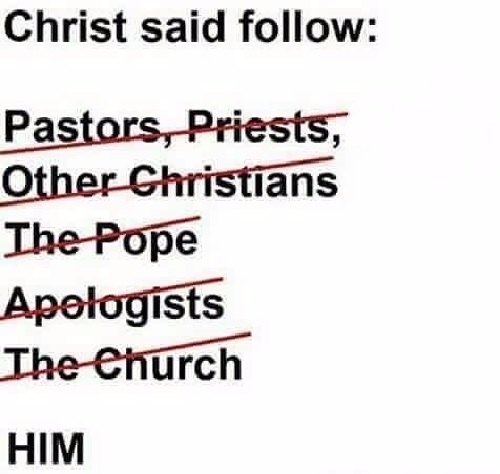
We felt that since the Spirit lives within us there is no need for a middle-man (pastor) to lead and teach us. If the Spirit of God actually lives within us, why do we so often depend on a human being to lead and teach us?

I certainly do not want to make anyone feel bad if they are still a part of the institutional church. They are like I used to be and feel that was the best way to show love for God and learn about God. I would not tell anyone they should leave the system, although for my wife and I we certainly do believe it was the best thing for us.

Whether you are in the church system, questioning the church system or have left it, the main focus should be to love God and love one another. Doing so fulfills all the law and the prophets (as Matthew 22:35-40 explains). Of course, we know that the law no longer needs to be fulfilled but at the time Jesus taught this he was living under the law. Now that grace has been applied, we no longer live by the law but by love.

Leaving the institutional church or changing and deconstructing your religious views and interpretations do not mean you are leaving God. Rather than jump on board with those who judge and condemn, take a little bit and find out more about what is going on. Then remember we are all at a different place on the path as we follow Jesus. Pray for one another, encourage and support one another but do not beat one another up as we each try to follow Jesus as we feel led.

Read Full Post »

by Jim Gordon

Growing up in the church system I was always taught that the pastor was the authority on anything spiritual. After all, they had been ‘called’ and had gone to college to be taught everything about God and the bible.

I remember how impressed I was by pastors. If I had a question about the bible I could make an appointment and go in and talk with the pastor. I figured he would have all the answers.

As I got a little older, I became infatuated with some of the big named evangelist. I would listen to them, send them money and if at all possible, go to their crusades. I can remember thinking if I could only be like them. They were super-spiritual and knew all about God and had the answers to all spiritual questions.

I really thought that was the way to learn about God, by going to church, reading the bible and getting all the wisdom of the pastors and evangelists.

Fortunately, I got to a point where I realized the pastors and evangelists were no different than me. They did not have all the answers and they were not super-spiritual like I had always imagined. I came to understand that people are people. None are closer to God or more special to God than another. Yes, some are more knowledgeable due to more time reading and studying but no one is higher up or more important in God’s eyes.

Now days I really do not care much what men and women say, it is just their opinion. They are humans like the rest of us. We can certainly discuss things and get insight from one another, but God loves each of us the same. The Spirit within us can guide and teach us without the help of any human being. If we believe the Spirit lives within us, why are we more interested in what another human says? Why not learn how to hear the voice of the Spirit from within rather than the thoughts and traditions of men?

Read Full Post »

by Jordan Hathcock

“The moral standards by which Israel’s first ancestor were expected to act seem to come not so much by God’s unique command, but by expectations of the surrounding cultures” – Pete Enns

We are all products of our environment. Our cultures play a huge role in how we as a collective, strive to improve and develop ourselves into a reality of wellbeing and enjoyment. The Latin root word cultura: “till the soil, tend, grow” is the same root as Cultivate and Cult. Which I find fascinating when we when look at how cults work in our religious settings. I see it more expansive then that. Culture is the true cult when it comes to how we as a society interact, develop, and grow.

One of the definitions of cult states: “a religion regarded as unorthodox or spurious”. I think this is the most used definition when it comes to religious people accusing other religious people for “not doing it right”. Within Christendom, there is an everlasting list of religious groups that are accused of being cults: LDS, Jehovah Witnesses, Seventh Day Adventist’s are the main targets. Yes, these groups have their problems, but I think as research shows, majority of the churches we see throughout Western Civilization are showing unhealthy practices which is leading to an exodus from the religious institutions. Alas, the great cult list continues.

With that being said, for all those religious/spiritual practitioners out there, what do we do with the other definition of cult: “great devotion to a person, idea, object, movement, or work”. From the Christian perspective, isn’t this what we do with Jesus? Aren’t we in the end, a cult? I mean this is how we got our name in the first place, right? We were following The Way (what followers of Jesus called it) of Jesus and when other groups saw this, the cult name we were given was “Christian”. So, is this word/idea of cult the end-all of good and healthy religious practices?

Don’t think the religious/spiritual are the only group guilty of being cult-like. From Patriots and their civil duty to a person and idea, to the Scientist and her devotion to the work of the scientific method–all humans in one way or another practice cult-like behaviors to bring about “wellbeing and enjoyment” to their social structures. See, culture is always influencing how we as humans view the world. What culture is best? I don’t think that’s the question we should be asking ourselves.

We should realize that culture will always be part of the human experience. All of us will have our cult-like ways in how we move through this life. But the thing that still moves me to still participate in the way of Jesus is the realization that culture doesn’t always produce healthy, peaceful and loving outcomes. Injustices still are running amok throughout the world of cultures. The poor are still poor, the hungry are still hungry and the rich are still getting richer.

The violent cultures of Empire & Religion are still manipulating how all this social process works. These structures only want one thing: controlling power. This model will not bring justice, mercy, peace and love. What do we do as a society to change this culture? Well, tough to say. But I do believe Jesus showed us a way to develop a new process within our cultures: It is the powerless who act out of love in order to change the cult of culture (Mark 10:42). Let us be lovers who seek peacemaking; not haters who seek warmongering…

“Jesus was not killed by atheism and anarchy. He was brought down by law and order allied with religion, which is always a deadly mix. Beware those who claim to know the mind of God and who are prepared to use force, if necessary, to make others conform. Beware those who cannot tell God’s will from their own. Temple police are always a bad sign. When chaplains start wearing guns and hanging out at the sheriff’s office, watch out. Someone is about to have no king but Caesar.”- Barbara Brown Taylor

Read Full Post »

« Newer Posts - Older Posts »