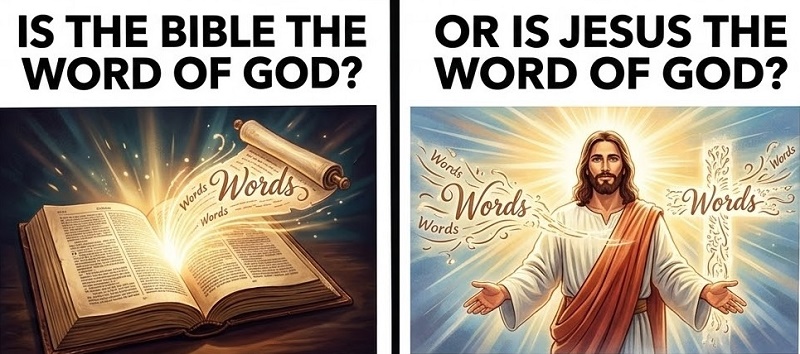
When we talk about the Word of God, we usually think of the Bible.
If we say the Bible is just a book, people get all offended and ready to voice their opinion about the Bible being the Word of God.
Actually, I disagree with that thought. Based on John 1:1, the Word of God is Jesus. He is the true, living and inerrant Word of God. The Bible never says it is the Word of God or that it is inerrant.
So often, we Christians focus so much on the Bible that we forget we have the living Word of God inside of us. The Holy Spirit, who is God in spirit form, just as Jesus was God in human form, lives within us.
There is certainly nothing wrong with reading the Bible. Men were inspired to write what they thought about God, what they experienced in their search for God and what they saw as they followed Jesus. Through it we can learn from the past, we see the story of redemption throughout, we come to know the love God has for us and how God provided our salvation through Christ. We learn what pleases God and we come to know that it is only by grace that we are restored to fellowship with God.
The Bible teaches us the law and how we humans are completely unable to live a life pleasing to God through the law. The law was our tutor to bring us to realize that we need God’s grace through Christ.
The Bible teaches us of the freedom we now have in Christ and by that grace we can live a life pleasing to God. We learn that God is a Spirit of love and that God loves the world and wants to fellowship with us.
The part we need to get over is how we like to fight and argue over which version is the correct writings of the Bible. We need to remember that all versions of the Bible are only translations and man-made interpretations of what men thought about God and what they knew about God, yet all was given through inspiration of the Holy Spirit.
We need to focus on Jesus. Only Jesus is the true and living Word of God. When we focus on Jesus and listen for the voice and leading of the Holy Spirit within us, we will then hear and come to understand that the true and living Word of God is Jesus.
*******
Michael Donahoe was added as a writer for Done with Religion as his views fit perfectly with those that are shared on this site. He and his wife have been outside the walls of religion for fifteen years. He enjoys writing about his experiences and thoughts, and he wants to encourage others who are going through the religious deconstruction process. He also writes on Substack at https://deconstructiontrail.substack.com/ and https://personalmeanderings.substack.com/
Books have been written trying to answer this question. It is a fair question. If an almighty God truly exist and since a non-evil God is the only God worth believing in, why don’t they intervene more in evil. I’ve written a great deal trying to answer why God doesn’t intervene more in suffering and evil if supposedly all-powerful and loving. See here. I am trying to give a brief answer, though this Post is longer than previous ones, to spur thinking on one’s own how they might answer or think about God on this question compared to what they have heard. It matters – one’s attitude toward God can determine the depth of their relationship with God. One of the main reasons many want to believe in God but hesitate is why so much evil exists if a good God is real and all-powerful.
Is God Really All Powerful?
Most who have grown up in the institutional church have been taught that God is all-powerful, thus why doesn’t God, supposedly loving, intervene more with evil in this world? But, how can God be all-powerful and humans have some freedom/power? It makes no sense to say God can exert all power and creatures can exert some power. Even the Bible doesn’t claim God is all-powerful and can do anything. God can’t tempt others (Jas. 1:13). God can’t lie or be unloving. God can’t make one believe or freedom would be a farce. Maybe God can’t be all-powerful. Thus controlling!
God can’t be controlling!
If God is supposedly perfectly loving, adult children know perfect love can’t be controlling. This may explain why God can’t intervene in suffering. This may be an unsatisfactory explanation to many – but better than some rationalizations given below. A parent may think they know best for their adult child, but acting controlling in a child’s life could make them even more rebellious. Besides, controlling love is an oxymoron. Even the Bible claims love does not insist on its own way (I Cor 13:5). Instead, God works with creation through influence. In this view, God suffers with the world and works to heal it, but can’t unilaterally prevent all suffering. See A Loving God Can’t Be All-Powerful!
Don’t miracles prove God is all-powerful?
But how can God do miraculous things – against natural laws such as bringing Jesus back from the dead – and not be all-powerful. One cannot deny Craig Keener’s scholarship on miracles as reliable reports exists all over the world of physical/literal miracles. I am not going to try to convince you to believe in miracles or not. But it is important to consider if miracles are possible because it can shape our views of God and God’s love. Most of us have asked God for a miracle in our life, even unbelievers. Most would admit the answer usually has been “no.” I am defining a miracle as something supernatural such as a malignant tumor disappearing in one’s body without any possible medical explanation, or walking on water. Most miracles prayed for seem to defy natural laws. .
I doubt miracles don’t happen because some people are less sinful or beg better at the feet of an arbitrary God? A possible better explanation for healings is that various biological and environmental factors are involved such as cells and organs. It may not be a stretch to say God has to account for human and natural freedom as well. Perhaps miracles can happen when God’s love aligns with countless factors known and not known. God cannot intervene singlehandedly, but a loving God always wants to intervene whenever circumstances will allow.
Many believe in miracles because the Bible says so. It is possible that many miracles in the Bible weren’t meant to be taken literally but to illustrate God’s love for righteousness than actual events. Thus, the writer isn’t lying. Genesis talks about a magical tree of good and evil and talking snakes. No such trees and snakes exist. A Global Flood could be a literary device to illustrate the destructiveness of human versus God’s ways. The same for the parting of the Red Sea. Maybe Jonah wasn’t really shallowed by a whale. The gullet of a whale is too small to swallow an adult. Was the writer trying to show God has a right to show compassion and Jonah’s misguided enthusiasm for the destruction of his enemies? See here others explanations miracles not being literal such as feeding the 5000.
But the Bible can’t be the definitive word on God
I often don’t refer to the Bible because the Bible or any ancient literature is subject to interpretation. Maybe I am right or wrong on my understanding. Scholars don’t agree on interpretations of many biblical passages. And we are free to speculate if God agrees what all the writers penned about God, even if we agree on the meaning of the passage.
Most Bible-quoting folks believe we are made in the image of God. If a Creator exists, perhaps that Creator informs their image-bearers – you and me – through their moral intuitions how we ought to love others. Humans are free to speculate what a God’s love is like. Such a God should love how humans love. I am convinced God is always seeking to intervene when possible, as I am as a parent. We don’t have to assume God can answer our prayers but doesn’t for some unknown reason. We can wonder why a loving God doesn’t always intervene. Maybe God can’t! Surely, God suffers with us but the unfortunate truth in a free world is suffering happens and God can only influence and not overpower.
Freedom can explain some evil but not all evil
It is not logically possible for God to create freedom unless there is the possibility of love or hate. I don’t know of any human parent who brings children into the world not desiring their children freely reciprocate their love as opposed to being forced. Without freedom we could accuse God of not creating the very best world where only true, authentic relationships can develop. Freedom allows human to develop qualities of moral character that cannot be created initially. Freedom obviously cannot guarantee a pain free universe.
Not “all things lead to good, even horrific evils.” Is God really in total control?
Others come to see suffering not as something caused by God, but as something used/allowed by God because God is supposedly all-powerful. That view may work for some, but I believe many hold onto this view because convinced God must be all-powerful. The Bible is quoted which implies God allows evil for good. Genesis 50:20 is quoted: “Joseph, reflecting on his brothers’ betrayal in selling him into slavery, says: “As for you, you meant evil against me, but God meant it for good, to bring it about that many people should be kept alive, as they are today.” Romans 8:28: “And we know that in all things God works for the good of those who love him, who have been called according to his purpose.”
This suggests to many that God is always in control, even though bad things happen. It simply is not true all evil leads to good, as if God in complete control. Ask victims of rape or abuse. We must ask why doesn’t God stop such evil if all-powerful? Some abuse often leads to a lifestyle of abusing others or hating God. It isn’t always true that all suffering helps develop virtues like courage, compassion, and resilience. This may be true for some but not all.
It is natural to ask, “If God could stop this (by allowing), why didn’t He? Many feel betrayed or abandoned by God. Some find it hard to pray. This reaction isn’t a lack of faith — it’s an honest human response to suffering. Feeling angry with God can be part of a genuine relationship — it means you still believe. God can be questioned! If we maintain that God allowed – thus limits their Power – this suggests God can do something but doesn’t. We must come up with a better explanation that God simply allows – thus controls – evils but isn’t responsible for such evils. A God who can prevent evil but doesn’t is counter-intuitive to love. No loving parent or God sits idly by when they could prevent tragedies such as rape or murder. What loving parent acts that way. We are left to believe God doesn’t care, God is punishing us, or God has abandoned us and left us.
Explanation that God and evil being a mystery doesn’t suffice either
Some argue that God’s reasons are beyond human understanding — that we can’t see the full picture from our limited perspective (as in the Book of Job). It makes no sense if God is seeking a relationship, why would God be mostly mysterious. When my child is seeking to understand, I don’t simply tell them “you can’t understand. Just deal with it.” It is true we can’t understand God fully, but God’s spiel when seeking to understand isn’t “go away, figure it out.”
What may be a start to a solution
Please know there are alternative views of God if currently struggling what claims you have heard. Accepting God is not all-powerful has helped me deal with brain cancer. See Why Did God Allow This Cancerous Tumor In My Brain?
No, God doesn’t plan or control tragedies in your life
God doesn’t plan for you to be unable to have children if you desire to be a mom or dad
God doesn’t plan for your body to be wrecked by cancer
God didn’t want you sexually or physically abused as a child
God didn’t want your partner to leave you by wanting a divorce
God didn’t want your loved one murdered or severely injured in a car accident
God didn’t want you let go from your job
In our suffering we don’t have to feel God doesn’t care or that God could do something and doesn’t. God knows and empathizes with us in our suffering. God grieves with us. God can empower, inspire, and accompany us. God can influence us to follow Jesus’ example which can make for a much grander world. God doesn’t derive pleasure by seeing us in pain but the unfortunate truth in a free, uncontrollable world is that God’s power it limited and suffering happens. Lean on God and others for emotional support and encouragement in difficult times.
Mike Edwards was added as a writer and has been a great addition to the site. Mike provides many interesting views and various ways of looking at things. He is not afraid to ask questions and he keeps an open mind as to teachings of the institutional church. Mike also has his own site where he writes at What God May Really Be Like
This is the first time I am responding to the below post written 6/22/25 when a tumor was found in my brain. See update after initial Post below. I still have brain cancer. The tumor was removed but I still get brain scans that the tumor is not back growing. I am done with radiation and chemo treatment for the next 6 months but who knows after that. For some reason the initial diagnosis of the MRI that you have a tumor in your head didn’t freak me out. I just went in death-mode preparation. I don’t have scan freak-outs that I get every 2-3 months (maybe because I take a zanax), but I am too aware that brain cancer could come back and decisions will have to be made. I don’t know if I want to go through chemo again or whatever.
+++++++++
Long story short 6/22/25
On April 15, 2025 my tennis partner, who is a Doctor, sensed I was off. (More than usual). I typically walk home after the match, but he insisted in driving me home and that I see my regular Doctor. I am so thankful for his urging. I saw my Doctor a day or two later and an MRI was scheduled. Within hours I got a call that I had a tumor in my brain. I had very few symptoms before except minor headaches that I thought nothing of. I was ready to play a third set of tennis that day but my buddies said no. Guess I was acting off/weird. Within days of the MRI, I was scheduled for brain surgery to remove the tumor (April 21). I spent those few days preparing my family, not knowing if I would make it out of the surgery alive or have motor skills severely damaged. Things went very well in terms of the tumor being removed (cancer still remains), The tumor was a severe cancer type. So, I begin chemo/radiation treatment shortly after for 6 weeks. I’m in my last week of 6 weeks of treatment.
No, God didn’t CAUSE my tumor!
I hope no one thinks God caused this tumor to teach me a lesson for my sins. I ain’t no saint but I’m kinder than most folks. I have friends who will verify. I know some selfish/evil people that are cancer free. I refuse to believe a loving God using tragedies to punish or teach one a lesson and we remain clueless reasons for such actions. Besides, that assumes God is simply pulling strings to control events in the world. Did God cause this for a greater good. I doubt it. God can’t control how I will react to a tragedy in my life. I could be pissed at God and no good comes of it. Some claim all evil eventually leads to good as if some grand plan by God. Not my God! Ask sexual abuse victims or family members of murdered loved ones if good always comes out of evil.
Or it is claimed we sinners have no right to question a Holy God. I have a God I can doubt, question, get angry with, whatever. That is what a loving parent/God is like. How do I know this? I have been a child of a parent and a parent of children. Why would a Creator create us to have intuitions of what true love is (allowing a child to question) but not be loving themself?
See Does God Really Punish Or We Just Reap What We Sow? Assuming God is in control of punishment makes a mockery of freedom. It is an oxymoron to claim God is in complete control and we humans have freedom. If God does actively punish and carry out wrath, God is letting a whole lot of evil in the world slide. God doesn’t love more those spared than those supposedly punished.
Does God Really Allow Cancer?
It is claimed a mystery how God can allow evil but not be evil. Humans don’t get a free pass if they can stop evil but don’t. Ask sexual abuse victims when their parent knew and did nothing. One might ask why God allows such harm if supposedly all-powerful. Thinking God is all-powerful (thus all-controlling) assumes God can pull strings to make certain things happen (allow). So much for genuine freedom? See God Can’t Stop Your Suffering And Evil!
Thankfully, I don’t entertain such a view of God which has helped having a positive view during all this, though I have many miles to travel in my journey. My silent friend (God), along with family and friends have been a life-saver. You have a lot of internal conversations when waiting for brain surgery or going through cancer. When one believes “God allows” your mind can wander. Why me and not others (is God’s love arbitrary – if God can supposedly control everything), what lesson is God trying to teach me. I never had to go there. I am convinced God isn’t all-powerful.
If we maintain that God limits their Power, this suggests God can do something but doesn’t. We must come up with a better explanation that God simply allows – thus controls – evils but isn’t responsible for such evils. A God who can prevent evil but doesn’t is counter-intuitive to love. No loving parent or God sits idly by when they could prevent tragedies such as rape or murder. Are we to believe God doesn’t care, God is punishing us, or God has abandoned us and left us clueless about the grand plan? God doesn’t just allow your suffering!
God may not be all powerful
It is only natural to believe a Supreme Being, if they exist, is all powerful. Most Christians believe this because of their understanding of the Bible taught in churches they attend but questions arise if God is all-powerful. If God can control everything, why doesn’t God intervene more in medical emergencies, rape, physical abuse, etc. A miracle supposedly saved Trump but not the gentlemen in the front row. I doubt it. God doesn’t pick and choose when to cause or allow suffering.
God can’t be all-powerful if all-loving. Perfect love isn’t controlling. Ask any adult child with a controlling parent. Thomas Oord in his new book defends ably that the Bible doesn’t necessarily claim God is all-powerful and can do anything. See here. God can’t tempt others (Jas. 1:13). It makes no sense to say God can exert all power and creatures can exert some power. I have never understood why God doesn’t stop evil if God can do anything. If “everything happens for a reason” because of God, this would make God responsible for all goodness and all evil. It is claimed a mystery how God can cause or allow evil but not be evil. This isn’t true for humans. Some claim all evil eventually leads to good as if some grand plan by God. Hardly!
What about prayer and miracles?
Many prayers asking for healing are obviously not answered. Are miracles arbitrary – God picking and choosing to bless some and not others? Conditions in our body may not always be right. Various biological and environmental factors are involved such as cells, organs, etc. If God wouldn’t take away your human freedom, it may not be a stretch to say God has to account for natural freedom as well. Miracles can happen when God’s uncontrolling love aligns with countless factors known and not known. God surely intervenes when circumstances will allow. Pray if you like, but God is already working to do all God can to prevent suffering. That’s what perfect Love does! See Why God Doesn’t Answer My Prayers?
I am convinced God is always seeking to intervene when possible. Pray for miracles, but don’t assume God can answer our prayers but doesn’t for some unknown reason. God suffers with us, but the unfortunate truth in a free world is suffering happens, though God is dying to help. We can pray but be more understanding when God can’t answer our prayers. Pray to God for emotional support and encouragement in difficult times. My silent Friend has gotten me through some difficult times when my brain begins to wander.
Did God really choose the Holocaust by not responding, including senseless suffering to children in the world?
Do you read the Bible Edwards?
I believe we should assume the Bible isn’t inspired by God. We can’t prove the Bible is or isn’t inspired by God. Besides, the Bible is literature that requires interpretation and we don’t all agree on the correct interpretation even concerning moral issues such as if God condemns gays or not. Many assume inspiration means God approved or controlled all recorded by the writers, especially characterizations of God. Many don’t think of inspiration as meaning that God encouraged or motivated writers/editors to record their understanding of God, thus possible being right or wrong.
See here all my rants on the Bible and why we need to rethink our understanding of the Bible.
So, what good is God?
The only God worth believing in or having a relationship with must be a perfect Lover. God can’t be all-powerful or controlling and be true to God’s nature. Thomas Jay Oord in his books says that so many positive elements can come from affirming a universal, divine Lover. Such a Spirit empowers, inspires, and accompanies us in our relationships with others. God knows and empathizes with us in our suffering. This is what I have experienced. God obviously grieves due to all the evil in the world. God suffered when Jesus was crucified. God suggested through Jesus’ example and words what kind of life lived here on earth can make for a much grander world. My relationship with God, though a silent friend, has carried me so far.
My future
I thought initially that surgery and removing the tumor out of my brain was my greatest danger, when discovered I had a tumor. Thus, why I tried to prepare the family and get financial house in order, as I thought I might not be back. Turns out most don’t die on the surgery table. Motor and physical skills can be damaged, which I didn’t realize as much, but I had a great surgeon. I was only in hospital two days after brain surgery, had brain fog for a week (you had to have 5 PHDs to understand my texts), but I felt pretty good after a week. It does help to be retired. I began radiation and chemo therapy for 6 weeks. So far, no nausea, I can handle the tiredness because I was very active before tumor. I get tired – I get moving. Sitting makes me more tired. My stamina affected but I can change some of my habits to hopefully see my grandchildren become teenagers. I am a cool POPS. I didn’t have a relationship with my grandparents, so I want to get it right as I did as a parent when I had children.
I am walking on the average 2-3 miles a day. Playing tennis two days a week. But, 5 weeks of great fortune with treatment doesn’t guarantee the next week of treatment and thereafter. And it takes some weeks after treatment to recover from tiredness, etc. So the journey ain’t over! I will have an MRI August 6th, a month after treatment to see how much treatment was successful with the cancer. Even if very successful I may be prone to seizers and other medical matters down the road. I could live a year but some with my type of cancer live 10 years or more. We will see. Thank God for God, family, and my friends. Peace!
February 25, 2026 – Update of my brain cancer journey
I have mainly written this journey to hopefully help some suffering and disappointed with God. What we have been told about God may not always be true. This is the first time I am responding to the above post written 6/22/25 when a tumor was found in my brain. I still have brain cancer. The tumor was removed but I still get brain scans every 2-3 months that the tumor is not back growing. I am done with radiation and chemo treatment for the next 6 months but who knows after that. For some reason the initial diagnosis of the MRI that you have a tumor in your head didn’t freak me out. I don’t have scan freak-outs (maybe because I take a zanax), but I am too aware that brain cancer could come back and what decisions have to be made. I don’t know if I want to go through chemo again or whatever.
Spiritually speaking, I know God didn’t cause or allow this. See above. God and I are good thanks goodness. God has been my biggest comfort through this journey as well as my amazing partner Janet. And I have amazing kids, I can talk and share with God with all my thoughts without feeling that God doesn’t care by allowing/cause my cancer. I happen to believe God is the perfect lover. I am free to speculate what that means. Basically – how I should love others like I want to be loved. How I wish to be loved and know how I should love others is how God loves!
Future fears – honestly, this second leg of my journey has been more challenging. I have had a few setbacks but not like having head split open and possibly coming back brain damaged. I got a skin disorder (bullous pemphigold) and a mild case of shingles from treatment. Going through infusion treatment. I got a low blood count making me susceptible to infections but good to go. I gained weight and knees hurt, but still walking for recovering. Tennis by choice has taken a back seat.
If you sit down and talk to me and ask questions, I may be even more open. I am not sure I will handle this second journey better than the first. I am told I have been a good patient with the initial news -fake it till you make it! I’ve been told it helped being so active and healthy. What may not be so visible is my understanding of God and my amazing wife and children.
But we will see what the future holds. I know God, Janet, and kids will be there for me.
Mike Edwards was added as a writer and has been a great addition to the site. Mike provides many interesting views and various ways of looking at things. He is not afraid to ask questions and he keeps an open mind as to teachings of the institutional church. Mike also has his own site where he writes at What God May Really Be Like
We often hear that there should be unity among fellow Christians, yet how often does that seem to really happen? Do you get tired of seeing such disagreement among fellow Christians? Unfortunately, we do not see a lot of unity and agreement today.
Jesus said his followers were to be known for their love for one another. Yet today it is hard to find brothers and sisters in Christ being loving and kind. Fortunately, this is not the case in every situation, but it seems a lot more common than it should be.
I am not just talking about being accepting and kind toward those who are outside the Christian faith, but it is hard to find true love and acceptance among brethren of different denominations within the faith.
If we go to the same church building and accept the same doctrines, we usually find love and acceptance. I remember when I was in the church system the first thing I would ask someone was where they went to church. If they went to an organization I liked and agreed with, I would pretty much instantly like the person. If they went to a place that was different in their way of worship or interpretation of the Bible, then I would immediately be on guard and almost dismiss them as someone to get to know. This seems to be a pretty common occurrence.
It is sad that we put such walls up with people who think differently. It is sad that we have made such importance out of buildings, doctrines, interpretations and Bible versions that we forget God loves each of us no matter what we believe. We are to love God and love others just as God does no matter what they believe, especially among those who are also followers of Jesus.
Loving and accepting people does not mean we are always in agreement and that we always get along. Of course, there will be disagreements and differences of opinions, probably even arguments and hurt feelings at times, but that is life. We can disagree and even argue at times and still respect and accept the other person.
By the power of the Spirit within us, we can accept, respect and be loving toward others. Not only our brothers and sisters in Christ, but those who are not of the Christian faith and belief. I think we can disagree and have different opinions and still act in a respectful and accepting way toward our fellow human beings.
Jesus said that they will know we are his disciples by the love we have for one another. Love draws people, but condemnation, judgment and unloving behavior drives them away. It seems that when I say we are to love and accept others, I am often told that I am wrong because as Christians we are to point out the sins and mistakes of others. They say it is our responsibility to make sure others know what they are doing wrong with the purpose of making them change their behavior.
I personally do not think we are to be the sin police. We are not told to do such things. We are told to love God and love others. As far as I am concerned the Holy Spirit will convict the world of sin where conviction is needed. That is between the Spirit and each individual as to what they do and how they respond. We are only to love others. Love draws people, not judgment and condemnation. God is love. Rather than judge, condemn, separate and argue, get out there among humanity and let the love of God flow out of you by the power of the Spirit. There is a whole world of hurting people, both Christian and non-Christian who can use the encouragement of an accepting person who cares and shows the love of God.
*******
Michael Donahoe was added as a writer for Done with Religion as his views fit perfectly with those that are shared on this site. He and his wife have been outside the walls of religion for fifteen years. He enjoys writing about his experiences and thoughts, and he wants to encourage others who are going through the religious deconstruction process. He also writes on Substack at https://deconstructiontrail.substack.com/ and https://personalmeanderings.substack.com/
There are many reasons why people support strongly America’s defense of Israel as opposed to having the same fervent for other nations. There are moral, political, religious, and personal reasons. It’s rarely just one factor. Justice reasons may be because Israel has suffered so many injustices during the centuries including the holocaust and October 7th
Why might Christians support Israel for religious reasons?
One reason that concerns me the most is that many Christians and Jews support Israel based on interpretations of the Bible. Many Christians believe Israel plays a role in biblical prophecy and to not support them would be going against God’s future plan. Many do not admit that biblical experts don’t agree on the meaning of many passages that may or may not relate to future events. Many claim dogmatically that the Bible predicts future events such as what is happening in Israel currently and the end-times when Jesus returns down to earth. We all must admit there is no consensus of beliefs about prophecies in the Bible. I trust more those who admit their interpretation of ancient literature (Bible) could be wrong. I am not certain my views are correct.
I have claimed prophecy can’t be God knowing or predicting what happens in the future. God can’t know an undetermined future. It is likely prophecy is conditional to respect freedom. God warns what could happen if Israel rebels against God’s ways or to others that don’t respect God’s morality. See: Does Prophecy In The Bible Really Predict The Future?
Foreign policy should not be guided by disputed theological interpretations/religiosity. Assumptions about biblical prophecy and Israel can lead to foreign policy decisions in God’s name that don’t fulfill God’s desires at all. Foreign policies should not be based on theological ideology based on complex interpretations of biblical prophecy. This doesn’t represent citizens who don’t share such theological beliefs and whether believers are into God or not. Shouldn’t a nation’s policy be based on the protection of all its citizens within a moral framework?
Why might many oppose support of Isreal or favor Israel?
I understand many may especially support Israel for important military and intelligence reasons. Those who oppose Israel support should consider for America’s own protection. Many people’s views are often shaped by the media they consume. We should consider all opinions. We must encourage healthy debate. I suspect many may oppose supporting Israel over America’s own citizens for financial reasons. We have enough financial problems without giving so much money away to other nations. I have some sympathy for this. When I have a choice, I am going to protect and support my family financially over other families. I don’t think that is totally selfish. A family or nation is often more capable of aiding others because they are strong and united.
Mike Edwards was added as a writer and has been a great addition to the site. Mike provides many interesting views and various ways of looking at things. He is not afraid to ask questions and he keeps an open mind as to teachings of the institutional church. Mike also has his own site where he writes at What God May Really Be Like
Many believe only those who believe/follow God here on earth will make it to heaven in the afterlife. For contrarian views see: What Religion Leads To Heaven If you don’t believe all have a chance to be in heaven regardless of beliefs here on earth, then how can heaven be a happy place if unbelieving loved ones aren’t allowed in heaven.
At least you don’t have to worry about Hell
One barrier to happiness is a belief held by many that there is a literal hell where God tortures those in the afterlife who don’t believe while here on earth. The only place one may get such an idea about a loving God is a supposed inspired book by God (Bible). The good news is that a literal hell is unlikely biblically speaking. You don’t have to worry about a loved one being kept alive to be tortured. God creating a literal Hell where people are tortured for billions of years for beliefs held a short time here on earth isn’t possible morally or biblically. See here. See here. Humans wouldn’t even create such a place for our enemies. God or humans can’t possibly be happy in heaven if loved ones are tormented after death forever. If God supposedly has such control over happiness, why not use the same power over rebelliousness?
And, all loved ones may go to heaven eventually even according to the Bible?
Many may reject universalism because they believe the Bible teaches against it. Many who reject universalism often resort to name calling rather than defending their views – referring to those who reject their claims as heretics. What many may not know is there are many biblical scholars who believe the Bible can be interpreted to teach God saves all eventually. See: All Will End Up Heaven According To The Bible!
The main reason to think God doesn’t accept all in heaven when meeting their Creator is because the Bible supposedly says otherwise. Does God’s loving nature allow stopping to forgive? There are consequences in this life and there may be painful reckonings in the life to come, but a loving God can’t stop showing grace. Why would God undergo a complete character lobotomy after we take our last breath here on earth? Is a thief going to enter Paradise but not others with lesser sins because they weren’t next to Jesus hanging on a Cross right before their last breath? God’s grace doesn’t depend on whether one has more opportunities to respond to God than others. The Bible doesn’t rule out decisions after life here on earth. Even imperfect human parents wouldn’t cut off a child who eventually accepts responsibilities for their actions. Universalism is possible or even probably true because there can’t be a deadline or time limit on God’s love. There isn’t on my love for my children. Am I a better lover than God? We are told to forgive our enemies as many times as necessary but God doesn’t?
Even the Bible doesn’t rule out decisions after death regarding one’s eternal destination
John 5:25 says that the dead will hear the voice of God and those who hear will live. Verse 29 says those who have done evil will be condemned but we do not know whether repentance will take place. Romans 14:11-12 says: “It is written: As surely as I live, says the Lord, “every knee will bow before me; every tongue will confess to God.” So then, we will all give an account of ourselves to God.” Why couldn’t some make a decision at Judgment? I Peter 3:18-20 speaks of Jesus preaching to those in Noah’s day who were disobedient. Preaching is normally for the opportunity to respond. I Peter 4:6 goes on to say that the dead can live according to God’s spirit. Eternal decisions after death doesn’t diminish the blessings of changing here on earth. A perfect, merciful God can best decide when enough chances are given.
A loving God can’t be a God of chance!
A loving God wouldn’t only let Christians into heaven when the majority of people born into this world died without knowledge of Jesus the Christ. Besides, one’s religion or rebellion against a certain religion is often based on the family born into whether it is Christian, Muslim, Buddhist, etc. No human or spiritual parent brings children into the world requiring that one’s eternal destination is based on circumstances out of one’s control.
What about justice though?
The Bible talks about everyone, whether having faith here on earth or not, will be judged (2 Cor 5:10; Rom 14:12). Punishment doesn’t bring back a victim’s robbed memories of the future due to the murder of a loved one. Justice can be understanding your victim’s pain and accepting the harmfulness of your actions. After death God may seek for all to face every action of betrayal and how it felt to their victims. The cleansing and educative effect may take longer for some than others. Humans, like God may forgive their enemies if they truly regret their actions and seek forgiveness. Justice from a fair, merciful God is possible despite people being given a second chance after death.
Happiness in Heaven possible even if loved one not there
I supposed it is possible some may reject God and Heaven when meeting their Creator and chose final death. So, God may not be able to save all. But, if my loved one sees what God is really like meeting and still reject God, I can better except it is their choice than God rejecting them. I can better accept their death than forcing them to be in heaven is fair and I can be content with that decision.
Mike Edwards was added as a writer and has been a great addition to the site. Mike provides many interesting views and various ways of looking at things. He is not afraid to ask questions and he keeps an open mind as to teachings of the institutional church. Mike also has his own site where he writes at What God May Really Be Like
No one would think a loving God or caring parent would create a place to torture those who didn’t believe while a short time here on earth. Such pain serves no purpose. Most humans wouldn’t even treat their enemies that way. The only reason one may believe in Hell is because it is believed to be claimed to be real in a Book (Bible) that supposedly God inspired (controlled the writers having correct views of God written down). But it turns out the Bible can be interpreted to not believe Hell is a literal place. See articles above.
What I tell a young child about heaven and hell when they bring it up.
Heaven is a place everyone goes after death here on earth to be with God. See link above about Heaven. It case you don’t believe that, you tell your kid Santa Claus is real and surely you don’t believe that is true – overweight guy visits every house in the world in one night on a sled pulled by reindeers and goes down every chimney. You tell them they will always be safe flying, but you don’t know for sure their plane won’t crash.
I may ask a child what they have heard Hell is. I would tell a child Hell is not a literal place. It is sometimes mentioned in the Bible as a place people don’t believe in God’s or don’t want God’s influence- not treating others kindly or like you want to be treated. I tell adults Hell is a metaphor (There is a heavenly or hellish way to live life).
Parents – God’s influence in life is similar to the influence you hope to have in your kid’s life.
Mike Edwards was added as a writer and has been a great addition to the site. Mike provides many interesting views and various ways of looking at things. He is not afraid to ask questions and he keeps an open mind as to teachings of the institutional church. Mike also has his own site where he writes at What God May Really Be Like
There is so much violence throughout the world. Evil is alive and well even in churches, synagogues, and mosques. Shouldn’t we fight against evil? Must God-followers always lay down their arms according to Jesus’ words and example? Does non-violent reactions really end evil. Pacifism in my opinion is unrealistic. Evil only end when all individuals and nations decide to stop victimizing others.
More and more God-followers are rightly advocating for a loving than wrathful God. Many suggest since Jesus is God Himself, we should follow His words if we think they contradict an Old Testament prophet’s understanding of God. It’s too simplistic to think the Bible was written so we can simply turn to a page to get an answer for our problem. I might give my kids different advice when dealing with similar or different circumstances. Jesus too! Should you confront, should you divorce, etc.? It depends! Seek God and the wisdom of others who are slow to be certain. See: Does God Ever Advocate Violence To Stop Evil?
Mike Edwards was added as a writer and has been a great addition to the site. Mike provides many interesting views and various ways of looking at things. He is not afraid to ask questions and he keeps an open mind as to teachings of the institutional church. Mike also has his own site where he writes at What God May Really Be Like
Have you noticed how many people seem to only include their preferred group? They only include people who think like them, have similar interests and likes. If you think differently or have different views and opinions, people feel you should stay in your own group with like-minded people, but leave the other group alone.
We seem to find this attitude in every walk of life, but within organized religion or institutional church it seems even worse. We all should be accepting of people in general in our daily lives. Yet, we see this so often within Christianity with the wide variety of denominations and interpretations of the Bible.
When it comes to including people who we see as completely different from us, African-American, Native-American, White, LGBTQ, Atheist, Muslim, Jew and so on, we tend to want to keep each group separate. We think as believers in God we need to separate ourselves and not associate with those who see things differently. Why is it the word inclusion seems to make so many Christian people cringe?
Really, behind all the labels we put on people we are all basically the same, so why not associate and get to know people who we feel are different from us? We can learn from one another, get to know one another and find that we really are not all that different.
We see Jesus do this all the time when reading the gospels in the Bible. He did not differentiate people based on their religion, belief, lifestyle, sexuality or nationality. He did not separate himself from those who thought, believed and lived differently. He loved and accepted all people and showed them the love of God.
Obviously loving and accepting people does not mean total agreement, nor are we going to always get along in life and live happily ever after. Yet I believe it does mean treating others the same, with respect, kindness, acceptance and with the love of God through the power of the Spirit within.
Inclusion is not a bad word. It is not a bad or unholy way to live. Inclusion is about ALL of us. Inclusion is about living full lives – about learning to live together. It makes the world our classroom for a full life. Inclusion treasures diversity and builds community. It is about our abilities – our gifts and how to share them. Inclusion is the way of God and the way of showing the love of God to all we meet.
*******
Michael Donahoe was added as a writer for Done with Religion as his views fit perfectly with those that are shared on this site. He and his wife have been outside the walls of religion for fifteen years. He enjoys writing about his experiences and thoughts, and he wants to encourage others who are going through the religious deconstruction process. He also writes on Substack at https://deconstructiontrail.substack.com/ and https://personalmeanderings.substack.com/
Try claiming God doesn’t condemn gays. You are called a heretic in religious places, despite disagreement among scholars what the Bible claims. Dare to argue Covid vaccines have risks and you are called a mis-informer or conspiracist. It isn’t science without debate. The problem is condemnation of expression of opinions. The solution is encouraging civil discussions. Certainty is a myth except in the eye of the beholder!
Helping Survivors is on a mission to help heal, educate, and empower people who have been impacted by sexual abuse, assault, or harassment. We are a passionate group of experts and advocates who believe individuals who have experienced sexual assault, abuse, or harassment deserve to know their rights and options.
If you are in crisis and need support
call the Trevor Lifeline
at 1-866-488-7386
Undue Medical Debt
Undue Medical Debt empowers donors to forgive billions in oppressive medical debt. We are dedicated to removing the burden of medical debt for individuals, families and veterans across America. Click HERE to donate now.
Doctors Without Borders help people worldwide where the need is greatest, delivering emergency medical aid to people affected by conflict, epidemics, disasters or exclusion from health care. Help support us by making a donation here:
Wishes are more than just a nice thing, they can be a game-changer for a child with a life-threatening medical condition. We grant the wishes of children with life-threatening medical conditions to enrich the human experience with hope, strength and joy. To make a donation click here:







 Done with Religion
