Feeds:
Posts
Comments

The Feels

by Shannon Glenn, Guest Blogger

In the world of fandoms, “the feels” refers to the intense emotion we experience when remembering a powerful scene in a book, TV show, or movie. The most recent example I can think of is how everyone took a shot to “the feels” when we watched everyone fade to dust after Thanos snapped his fingers at the end of Avengers: Infinity War. I think most of us who had invested so much in all of our beloved Marvel characters felt like we had lost actual loved ones. I could not speak of Loki without tearing up for at least a week! In many situations these characters feel more real to us than some of the people we deal with on a daily basis.

As a child, I have very distinct memories of experiencing “the feels” of almost everyone around me. I cried when they cried, and I wanted to help everyone. Though it seemed odd strangers would often tell me their life story. I simply attributed it to being a good listener. I thought everyone was like me, but I found out quickly few people have this gift. Everyone loves to be around someone who has this gift, at least for a while. Life with humans reveals we often have a heavy price to pay when we love first and ask questions later.

The first time I heard the word Empath was based on a character named Counselor Deanna Troi on Star Trek the Next Generation. I saw myself in her. I would know if someone felt afraid or could sense if they were being dishonest, but at the time I did not know to trust myself.  Often people would look at me crazy when I would walk away from a conversation and indicate a person was lying. I would say things like, “You can’t trust them. I just know it’s a bad idea,” or “They are furious at me and did not show it.” Anytime those around me or I would discount those nudges, we would pay the price. I have a trail of broken relationships (which I likely should never have invested in) because those I loved and followed did not listen to my warnings. I’ve learned the hard way to trust my instincts.

Life in the American Fundamentalist Christian Bubble does not make room for empaths. I was told it was simply “new age hooey” so I learned to bury my gift and hide a part of myself.  I do not believe my gift, and I do now believe it is a gift, was given to be stifled because it does not fit in the ribbon wrapped box of American Christianity. The case can be made that Jesus himself was an empath as He was moved with compassion to restore the crippled, heal the lame, open blind eyes, and raise the dead.  He even confronted the religious leaders as He perceived their thoughts revealing true motives and intentions. These things can’t be explained away with the simple explanation of He was God. Scripture says He was moved and He perceived which indicates He identified and understood their situation, position, and intention.

After walking away from the church system a few years ago, I have been able to fully embrace being an empath. I believe this gift was given for a reason, and I use it to help those around me. However, I’ve now learned I must set up healthy boundaries which I never had before. It is not necessary to always reveal what you may know as it’s the equivalent to tipping your poker hand, and all things tend to be revealed in the right time. After a lifetime of hurt feelings and broken friendships, I am moving forward. I recently listened to the song “Walk On” by U2 which I had always loved. However, this time it really spoke to me. “I know it aches, how your heart it breaks you can only take so much” just echoed in my mind. I have been learning to walk on for many years and suspect I will do so for years to come.  I will continue to embrace the feels because it’s what makes me who I am. Sometimes I will hurt, sometimes I will laugh, but finally I will be able to feel them without doubting myself or my instincts and that is a freedom worth walking toward.

Peace and Love!

Shannon

You can check out more of Shannon’s writing at Life of a Prodigal or click below for other posts she has contributed to Confessions of a Recovering Churchboy.


by Cindy Felkel, Guest Blogger

A friend sent me a picture (of a little boy praying in front of pictures of missing children) this past Sunday morning. When I saw the picture, I burst into tears.

See, all week, I’ve been processing information I heard at a seminar put on by the Underground of Ct., where they talked about the realities of domestic minor sex trafficking.

In this seminar, they covered statistics about how much it happens in Connecticut. One of the speakers drove home the point that the men who are paying tons of money to abuse youth in our neighborhoods are mostly middle class white married men with good jobs. They are our neighbors and leaders in our communities. They are hiding in plain sight because no one is suspicious of them.

Another speaker at this seminar was a survivor of sex trafficking. She spoke about the importance of being seen. She said that when she was trafficked, she only thought of herself as a body, an object to be used. It was being seen as a whole person of value that led her out of the abuse.

This beautiful young survivor sells t-shirts which say, “You are seen”.

With each t-shirt, she gives people a postcard which says, “Whether you got this t-shirt to remind yourself you are not alone, or to remind others, both are equally important. Darkness thrives in its ability to hide, but you have the ability to acknowledge that it has been seen and the power to not walk away. As a survivor of domestic minor sex trafficking, I wear this shirt in remembrance of one simple healing truth:

If there is only one thing you could offer someone in need, let it be your willingness to stay.

The glaring message that I walked away from this seminar with was the need to really see the people around me.

praying for missing children facebook

I also left with a nagging sense of the reality of how much the two biggest so- called Christian institutions in our country, the Catholic church and the Southern Baptist convention, have perpetuated systems of covering up abuse*.

The very next day, I read this quote from Brené Brown’s book Dare to LeadPerhaps the most devastating sign of a shame infestation is a cover-up. Cover-ups are perpetrated not only by the original actors, but by a culture of complicity and shame… When the culture of a corporation, nonprofit, university, government, CHURCH, sports program, school or family mandates that it is more important to protect the reputation of that system and those in power than it is to protect the human dignity of individuals or communities, you be certain of the following problems:

Shame is systemic
Complicity is part of the culture
Money and power trump ethics
Accountability is dead
Control and fear are management tools
And there’s a trail of devastation and pain”
pg 135

Sadly, this describes much of what has been happening in American church culture a little too well. I know so many of the stories of people who have been hurt. As sickening and devastating as those stories are, I also know that they represent only the tip of the iceberg.

It is no wonder we have a culture of middle-class white men committing unspeakable abuse against our children and supporting a $10.5 billion industry. When our church culture became about building the individual kingdoms of dynamic leaders, the religious culture of America made shame so much the norm that I doubt there is any life in America right not that has not been negatively impacted by it.

And those perpetrators? That’s totally a result of shame and inadequacy in their own lives. No one abuses others without dehumanizing them and without a need to use others to fill voids in their own lives. It’s a shame cycle that is devastating our country.

As I processed all of these things, I felt like I was almost in a state of shock. The reality of what was happening in our country,

Then, on Sunday, when my friend sent me that picture, I was also listening to a sermon by Andy Stanley where he said, “When what’s best for people is no longer what’s most important to you, you are at odds with God.”

As I sat there crying, ridiculously, it all came together for me.

If we don’t care about the healing of the individuals who have been abused by and because of church culture, and the shame culture so prevalent in America, I completely believe that we are at odds with God.

Our young people don’t need us to get better at sharing our theology or making sermons more attractive. They don’t even need us to pass more government programs or less or whatever politics you fool yourself into believing is going to change things. Nothing can bring people out of the darkness except seeing them.

They need to be seen. They need to be cared for.

That is the job of people who are following Jesus. That is what Jesus taught.

Forgive me for all the times I don’t see.

Blessings,

Cindy (rumandcolaforthesoul.com)

*I’m aware that there is abuse happening in other denominations and religions. I have only witnessed the abuse and heard the stories from these two cultures. I grew up going to Southern Baptist churches and I live in a predominately Catholic area. My adamant belief is based on anecdotal evidence and informal research into what others have written. However, I stand firm in that is obvious when leaders cover up abuse and allow victims to be shamed, the influence of the shame culture they model extends far beyond the incidents we hear about in the news. It impacts every person in that church and all the people the religious elite have labeled less important than their vision.

By Mike Edwards

We cannot definitively say what an invisible, inaudible God is like or even prove that God exist. But, millions if not billions are not insane for knowing or at least hoping there is a Creator who can provide worth, perspective, meaning, and hope of life after death. We should not have hidden agendas in relationships. If people want to pursue a relationship with God, they should see in our life something worth asking about. One can argue what if it turns out there isn’t a God. What do we loss striving to be unselfish and trying to be the person we deep down desire to be with the help of our Creator? Many rightly tune out God because of claims made about God. What is God like?

Why does it matter what we think or say God is like? 

Understandings about God shape attitudes toward God. Our relationship with God cannot exceed our views of God. The more we respect our earthly or heavenly parent, the closer we are to them. Some are atheists, not because they believe God can’t exist, but because what they imagine a loving God should be like isn’t what God-followers claim. Don’t believe everything you hear! 

We can begin to understand God through our moral intuitions.

If God does exist and desires a relationship, the Bible likely isn’t the only way to know God. Over half the people born into this world never had a Bible or heard of Jesus. Also, we can’t prove if the Israelites wrote more about what they thought God to be like or what God was really like. The possibility for a universal desire to treat others like we want to be treated is a Creator communicating through our moral intuitions. We all intuitively know how we “ought” to treat others.

God is claimed to be a mystery sometimes because one’s interpretation of Scriptures suggest God is evil from a human perspective. Don’t we have an inborn intuition that God and human perfect love are the same? Even the Bible assumes we can know what perfect love is, because the Bible tells us to be perfect like God (Mt. 5:48). God’s love surely is the same as perfect human love.

We cannot definitely say what God is like according to the Bible.

It doesn’t matter if you believe the biblical writers/editors didn’t always understood God perfectly, or whether you believe God inspired every word of the Bible. Literature requires interpretation of a writer’s meaning and application to personal circumstances. This is why there is disagreement whether one should divorce or not according to the Bible. It depends on their situation. Biblical certainty is an illusion. Laypeople, much less biblical scholars who respect Scriptures as authoritative, disagree what the Bible says about same-sex relationships or gender roles to name only a few critical issues. Something isn’t immoral just because we think the Bible says so.

Can’t we at least say God is like what the New Testament and Jesus says?  

The New Testament still requires interpretation and we don’t always agree, even what Jesus would do. Many theologians rightly question if Old Testament writers always had a complete understanding of God. In OT times it was sacrilegious to not speak of God as being all-powerful and controlling even through violence. This may explain violent warfare actions in God’s name. It is suggested Jesus, who claimed to be God in the flesh, had a more complete understanding of what God is like. We still though have the challenge of interpreting Jesus’ words. Turning the other check is used to claim Jesus never advocated violence, but a possible literal translation of Mt. 5:39 is “do not resist by evil means.” Would Jesus say violence is never desired but may be necessary sometimes? We must be careful declaring the Bible said or Jesus said, especially if such beliefs hinder others from pursuing God on their own. God can explain themselves to individuals.

A God who is a moral hypocrite isn’t worth believing in!  

Believers and unbelievers at least agree an evil god is not worth believing in. Such a statement is nonsensical unless we can distinguish evil from good. As mentioned even those who claim God is sometimes a mystery do so because their interpretation requires an explanation of God from a human, moral perspective. If your view of God seems immoral to another, be gracious enough to let God reveal themselves to others unless others believe like a terrorist. Terrorists can only defend their beliefs because of a supposed inspired Book, which of course their interpretations are correct. Who can argue with a Book supposedly directly from God! We can’t know perfectly what God would do in everything situation but human perfection is our best starting point.

What are some beliefs about God that are common stumbling blocks?

God can’t be a hellish, sadistic torturer. Why would a loving God torture anyone forever since such pain serves no lasting purpose? Humans wouldn’t even create such a place for their worst enemies! Such a place may be only imagined because of a Book. It turns out the Bible doesn’t say anything about the traditional understanding of the word Hell. Jesus used the Greek word Gehenna that was translated into the word Hell in some of our Bibles. Gehenna was the name of a real valley near Jerusalem that was filled with garbage and even dead bodies. Fires were set to get rid of the garbage and smell. We don’t translate names of valleys with different name. Gehenna should be translated as Gehenna. Jesus used the word Gehenna symbolically to illustrate spiritual death is as horrific as physical death, not what happens to people in the afterlife.

God can’t be a homophobe. It makes no sense why God would condemn gays when they can no more choose who they love than straights can. Just ask heterosexuals or homosexuals. It can rightly be argued that not even the Bible condemns same-sex relationships. I have written here to please reconsider that the Bible doesn’t condemn gays. Some only condemn gays because they are convinced the Bible does. We know the psychological harm done when one must hide their sexuality because of bigotry and hostility. Shouldn’t we be guided by love – how should I treat others if I had the same non-choices? 

Lack of certainty about God does not mean anything goes? How do we decide?  

We don’t have to make laws against murder. Criminals don’t deny their actions are wrong; they deny they committed such a crime. It is almost universally accepted that it is morally wrong to kill someone out of revenge or for selfish reasons. It is universally accepted that it is morally wrong to behead people for their beliefs unless you are a terrorist. Believing the Bible can’t be use to definitively tell us what God is like protects from those claiming their interpretation is definitive while demonizing views to the contrary. 

Unfortunately, Christians often claims certain morals are universal because of their personal beliefs based on a Book. To divorce or not is not a universal law to impose upon others. A partner may respond with gratitude for a second change or another chance may simply enable bad behaviors to continue. Consensual relationships, straight or gay, are not violating anyone’s personal rights. It doesn’t matter if you think gay or straight relationships aren’t natural. You either aren’t gay or straight.

Some relationships, such as pedophilic relationships, are obviously not consensual. There are always exceptions to general guidelines. The Bible isn’t a rule Book or question and answer Book. We may have to kill to protect another life. Let’s have a respectful discussion rather than shut down discussion by claiming we speak for God because of our understanding of a Book. Certainty has led to forcing “supposed” truths onto others. Uncertainty allows different opinions to stand side by side as we continually evaluate the most loving approach. Differences don’t have to lead to chaos but to new understandings and creative solutions.

How we ought to treat others is how a good God treats others. 

Common moral, loving sense is not the enemy. Don’t let your interpretation of a Book override the golden rule with others of different gender, color, or sexuality. Terrorists or extremists justify immoral treatment of other by hiding behind a supposedly infallible Book. A Book questioned if entirely inspired by God seems to lead to more open discussions. You can hardly every going wrong treated others like you wish to be treated were you in their shoes. Actions of love are always more important than any beliefs you may have.

Don’t let your understanding of God turns people away from God?

Terrorists’ view of God can’t be right. It is almost a universal belief that God respects freedom if such freedom does not endanger the lives of others. Forced love is an oxymoron. Others are convinced God condemns gay love, women leading men, etc. only because of their interpretation of a Book. Well, not all who respect the Bible agree with that interpretation. Do not speak for God when your interpretation is debatable. Let people decide on their own what God is like. God can handle their own business. 

What do you imagine God is really like?

You may be right! Listen to your moral inner voice. We just seem to know what is moral or immoral in most situations. Be guided by love in treating others like you want to be. We can imagine what God is like by discussing what human perfection is. Those who argue humans are created in the image of God usually accept that God created us to know and hate evil. If God sometimes is evil according to one’s interpretation of the Bible, should we hate God sometimes? A God who seeks a relationship is surely more understandable than mysterious.

Don’t we get closer to understanding what Godly love is by accepting that loving others like we want to be loved is the same as how God loves us and others?


Forever Recovering

by Rocky Glenn

This week marks the three year anniversary of my blogged Confessions.  When I began sharing my thoughts in 2016, I had no plan, imagination, or notion I would still be doing so three years later or any clue all of the twists, turns, bumps, hills, and surprises which lay ahead.  I never truly intended to take the path I have now followed and never imagined I would oppose and disagree with so much I once held dear.  I labeled myself a churchboy as the most accurate description of the life I lived and was leaving behind: a life of performance, a life of striving to achieve a standard often unspoken yet expected, a life of constantly comparing myself to others to ensure my efforts exceeded any they may put forth to please God.  The churchboy moniker was not intended to identify one who attends church, to me it was simply a name to identify what I had become . . . a modern day religious expert concerned more with complying to rules and traditions rather than living with a humble and loving heart.   Last year at this time, I took time to expound on my definition in What Is A Churchboy?  This year I want to take a look at a different part of the blog title.

Capture

I’ve often heard those who have overcome addictions refer to themselves as a recovering addict.  Even when interviewed after they’ve been clean or sober for twenty, thirty years or even longer, many still use the term.  Per the definition above from Merriam-Webster, recovering is being in the process of overcoming a disorder or shortcoming.  Does this mean they are still fighting the sames urges, battles, and temptations just as strongly as they once were?  Is it indicative of a lack of growth or progress in their battle to put their demons behind them?  Quite the contrary.  They are not living in a defeated or pessimistic state of mind.  It’s a point of humility, a reminder of who they once were, where they came from, the hills they’ve climbed and the valleys they’ve walked.  It keeps the awareness alive in their mind of the possibility of slipping back into addiction and serves as a connecting point to others battling the same addictions which once held them captive.  The term recovering sums up in a word the oft quoted phrase, “There but for the grace of God goes I.”

Being a recovering churchboy is a similar journey.  Having been set free from a prison of religion, it’s easy to slip back into “religious” habits as the pendulum swings to the opposite extreme of what I once believed.  If someone doesn’t value the freedom I’ve found but instead chooses to criticize, condemn, or attack these new-found freedoms and beliefs, the churchboy inside would seek to condemn them and lash out at them for being wrong and not truly understanding the gospel.  As one who is now willing to admit vast uncertainty about many issues I once claimed absolute certainty on, I bristle when encountering others who remind me of my former self.  It’s not always easy to avoid being just as harsh and critical as before of those displaying the same close-minded, smug, self-righteous attitude I once carried.  Once again, the churchboy inside seeks to commend himself for now being more acceptable, more open, and more loving than he once was all the while refusing to be accepting, open, and loving with those who disagree with him.  The long held churchboy tendencies to only associate with those who share similar beliefs and exclude all who disagree seek to rise to the surface but as one podcast host shared recently, “Exclusive inclusiveness is still exclusiveness.”

No one who has overcome an addiction desires to ever again become enslaved to the addiction which once held them captive.  To lessen the likelihood of this happening, it often requires a complete change of life which could include anything from new hobbies or friends to help pass the time all the way to relocating to a new city.  Likewise, I have no desire to return to the holier than thou, judgmental life of a churchboy.   The key to overcoming the churchboy life also requires change.  Our change comes through repentance.  Repentance is a word thrown in Christian circles quite often to imply a time of great sorrow and remorse accompanied with tears and confession of shortcomings and sins committed.  To define it in such a manner is short sighted and inaccurate.  According to Thayer’s Greek Lexicon, it means a change of mind and according to Strong’s definition it means a reversal of one’s decision.  For churchboys to recover it requires a change of mind to understand the Father’s unconditional love which exists regardless of anything the churchboy may or may not do.  According to Paul, the sole reason for God’s kindness was to bring us to that change of mind.  Our decisions are reversed when we stop striving to meet God’s standards through our accomplishments and squash the comparisons of others to ourselves.  True peace comes in realizing if God has offered me his love and kindness with no requirements and no strings attached, he has done the same for everyone.  Waking up to this knowledge should truly allow us to love our neighbor as ourselves just as God loves us which fully embraces the idea of recovering.

I am beyond grateful for the freedom I have discovered in God’s love and for the ability to share the journey over these last three years.  Do I have everything figured out?  No!  Am I confident what I now believe is what I will always believe?  No!  Is it okay to live with uncertainty and live a life of perfect imperfection secure in God’s love?  Absolutely!

Thank for you taking the time to share the past three years with me and I look forward to sharing many more with you.  I will forever be a recovering churchboy.

Rocky

by Jim Gordon

The Ten Commandments, tithing, church attendance, do this, avoid that….we Christians like to make things so much more difficult than God intended. We have the mentality that in order to be approved by God we need to obey the law and be busy doing good things for Him.

Galatians 2:16 and 20 make it plain that we are not justified by the works of the law. We are justified by faith in Christ. Jesus lived a perfect life here on earth. He lived up to the Law, the rules and regulations that God required for a person to be perfect. By doing so, when Christ died on the cross he was qualified to be the perfect sacrifice that would fulfill the law, forgive all sins and restore our fellowship with the God. When Jesus said it is finished he meant the old agreement was complete and done.

LoveFulfillstheLaw

We no longer live by the old covenant. We no longer need to mix old covenant law with new covenant grace. It cannot be done.

When Jesus died and rose again he restored our fellowship with God. We can have direct access to him without an intermediary. We were spiritually crucified with Him. We are now raised up as new creatures in Christ and live as the righteousness of God because of the free gift we received through Christ.

We no longer live according to the old covenant nor trying to live by the law. We are now free in Christ and we live each day by faith in Him. We live out of love for God because of the grace that was given to us by Christ. When we continue to try to follow the ten commandments and old testament law we are saying that the death of Jesus was not enough.

Enjoy the freedom we have because of Christ. Do not bind yourself to all the rules and requirements of the law. Live a life being free in Christ. Live out of love for God and enjoy daily fellowship with Him.

By Mike Edwards

One would think Christians wouldn’t be judgmental. After all, we are guided by the principle of loving others as we want to be loved. Jesus certainly didn’t seem judgmental. He hung out with all kinds of people who didn’t necessarily have His same beliefs. Jesus did get His dander up with religious folks because they were misrepresenting God. We may be doing God a favor if Christians questioned their own leadership and stop trying to force their beliefs on the rest of the world. I am not suggesting we shouldn’t stand up when children are abused, women are violated. That requires judging. It should though not be in our nature to unload on others because their beliefs aren’t ours.

Spoiler Alert – One’s view of the Bible may be one main reason Christians are so judgmental.

Some Christians may be judgmental as a defense mechanism.

Christians are only human. I can’t quite explain it but it does seem those most judgmental may be a way to prevent looking in the mirror and judging themselves for unloving behaviors. I suppose some play offense to avoid playing defense and looking inwardly. The is something one can only answer for themselves if they noticed being so judgmental despite being a God-follower.

Are Christians judgmental because of examples of Leadership?  

Catholics, Methodists, Etc. establish creeds that are implied one should believe in. Try challenging the doctrines and see where that gets you! One creed may be Jesus came to forgive our sins. Theologians don’t agree if the Cross was to influence a lifestyle toward love or pay a price for God’s sake. So, God never did or couldn’t forgive sins until Jesus died? If God was so concerned about beliefs such as the Trinity, Angels, the Bible, Judgment, the Virgin Mary, wouldn’t there be more agreement what all these creeds. If Religions only had the Creed of Love, maybe Christians would be more united and less judgmental.

It gets worse how Christians judge!

Doctrine differences are one thing because only those who grew up in church care about those matters. Christians though condemn same-sex relationships, women are denied equal or authoritative roles as men, and it is said only Christians can go to heaven so all other religions can go to Hell. Good people often only condemn same-sex relationships because they are convinced a Book inspired by God condemns them. Biblical scholars who respect Scriptures don’t all agree the Bible condemns same-sex relationships. Shouldn’t we take the less judgmental stance toward others since we could be wrong?

Would you naturally assume if not for a Book:

God condemns gays

God prohibits women from serving as pastors or priests

God encourages wives being submissive to husbands differently than husbands to their wives

God judges based on religion when the religion the majority adhere to depends where born

Every view above is debated among biblical scholars. We can listen to what God’s Spirit is telling us also or at least have an open-discussion rather than hide behind a Book like terrorists do! I am convinced this would lead to Christians being less judging.

by Jim Gordon

It is sad that Christianity is divided into so many different groups. We all have a little different interpretation of the bible and a little different understanding of doctrine. Obviously we are not going to agree on everything, but we certainly should be able to love one another and accept each other even when we differ on these things.

It is hard to understand why this happens when God tells us we are to be one as Jesus and the Father are one. Yet, we understand that we are human and it is easy to lose sight of our first love. If we could only stay focused on Christ, listening for his voice and the guidance of the Spirit, loving God and loving others as God intended, then we could look past our differences and accept one another.

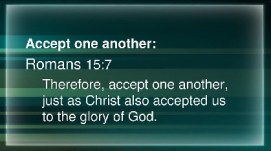
acceptOneAnotherNew2019The problem seems to be that we are unwilling to see any other viewpoint other than our own. There are those such as my wife and I that do not attend an organized church. There are those who attend a church every time the doors are open. Some attend a house church, some meet with fellow believers at cafe’s, parks or restaurants and others meet in their homes over dinner. We should accept these differences and love one another rather than argue over who is right and who is wrong.

There really is not a right or wrong way to assemble together and we need to stop expecting everyone to do things exactly the same way. We should respect others views and focus on loving them rather than expecting them to see things our way.

Things will not change until we start focusing on what is common in our lives rather than the differences. The common focus should be on Christ, the head of the body. After that we should focus on loving others rather than arguing about the differences in interpretation.

We also need to keep in mind that we are all constantly changing as God brings new truth to us. We are all learning and changing as we are ready to accept new truths. The interpretations I had five years ago are completely different from some of the interpretations I have now. I am sure in another five years they will change again as God leads me into more truth.

Sometimes we are afraid to accept others interpretations because we feel if we do not hold to our way of thinking we are compromising and not standing up for what we believe. We do not have to give up how we interpret the bible, but neither should we think everyone else is wrong. Besides, we really are not responsible for convicting people of sin,  leading them into truth or even saving them. That is the job of the Holy Spirit. We are told to love God and love others.

When we realize we are each equally important functioning parts of the body, and Christ is the head, we can start to change how we feel about those who do not see things exactly the way we do. We can begin to accept our brothers and sisters in Christ just as they are as we realize we are walking as one together with God.

by Cindy Felkel, Guest Blogger

Religion Seeks to Manipulate People

I sat through the Sunday morning service in disbelief. The preacher presented his plan for a huge building project to the congregation. Everyone was all caught up in his dream. His incredibly expensive, massive building project, dream, that was supposed to be supported by our tiny working-class congregation.

The sermon he preached was about when Jesus called Simon Peter to be his disciple. The preacher talked about how Peter caught the biggest catch of fish in his life and just left it to rot on the beach so he could follow Jesus. I wanted to stand up and shout about how illogical and emotionally manipulative the pastor was being, but I settled for exchanging eye rolls with my husband, followed by the heavy despairing sigh of “this is what church does”.

It makes no sense to think the other fishermen just cut Peter out of the profit, after all, it was Peter’s boat. But the pastor’s twist on the story fit his agenda. Thinking Peter left wealth on the beach to rot seems extreme and calls religious followers to pious extremes like digging deep to support this pastor’s vision. It makes us feel good about ourselves to think we are doing something similarly extreme to please God. It just isn’t what the story is actually about.

The real story is much harder to wrap our brains around and it’s much more freeing!

Peter Was A Religious Follower of Jesus Before he Became a Disciple

Before the catch of fish, the first encounter that is recorded between Jesus and Peter is when Jesus went to Simon Peter’s house. In the ancient world, going to someone’s house was a huge deal, it was a sign of acceptance. The people you ate with were the people you were associated with.

While Jesus and Peter were hanging out at his house. Jesus started healing people. He healed Simon’s mother in law who immediately got up and started waiting on everyone, because there was a crowd of people in the house to see Jesus. Peter was using providing for all of them.

The story goes on to say that Jesus stayed up all night healing people of various sickness and casting out demons. Peter had a front row seat to all of this.  He was obviously impressed with Jesus. At this point in the story, he was already serving Jesus by having him in his home and letting people visit Jesus there.

In the second part of the story, Jesus walks up to Peter after Peter had been up all night, fishing. He was washing his nets. He had worked all night and caught nothing. He was tired, discouraged and still had a lot of work to do before he could go home and rest. Jesus asked Peter to take him out in his boat so he could preach to the crowd of people on the shore.  Peter shows a tremendous amount of devotion to Jesus by taking him out in the boat and staying with him while he preached.

HOW IMPRESSED WAS SIMON PETER?

Chew on this for a minute: I’ve never heard any preacher that I’d stay up for after working through the night. Why? Because I can hear preachers whenever I want. America is inundated with preachers. I have gone to church most of my life. However, my exposure to religious teachers is probably nothing compared to how much Peter heard. His whole culture was built on the Rabbi system. So, he was surrounded by religious teachers and wannabe teachers. And generally, hard-working men who are tired, don’t want to hear someone preach…I can’t say how much Peter’s heart was in this particular act of service, I can just tell you, it was indeed an act of service.

THE OVERWHELMING TRUTH OF JESUS’ LOVE

After Jesus finished preaching, he told Peter to take the boat out into deep water and fish some more.

I love Peter’s reaction of explaining the obvious to Jesus: He basically said, “So, yeah, about that. See all my fishing partners over there, washing their nets? That’s what we do after we’ve been fishing all night, you know, when fish are feeding! (I imagine him speaking loudly, so everyone would know that it was Jesus’ idea.) I will do this because you told me to.”

Then Peter went out, threw his nets out and caught so many fish that he had to call to his partners (the ones who took care of the fish later in the story!)  for help. His fishing business partners brought another boat out and they filled both boats so full of fish that they were about to sink.

When they got to shore, Peter looked at the huge, miraculous catch of fish and then fell to his knees in front of Jesus.  Peter, freaked out. He said, “Get away from me. I’m unclean.

unbelievable-runandcoleforthesoul

Before this, Peter had witnessed miracles. He hung out with Jesus. He served Jesus, He obeyed Jesus. He seemed to be ready to follow Jesus.  Peter witnessed multiple demons come out of people and declare that Jesus was the Messiah only to be silenced by Jesus. That had to be more impressive than a big catch of fish.

So, what happened? Why did Peter react in such an extreme way? Why did he fall at Jesus’ feet and beg him to get away from him?


THE OPPOSITE OF WHAT RELIGIOUS LEADERS TEACH:

In order to understand why Peter was so completely freaked out by the catch of fish, you have to consider what Jesus actually did for Peter.

Before he called these fishermen to follow him, Jesus provided for their needs. The story clearly indicates that they had partners working with them. James’ and John’s father was one of the people working with them. Obviously, the partners took the fish and sold them. The huge catch of fish was a blessing for Peter, James, and John. It freed them to follow Jesus.

BUT WHY DID PETER TELL JESUS TO GET AWAY FROM HIM?

Because when Jesus provided for Peter personally, it changed everything.  Jesus entered into Peter’s life and cared about his needs. Religion finds it easy to follow Jesus when he is fixing everyone else. It’s easy to want to serve him when he’s making the world better. It’s comfortable to follow rules. Religion gives us security.

But for some reason, truly letting God love us is scary! As soon as we realize we have right standing with GOD, we know we don’t deserve it. The second we realize that he actually cares about us. He cares about you, as an individual, reading my blog, looking for freedom from religion. He isn’t a celebrity to entertain, or a deity to control, he is GOD and he wants to walk through your life with you.  That is a truth that we can’t handle. If you begin to glimpse it, there can be no response except an overwhelming sense of how much you don’t deserve it.

But that is the beauty we find when we free ourselves from religion and start to see who Jesus really is. He loves us so much that in Ephesians 3:17-19, Paul prays for believers to have POWER to comprehend this truth.

I pray that you, being rooted and established in love, may have power, together with all the Lord’s holy people, to grasp how wide and long and high and deep is the love of Christ,and to know this love that surpasses knowledge—that you may be filled to the measure of all the fullness of God.

When we truly see who Jesus is and how much he cares for us, as individuals, it’s overwhelming. If we actually understand it, there is no response possible except: I don’t deserve this!

MAKING IT PERSONAL…

I still get uncomfortable with the reality that Jesus is with me and wanting the best for me in everything I do. I constantly battle my own religious tendencies to try to gain control in this world. I want safety, comfort, and fame. But when in those moments when I  grasp just a little, that Jesus is with me, I am overwhelmed with how much I don’t deserve his presence and I’m extremely grateful that he gives it anyway. The more I see this, the more it frees me from my religion and the more it makes me want to know God’s love and share it with others.

MY PRAYER FOR YOU…

I’m praying for everyone who reads this that you understand a bit of how overwhelming Jesus’ love for us is; that you understand why Peter said, “Lord, get away! I don’t deserve your care.” I pray that you allow this love to heal your heartaches and give you purpose, joy, and peace. I hope it frees you from the control of religion. I pray that you grow in this love every day. I pray that we all represent this love well.

Blessings,

Cindy (rumandcolaforthesoul.com)

By Mike Edwards

It doesn’t matter if you believe the biblical writers/editors didn’t always understood God perfectly, or whether you believe God inspired every word of the Bible. Literature requires interpretation of a writer’s meaning and application to personal circumstances. The greatest sin among Bible people may be the sin of biblical certainty.  Scholars who respect the authority of Scriptures don’t agree on major concerns. Some believe the Bible teaches God elects certain people to go to heaven while damning others; others believe the Bible teaches God eventually saves all to enter Heaven and the traditional understanding of Hell isn’t biblical.

Does the Bible really declare some are in danger of going to a fiery pit such as Hell after death?

If such a place exists why did Paul, who wrote the majority of the New Testament, never once warn this dire fate? Why didn’t Noah who had to warn of tragic consequences for evil inform people at least once of the danger of Hell? It is questioned by scholars whether there is any Hebrew or Greek word translated as Hell that pictures what our word Hell suggests.

Does the Bible really teach that God proclaims leadership roles are based on gender than gifts?

When the Bible says: “Women should remain silent in the churches” (I Cor. 14:34), maybe the writer would encourage men to be silent in certain situations for the sake of peace. Why did the Apostle Paul say practically in the same breath that women could prophesy just like men during worship (I Cor. 11:5)? Is prophecy not speaking?

Does the Bible really teach God condemns monogamous gay relationships?

It is not natural to think a loving God condemns gays who can no more choose who they have feelings for then straights can. Scholars who respect the authority of Scriptures don’t agree God condemns same-sex relationships which don’t violate anyone’s rights. It doesn’t matter if it doesn’t feel natural to you. You aren’t gay! How we think we ought to treat gays is how God thinks about gays. Take the more loving road? Don’t push people away from God when you could be wrong.

Does the Bible really say that God is coming again to destroy the word in the future?

Why did Jesus tell his audience that supposed predictions about the world ending would happen in their lifetime: “Truly I tell you, this generation will certainly not pass way until all these things have happened” (Mt. 24:34)?” If Jesus is coming again down from the sky why did the disciples ask Jesus: “what will be the sign of your coming and of the end of the age” (Mt. 24:3)? Only non-visible, spiritual comings are missed.

Does the Bible really teach God only lets certain people get into Heaven?

Why does the Bible say: “For as in Adam all died, so in Christ all will be made alive” (I Cor. 15:22)? That would only exclude those who have never died, but last chance I checked all have or will die. The Bible clearly teaches forgiveness is unlimited (i.e. Mt. 18:21-22), but is that not true of God? Might there be second chances after death where one wishes to spend eternity?

I can’t claim because the Bible says so but personally, I am convinced Hell doesn’t exist; God wants women to pursue any role their gifts allow; God doesn’t condemn gays; God isn’t going to destroy the world; and we don’t know if there may be second chances after death when one meets their Creator and all misconceptions are done away with.

When our views of God are stumbling blocks for others, let’s admit we could be wrong. Let God work in the hearts of individuals to reveal what God is really like!

by Jim Gordon

It seems we hear a lot about change and becoming a better person in the way we live and believe. We often hear from some christian people about judgment and condemnation of others because they do not live the way they think the bible says.

I think it is time we accept people for who they are beginning with ourselves. We need to remember that we are all made in the image of God. The bible says God saw all that he had made and it was good!

BeYourself for 3-13-19

Rather than judge someone and tell them they need to change, why not do what Jesus said to do. Love God and love one another. We do not always agree but it is not up to us to tell people what they need to do or how they should live. Accept one another for who they are.

Rather than worry about what everyone else thinks just be yourself, accept yourself. Do not let anyone say you do not matter or make you feel like you need to be someone you are not.

You are not a mistake. You are fearfully and wonderfully made. God created you and loves you just as you are.

Of course, we all want to better ourselves in this life but as far as the real you, whether gay or straight, white or black, male or female we are unconditionally loved and accepted by God.

There are a good many of his followers out there that feel the same way. Ignore those who judge and condemn, they will only bring you down. Move on and seek out those who will love you with the unconditional love of God and who will accept you just as you are.