Feeds:
Posts
Comments

by Mike Edwards

It is suggested Jesus showed a better way through example and words, than the Old Testament, by dealing with enemies and relationships by non-violent means. But, would Jesus condemn a nation who sought peaceful means to resolve terrorist threats but when necessary protected themselves? Would Jesus really condemn an individual citizen who opened fire on one seeking to kill all in site in a school setting? If you would protect your own children, why not consider means to protect children in a foreign land from a dictator who enslaves them for sex and other evil acts?

It matters how we represent God when it comes to violence.

Condemning others in God’s name when we aren’t absolutely sure of God’s disapproval can drive people to unwarranted feelings of guilt with God or cause people to reject God for wrong reasons. One may think: “Why would a God who doesn’t intervene always in evil not allow me to protect myself.”  Obviously, God is opposed to beheading others for their religious beliefs. When we advise God opposes all violence, implying it is wrong to protect ourselves against evil, such words condemn military individuals fighting for freedoms or private citizen forced to protect their family or others in a dangerous situation. Does God really condemn all violence?

The Bible can’t be our only source for guiding us about God. 

The Bible surely wasn’t written to be an answer book as to what God would do in our unique situation. Jesus often didn’t answer questions directly. Jesus sought to change hearts which changes how we solve our problems. Imagine a world where all looked out for the interests of others and not just themselves when dealing with difficulties. Besides, literature requires interpretation and we don’t always agree what the writer meant speaking for God. Even the Bible tells us the Word of God has never been the Bible but flesh in the body of Jesus (Jn. 1:1-14). Jesus’ Spirit now lives in us to guide us in truth (Jn. 14:16-17; 16:13). Reading the Bible with a questioning spirit rather than blind obedience can lead to more accurate understandings of God.

Does Jesus really oppose all violence?  

As you might suspect since the Bible must be interpreted, there is disagreement about the passage most often used to advice Jesus speaks to a new way in dealing with our enemies: “But I tell you, do not resist an evil person. If anyone slaps you on the right cheek, turn to them the other cheek also…You have heard that it was said, ‘Love your neighbor and hate your enemy.’ But I tell you, love your enemies and pray for those who persecute you (Mt. 5: 39, 43-44). I just don’t know anyone in their right mind that would advise a wife being beat by their husband to turn the other cheek or not protect themselves. It is possible the literal translation of Mt. 5:39 is “do not resist by evil means” which is more in line with Rm. 12:17: “Do not repay anyone evil for evil.”  

I am opposed to pulling verses from the Bible to prove a point, but there are passages which can suggest God is not opposed to protective violence. In Acts 23 the Apostle Paul, who wrote much of the NT, defended himself quite strongly and then requested military protection from being killed by religious leaders. Jesus didn’t exactly turn the other cheek when struck while defending His innocence (Jn. 18:22-23). Parables are not meant to be taken strictly literally, but one might think if Jesus was opposed to all violence His teaching would have less violent metaphors (i.e. Mt. 13, 18, 25; Mk. 12; Luke 20). Evil is real and may require a violent response.

What we can know for certain about God and violence.   

The majority may agree that God would oppose violence if more peaceful means were available to individuals or nations. More often than not violence begets violence. If we are always looking to meet violence with violence and never consider peaceful means, there will never be room for changes of heart and forgiveness. But, if you think niceness always begets niceness and a soft answer always turns away wrath, you may be leaving a slew of victims behind. In fact, some may only change when forcefully confronted with the pain they are causing. Though we may not know exactly what God would do in each situation, human shortcomings suggest violence should be our last option. If you are anything like me, I am quick to defend myself and confront others without consideration of other possibilities.

Lack of certainty what God or Jesus would do doesn’t have to lead to chaos.

Supposed certainty in the name of God has led to justifying genocide, sexism, homophobia, racism, and other atrocities. Being unable to declare the certainty of our opinions about God forces us to listen, think carefully, and come to an agreement. I don’t always know what God would do in personal or national situations. I do think the Bible as a whole encourages not seeking revenge and praying for ways to change hearts. I can’t say God would never advise a nation or individual to meet evil with force.  Future lives may be saved. I do think the Bible as a whole encourages exhausting all peaceful ways possible. God surely desires a world where all look out for the interests of others and not just themselves when dealing with difficulties.

Kayfabe Christianity

by Rocky Glenn

Though I cannot remember the exact year, ever since I heard the opening bass riff of Queen’s “Another Bites the Dust” and saw Sylvester Ritter walk down the aisle with a chain attached to the dog collar around his neck as The Junkyard Dog barking at his opponents, I have been a fan of professional wrestling.  From rushing through homework to catch the regional broadcasts on ESPN daily after school, I despised the defiant rule breaking of Jim Cornette’s Midnight Express as they fought Robert Gibson and Ricky Morton.  On Sundays after church, I would stand right in front of the nine inch black and white television in my bedroom trying to get the antenna in just the right position to catch the local broadcasts of “Bullet” Bob Armstrong and The Tennessee Stud facing off against The Dirty White Boy and Tom Prichard.  I hated Shawn Michaels after he kicked Marty Jannetty through Brutus “The Barber” Beefcake’s barbershop window, yet five years later when that same Heartbreak Kid had to forfeit his championship belt because he had “lost his smile” I was heartbroken.  I remember the parade down the streets of Disney World as Hulk Hogan made his triumphant arrival in WCW, and, of course, was just as shocked as the rest of the world when wrestling’s greatest hero made wrestling’s greatest heel turn with the creation of the nWo. I have feared The Undertaker, smelled what The Rock is cooking, yelled “Wooo!” with The Nature Boy, had two words for D-X and given Stone Cold a “Heck Yeah!” (Remember, I was a church boy.  I couldn’t dare say “Hell Yeah!”)  Minus a period of just a few years, wrestling has been and continues to be a part of my entertainment consumption whenever it is broadcast and has now become an activity we share as a family.

I see wrestling as a type of theater.  The wrestlers are nothing more than highly trained, highly athletic actors who have spent years crafting and perfecting their skills that allow them to take the hits, falls, and bumps in a manner to protect not only themselves but their opponents.  When they yell, scream, and shout at each other on the mic, it’s only after they’ve spent time in class learning how to cut a successful promo that not only spurs the ire, agitation, and opposition of those they are speaking to or about, but also controls the emotion of the crowd and furthers the story line of the current angle they are working.  Every single aspect of a wrestling event from the lights, pyrotechnics, and music to the commentators, ring announcers, and referees are for one purpose and one purpose only . . . to get the audience to believe and buy in hook, line, and sinker!  All of these things are determined by the promotion’s booker.  The booker is the man responsible for deciding which wrestlers will be liked or hated, how long matches will last, and even the outcome of the matches.  If a wrestler is playing a heel, his job is to make you hate him.  The more you boo him, the better job he’s doing.  The opposite is true of a babyface.  He’s supposed to be the crowd favorite and make you love him.  Your applause and cheers are what he is after.

So, what’s the point of all this?  Am I feeling so guilty for not writing in a while that I just feel the urge to confess my guilty pleasure?  Is this just a walk down memory lane?  Actually, it’s neither of those things, although I enjoy reminiscing about all the events above and also truly enjoy the reaction received when people find out about our family entertainment.  As we began rediscovering and introducing the kids to sports entertainment a couple of years ago, the similarities between this sweet science that I have watched, loved, and shared with grandparents, my dad, and now my own family and the traditional church life I was feeling myself drawn away were too many to ignore.

As church attendees, we have perfected our performance.  Come in, flash a smile, shake a few hands, maybe give a hug or two, take me seat, play my part, and pretend I have no problems for an hour.  I will stand when you say stand, sing when you say sing, remain silent when I’m supposed to listen, and most definitely pay my admission when the offering plate is passed.  I will do my part to ensure the program goes as planned and give my money to be certain the program will go as scheduled again next week.

As a musician, not only have I received instruction in how to be sensitive to the response of the congregation, I’ve taken pride in my ability to read and respond to the emotion of the moment.  Although it was important to follow the printed color-coded order of service that was prepared to ensure every minute was accounted for, I knew to keep a watchful eye on the front row to receive the nod to continue or signal to play it again or wrap it up from the pastor.  I’ve received requests, and complied, on numerous occasions to play or sing a certain song with the intention of soliciting a desired response or altar call.  It was only after years of playing and, dare I say, performing that I was afforded this kind of trust and power.  I had to prove trustworthy to those in charge before I had the opportunity to lead the service.

When it comes to professional wresting, the most common reaction we receive is someone looking at us and saying, “You know it’s fake, right?”  The question is not a matter of wrestling being fake.  Ask anyone who has ever climbed into the squared circle, fallen on the mat, or bounced off the ropes if the pain and bruises they experience is fake.  For the most part, wrestling is planned, choreographed, and scripted.  Those in the business use the term “kayfabe” to refer keeping the secrets of the wrestling business. Exposing the inner workings or secrets of the wrestling business is said to be breaking kayfabe.

It is time we as Christians break kayfabe.  It is time to admit, as a good friend put it just days ago, that we’ve taught tradition as the commands of God for too long.  It’s time to question why we do certain things.  Are we performing to protect a tradition, an institution, something we’ve done our entire life just because we’ve been told to it?  Are we seeking to keep others out because they are not experienced or have not yet proven trustworthy?  When we read Jesus says, “Come to me all . . .”  do we really believe that means all . . . regardless of gender, race, intelligence, sexual preference, economic status?  In breaking kayfabe, we must admit we don’t have it all together.  We must admit that for too long we’ve played a part.  We must be real.

Wrestlers are performers . . . Christians shouldn’t be.

Rocky

(This post originally written September 4, 2017.)

By Jim Gordon

Those of us who are outside the walls of religion and institutional church have found a freedom we sometimes cannot explain. At least we cannot explain it in a way that people who still attend a church building will understand.

The problem is those who still attend the traditional church do not accept the fact that everyone is different and sees things in various ways. They usually want to stay away from us or talk about how we have backslidden and fallen away from God because we do not do what we have traditionally been taught was godly.

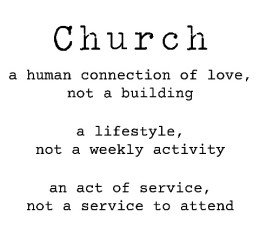
Nothing could be farther from the truth. We are worshipping and loving God just as much as before only in a different way. We have not left the Church (ekklesia) but we have left the building (church). Jesus is building His Church out of ‘living stones’ not brick and mortar.

My wife and I left the church because we felt the system was not the way God intended, yet we never left the true Church which is made up of all of those who are believers.

Each of us has an equally important part to play in the body yet no one is the head or over anyone else. Each of us are kings, priests and functioning parts of the body and we are all needed and important. Of course, only Jesus is the head of his Church not a pastor.

Those of us who have left the traditional church service are often told we need to attend because we should not forsake the assembling of ourselves together. Yet this verse does not mean we have to be in an organized, pre-planned service led by a pastor and a worship leader. It is saying we need our brothers and sisters in Christ. Whether we meet on a Monday at a café, Tuesday in a home, Thursday at a bar or Friday in a park makes no difference. Jesus said for where two or three gather together in my name there I am in their midst.

For us true and meaningful fellowship happens each and every day when God brings us together with a brother or sister, or when we meet up with another couple for dinner. It also may be a time of one-on-one fellowship online with a brother hundreds of miles away yet bonded closely through the Spirit.

Church1a

We are so conditioned to think of the church building and its events and happenings as the main way of fellowship and learning. Although we are told in the bible that when we come together each of us should have a word, or a song, or a praise. How often does that happen within the institutional church? Yet being outside the walls my wife and I have found this to be the norm. We all talk, we encourage one another, learn about each other, pray for one another and we support and care for each other. Fellowship is everyone having a part to play and everyone being open and talking about what God is to them. Sitting quietly in a church service does not fulfill what God intended fellowship to be among his children.

We should remember that rather than having a feeling of ‘us vs them’ mentality those of us who used to be part of the institutional church should also keep in mind that those who attend church are doing so because they love God and think they are doing the right thing. We are all children of God, whether we are in the institutional church or out of it. We are all parts of the Church that Jesus is building.

For those still attending, most do not think about how the system is wrong and is not what God intended for His people. After all, this is all we have known all our lives. We have been taught all along that this is God’s plan for us, to assemble together in a building, pay our tithes and look to the pastor as God’s spokesperson. I know I believed this for many years while within the system.

As people of God we are to love God and love others. We cannot do that in our own strength it is by the power of the Spirit within us. The sad thing is we should not have a problem loving our brothers and sisters in Christ. Yet sometimes it seems we have more trouble loving those who are part of a tradition that we no longer feel is right, but are still followers of the same God we love.

I pray that all of us can keep in mind that we are children of God, saved by grace and living in His kingdom now. Whether we are ‘in church’ or outside the walls, let us focus on our love of the Father and for one another. The world needs to see the love of God in action among His children. They do not need to see arguing, fighting and disrespect that is so familiar among Christians today.

by Mike Edwards

Do you hear things about God that lead to not wanting to even bother with God? Are you a person of faith but some teachings about God create questions or difficulties in talking about God to others should the subject naturally come up? I heard teachings about God in the church that just didn’t seem true of a good or loving God. It is only human nature to have a close relationship with those you respect. Why wouldn’t that be true of our relationship with God? Maybe we shouldn’t believe everything we hear about God!

What can we know about God?

Even scholars can look at the same passages in Scripture and come up with different interpretations. Jesus spoke in hyperboles and metaphors which can lead to vastly different interpretations. Besides, the Bible can’t be the only way to know what God is like since over half the people born in this world never had a Bible to read. We all seem to have an inborn desire to treat others like we want to be treated – there are “oughts” in our relationships. God surely has given us a moral, intuitive sense what a loving God must be like.   

God can’t possibly be a homophobe.

It makes no sense to me why God would condemn gays when they can no more choose who they love than straights can. Just ask heterosexuals or homosexuals. Some only condemn gays because they are convinced the Bible does. I have written here to please reconsider that the Bible doesn’t condemn gays. We know the psychological harm done when one must hide their sexuality because of bigotry and hostility. So, shouldn’t we be guided by love – how should I treat others if I had the same non-choices?

God can’t possibly be a sexist by favoring men in leadership positions.

God surely knew what many of us sense – appointing men as authority over women can encourage dominance on the man’s part and dependence on the woman’s part, which can be conducive for domestic abuse and the other atrocities women face at the hands of men. Women don’t need male leadership in marriage; women need men who have the heart of a servant (Eph. 5:28-29). When the Bible says: “Women should remain silent in the churches” (I Cor. 14:34), maybe the writer would encourage men to be silent in certain situations for the sake of peace. The same writer had just assumed women, without condemning, could prophesize during worship (I Cor. 14:34). See here for rethinking if God is a sexist!

Hell!

The Bible says nothing about the traditional understanding of the word Hell. Hell seems to be an invention over the centuries to scare people into submission and obedience. Our traditional understanding of Hell is no more a translation of the Greek word Gehenna (the name of a real valley near Jerusalem) in the New Testament than Atlanta is for Chicago. Why would a loving God torture anyone forever since such pain serves no lasting purpose? Humans wouldn’t even create such a place for their worst enemies!

Can God be dogmatic about which religion you choose.

The majority of people born in this world have never heard of Jesus in the Bible. Suggesting a loving God insists one can only come to God through Jesus is to ignore the realities of our world. The vast majority of people born choose or rebel against the religion where they are born, whether be Christian, Muslim, Buddhist, etc. Those who have heard of Jesus often have a distorted view of God. When the Bible speaks of being saved, it isn’t about escaping hell and going to heaven but allowing God to help avoid self-destructive ways for our own best interests. Do you believe that? 

God doesn’t encourage hidden agendas in relationships.

People often avoid God-folks because they can smell a hidden agenda a mile away. It simply is wrong to engage in friendships with others for the purpose of converting them to believe as you do without advising them upfront of your agenda. God-folks struggle to talk about God, for how do you explain a good God is supposedly a homophone, sexist, or sadistic torturer. It turns out God wants for our relationship what we want – not a means to an end (conversion) but an opportunity to share life and love one another.

God can’t be a religious extremist.

Extremists wish to force you to believe what they think is true of God according to some Book. What is not acknowledged is literature requires interpretation so their understanding may be wrong. A truly, loving God would never force one to love but give the freedom to love or reject Them. Forced love is an oxymoron. You can’t get enough of a person or God because you have so much respect, not because you are commanded to love. Love by force only leads to brief obligations out of guilt.

God is not cruel by being invisible and inaudible.

If God cared why doesn’t God make their Presence obvious? God’s awing or overpowering presence may only lead to fearful obligations to obey. When parent push their agendas, even if in their children best interests, they may rebel against coercion and never turn back. If God communicates in less demonstrative ways, this may more allow moral development for lasting convictions. A Creator may not reveal themselves for reasons we haven’t thought of and would accept in time. The road traveled of learning, reflecting, and freely choosing personal convictions may better lead to heart-felt lasting choices that turn out to be in our best interests.

Imagine God really is good news!

Listen to your moral inner voice. You may be right about God! If God claims to be Love and encourages us to be perfect like God (Mt. 5: 48), how can we follow in God footsteps unless God has empowered us somehow to know. And what loving Parent, earthly or heavenly,  doesn’t seek to help you be the best you can be for your best interests and the interests of others!

Meet Our New Author

by Jim Gordon

I would like to announce that we now have an additional author for Done with Religion.

Rocky Glenn has agreed to be an author and to contribute some of his writings to Done with Religion. I think you will enjoy his interesting articles.

Rocky also has his own blog site which you can check out at https://recoveringchurchboy.blog. You can learn a little more about Rocky and why he writes here.

We are certainly glad to be able to add Rocky’s informative articles to Done with Religion.

by Mike Edwards

How can we know God even exist?

I’m not sure why some are inclined to believe in a Creator more than others. I am not always a better human than some who don’t believe in God; I do know I am a better man with God’s influence. Don’t reject God because you can’t believe what others claim about a loving God. They may be wrong! It takes faith to believe that God or Heaven exist or that “we live and we die.” I am convinced my belief in a loving God isn’t wasting my time on earth.

How can we know what a relationship with an invisible God is like?

If there is a Creator, it is plausible they instilled in their creations a way to know them. An invisible, loving, perfect God – which most demand if One claims to be God – could reveal themselves through perfect human love. God is like a perfect human parent! God or parents don’t ask for worship or respect for egotistical reasons, but so we might become more like them. A relationship with God is surely better than any amazing human relationship we wished we had.

So, what is perfect human or Godly love like?

Until we believe God is worth respecting, we will never have the relationship with God we desire.  When loved by another person you deeply respect and care what they think, you feel total acceptance not judged. You can never get enough of their wisdom, but you never feel forced in what decision you make. I so long for a relationship with a older person that I have a deep respect for, so to grow more in wisdom. You just cannot get enough of humanly or godly perfect love!

What God doesn’t promise in a relationship?

I don’t like to make promises about or for God. I can tell you that the prosperity gospel is miserably false. A person who believes that all their troubles will be swept away through a relationship with God is left with the logical explanation that God has failed them. Why don’t these false teachers take their message to those in extreme poverty or go to hospitals and heal the sick? The Bible is clear that lack of faith is not the reason for physical ailments or economic hardships. In my experience I can promise you once you understand God you will be a better person than you were.

What may be God’s greatest promise in a relationship?

Think of God’s Spirit residing in us as other influential voices in our lives. God promises to influence and empower us to be the perfect partner, parent, or friend we desire to be deep down. We know the Spirit’s influence when we have wronged someone, we quickly confess and make amends. That just isn’t always natural. We know the Spirit’s influence when we don’t seek to control our friends or children. Such freedom leads to heart-felt lasting choices, not brief obligations to obey motived by fear or guilt. God speaks to when we hear: I love you; I forgive you; I won’t abandon you.

God isn’t offended you thinking what’s in it for me!

God seeks to encourage not condemn, so we might be the person we deep down desire to be. A relationship with God empowers us to be more like God. God isn’t pissed if you ignore them any more than a loving mom or dad is. They will do whatever it takes to convince you they love you and have your best interest in mind. They seek to influence you and your relationships for good.

by Jim Gordon

I would like to take a minute and announce that we now have an additional author for Done with Religion.

Mike Edwards and I have been communicating and talking about things and we seem to have quite similar views.

I have asked Mike to be an author and to contribute some of his writings to Done with Religion. I think you will find his writing to be enjoyable and informative.

Mike also has his own blog site which you can check out at https://what-god-may-really-be-like.com/  You can learn more what about what Mike believes/enjoys to write about here and how to best navigate his site here. 

We are certainly glad to add his interesting articles to Done with Religion.

by Jim Gordon

You may have noticed that many christian people seem very quick to judge and condemn others. If you are not a traditional, church attending christian or not a believer at all you probably notice it more than others.

When reading the bible we find that christian people are to be known for their love for God and their love for one another. Not only fellow believers but those who do not believe or see things the same way.

Unfortunately, we do not always see such actions. We see more backbiting, judging, condemning and anything but love. So much that many times those outside of Christianity see no reason to pursue it any further.

Over the centuries God has often been misrepresented by many of his followers causing a lot of questions and problems with people having any interest in being his follower.

Jesus is the representation of God the Father. When we read about Jesus in the gospels we see that he treated people, not by judgment and condemnation but with love, healing and forgiveness. He taught about the good Samaritan, the prodigal son and many other parables about God being loving and accepting.

OneAnotherFacebook

Rather than listening to other people tell us what God is like and what Christianity should be, we need to start asking questions, seeking answers with the guidance of the Holy Spirit and realize that God is a God of love.

Today we seem to spend more time worrying about which denomination to belong to, which bible version to read, what doctrine to follow and which political party is the one to support. Once we make a choice we will fight to the end to defend our point of view no matter who we hurt in the process. We seem to be concerned with everything else rather than following the example of Jesus by loving God and loving others.

It is a known fact that we will not always agree with one another, but there is no reason to be spiteful, condemning and judgmental when we should be loving, kind and accepting.

Loving others, respecting others and being accepting does not always mean we always agree but we can show the love of God to everyone no matter if we see things the same or not.

by Jim Gordon

Is it our job as Christians to convert the unsaved? Are we to force our views and beliefs on others so that they might come to God? My answer would be no.

We are to follow Christ and love others. We are to let the Holy Spirit convict and lead people to the Father.

GoodNews

We cannot convert others. We cannot make them come to Christ by forcing our views and beliefs on them. Only the Holy Spirit can convict the world of sin and lead them to repentance.

So often we are taught we need to use every opportunity to preach salvation to everyone we meet. We end up using sneaky methods to force conversations trying to convert others. We are told their blood with be on our hands if we do not tell them about Christ. I feel loving others with ulterior motives is wrong and does more harm than good.

Jesus said to love God and love others. Apart from that we have nothing more to do than to be available to Him and allow the Spirit to work and love through us. If we are talking with someone or enjoying their company, there is no need to force the topic into trying to convert them. If the Spirit so chooses to use us, we are to be available but we are not to force the issue.

We are called to make disciples, but disciples would be those who already have a relationship with Christ. The dictionary describes a disciple as ‘a professed follower of Christ’. We are to be there to encourage and build one another up to grow into maturity in Christ.

The good news is that God loves us. He has provided freedom from the effects of sin and has restored fellowship between God and his creation. By being judgmental, pointing fingers, threatening and using other means to force others to accept Christ, we end up driving people away rather than draw them by love.

GodIsLove

When we show the love of God to others and accept them as they are, people will be drawn to Christ easier than through condemning and threatening ways. This does not mean we have to agree with everyone or say you can live anyway you want with no consequences. Yet we can show the love of Christ to non-believers and accept them without expecting them to change and start acting like we think they should. God accepted us as we were before we came to Him and we should do the same. If there is any changing that needs to be done, that will be between God and the individual through the guidance of the Spirit.

In love, share the good news to those you meet when led by the Spirit. Encourage and make disciples of those who know Christ. Stop trying to force salvation on non-believers through ‘holier than thou’ attitudes, guilt and condemnation. Love is the answer, and God is love.


by Jim Gordon

We hear the word fundamentalism a lot in the christian world. I actually grew up as a fundamentalist but never realized that was what I was because I never put much thought into all the different terms and labels. I just loved God and went to church because that was the way I thought we lived the christian life.

When I looked up the word fundamentalism in the dictionary I found the following definitions: 1. a conservative movement in theology among nineteenth and twentieth-century Christians. Fundamentalists believe that the statements in the Bible are literally true. 2. in Christianity the belief that every word of the Bible is divinely inspired and therefore true. 3. a religious movement characterized by a strict belief in the literal interpretation of religious texts, especially within American Protestantism and Islam; the beliefs held by those in this movement; strict adherence to any set of basic ideas or principles.

Fundamentalism

Now that I know what fundamentalist means, I no longer believe I would be considered one. My views, beliefs and interpretations have changed so much over the years, especially since leaving the organized church. For some reason I never felt comfortable asking questions while in the organization. I just took what the pastor said as gospel truth and never questioned anything. Being outside the walls of religion I am letting all those questions come out and seeking truth from the Spirit of God rather than from a pastor.

I believe fundamentalism leads more to separation, condemnation and being judgmental. It seems to me being so set on specific doctrines, beliefs and interpretations can prevent us from asking questions, learning, accepting and loving others.

Are my thoughts a popular way of looking at the christian life? Of course not! I grew up in the organized church from a very young age and spent nearly sixty years in it. I also used to think everything depended on my works such as attending church, tithing, doing good works and reading the bible and believing it was perfect, completely literal and the only way God spoke to us today. There are many people still doing all this and they sincerely love God and think this is the way we are to serve God. Yet being outside of this setting, I have seen what is for me a better way. A way of depending on the Spirit within to teach and guide us. A way that loves and accepts others even when they do not see things the same.

Today the term fundamentalist christian seems to have more of a meaning of being hateful and not being accepting of others views. Completely different from what Jesus taught and what God is like.

Jesus was not a fundamentalist, he was not even a christian. Jesus was the personification of the Father who is a God of love. Even those writings from the old testament where men wrote from their beliefs, ideas, interpretations and what they thought about God were shown to be wrong when Jesus arrived. He showed us that God is not a god of vengeance, hatred and murder but a God who loves all of us.

We are to love God and love one another. Loving our neighbor does not mean just loving those who live next door, or loving those who believe like we believe. Our neighbor is everyone else in the world. Seems to me most fundamentalist reject those who see things differently and prefer to stay away from those who do not believe the same.

I would rather be known as a follower of Jesus rather than a fundamentalist christian. The way of the law and following rules and set doctrines of men have come to an end. The way of loving one another because of the grace of Christ is the new covenant way. I have actually become quite tired of using labels at all. We are all human beings who are loved by God. We should all be treated with love, respect, acceptance and have the same rights as everyone else. God did not create some people better than others, we are all created in His likeness and are loved by Him.

There are so many topics and beliefs I grew up learning in the fundamentalist church that I no longer accept. I certainly have not lost my belief in or love for God, yet the many interpretations that were taught by men and women in the institution I now find wrong and not like Christ.

Rather than adhere to a set of rules and institutional-taught beliefs we are to submit to the guidance of the Holy Spirit that lives within us. Learn to hear his voice and let your life be a daily communication of his love to others.