Feeds:
Posts
Comments

Posts Tagged ‘Bible’

By Mike Edwards

There is so much civil unrest because both sides demonize one another by insisting they are right and the other side is wrong. Can you imagine if couples acted this way when disagreeing? God-followers and religious leaders seem hell-bent in telling people what must be believed about God according to their understanding and interpretation of the Bible. Open-minded uncertainty rather than supposed certainty could go a long way to healing our nation and personal relationships!

Certainty about God because of the Bible

It is circular logic to suggest the Bible is infallible or inspired by God because biblical writers make such a claim.  Writers could have clearly misunderstood God. God’s nature is not to control thoughts and words of writers. Besides, the Catholic Bible has seven additional books in the Old Testament than the Protestant Bible. Which books are supposedly infallible? The Bible isn’t a question and answer book. Jesus didn’t always answer directly because the issue is our heart in solving problems. Can you imagine a world where all looked out for the interests of others and not just themselves when facing difficulties?

Certainty about our interpretation of the Bible

It is not often admitted one’s interpretations may be wrong but instead emphatically stated “the Bible says…” Literature always requires interpretation of a writer’s meaning and application to our personal circumstances. Scholars and laypeople, who even respect the authority of Scriptures, frequently disagree on the meaning of the same passage. Turning the other check is interpreted to claim Jesus never advocated violence, but the possible literal translation of Mt. 5:39 is “do not resist by evil means.” Is violence never desired but necessary sometimes?

Certainty about what is best for individuals about their relationships

Bible folks and non-Bible folks frequently talk as if knowing what is best in one’s circumstances, whether about personal or work relationships. It is easier giving advice than listening and helping one make their own decisions. Bible-folks claim one shouldn’t divorce because the Bible supposedly says so. It’s complicated. A partner may respond with gratitude for a second change or another chance may simply enable bad behaviors to continue.

The Bible is quoted that we must always forgive, but God is often said to not forgive the rebellious (i.e. Josh. 24:19). It’s complicated. Easy forgiveness can allow a husband’s abusive behavior to continue. When a sexual abuser doesn’t acknowledge their actions, secret behaviors continue. Victims can feel more victimized, and feel God must not understand their pain, when told to forgive despite their abuser denying any wrongdoing. Isn’t the whole point to do whatever helps control bitterness to stop the victimizing?

Certainty about what is best for a nation

God-followers must stop implying or claiming moral superiority because of the Bible for reasons stated. Thankfully, we live in a democratic society. We don’t have to vote if murder should be a law because one’s physical rights are clearly violated. Physical violence when disagreeing is obviously wrong and must be condemned, but it isn’t obvious if building a wall is right or wrong. Discussions best start with what parties agree on. Until we stop claiming morality according to a Book or our own intuitions, we will never be able to solve our differences. It is a dictatorship when we impose our will on non-moral issues such as health care or taxes.

Uncertainty, not certainty, can lead to creative solutions not chaos.  

  • We must first stop claiming our views are morally superior to those we disagree with
  • We must handle differences with physical and emotional civility
  • We can begin conversations by looking for areas we agree
  • We can discuss differences by defending our reasoning, respecting the opinions of others, and committing to growing in understanding
  • In a democratic society the vote of the majority must be followed until voted on again


.


Read Full Post »

by Rocky Glenn

I was raised with a father and mother who loved my sister and me and were not shy about letting us know it.  Does this mean they were perfect and didn’t mess up?  They would each be the first to admit that’s not true, but as I get older and learn more and more about being a parent myself I can look back and see many instances of their love shining through.  As a boy, I struggled immensely with fear to the point of hating nighttime and going to sleep because my mind would simply not turn off and I would lie in bed traumatized by the nightmarish images running rampant through my head.  It was not uncommon for me to lay in bed and scream to the point of echoing through the house.  To overcome these fears, my mother taught me, “God has not given us a spirit of fear, but of power, love, and a sound mind.”  For a brief period of life, I lived alone with my dad.  We spent many days after school throwing frisbee in the front yard, flipping a paper football across the dining room table we had lined with masking tape for yard lines, or leaving the television screen turned on to prove to the other their previous high score playing Donkey Kong had been broken.  I never realized until becoming a parent myself how tired mom must have been dealing with a scared kid night after night each night hoping maybe tonight would be the night he finally rests or how many other things dad could have been doing instead of spending time with me.  I have been blessed by two wonderful people to call mom and dad.

Over the past week, through the writings of Anabel Gillham I have been reminded of the fatherhood of God.  Prior to 2016, I was unaware of Anabel, but during that year I discovered a collection of writings from her and her husband organized into the Lifetime Daily Devotions reading plan in the YouVersion bible app.  It’s a year long plan, so I followed the plan daily in 2017 and have since restarted the plan for 2019.  Several of the writings for the year thus far have discussed the nature of God as a father, and recently I shared Anabel’s words below on social media along with the accompanying image:

49586743_10157247516095139_5680657714309496832_o

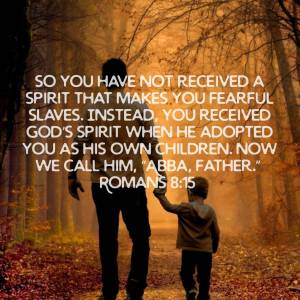
Do you know what Abba means? It’s the Greek word for “Father.” It “approximates to a personal name,” kind of like “Papa.” It is “the word framed by the lips of infants” and by older children “expressing [their] love and intelligent confidence” in their father.* Jesus came, talking to God and about God. But He didn’t call Him Jehovah. Or Elohim. Or Adonai. Or El Shaddai. Or any other of the names that the people called God. No, Jesus came and called Him Abba, Papa, Daddy, Father.

In the book of Matthew, Jesus addresses God 43 times as Father. He took an awesome God, a fearful God, an unapproachable God, a God who was known to strike out when He was not obeyed, the God of the Old Testament . . . and He introduced us to a loving Father.

God is a loving Father and that’s what Jesus came to show us.  He reminds us of this on multiple occasions by addressing him as such.  To further emphasize this, he plainly tells us that us in Mark 10:15, “I tell you the truth, anyone who doesn’t receive the Kingdom of God like a child will never enter it.”  To understand what Jesus was saying, we must clarify the phrase “like a child.”  Here’s how Anabel describes it:

With no reservations, no preconceived fears or doubts.

“Looking up” to Him — from a child’s perspective. He is big and I am little. He is strong. I am weak. He will hold me in His arms. He will hold my hand. He will know what to do. . .

Ready to listen and to ask questions, but not to express her views or to argue with Him about His views. Giving Him the responsibility of caring for her. Indeed, expecting Him to care for her. Trusting Him to care for her. Reaching out to touch Him. Holding His hand for security and comfort. Resting in His lap. Putting her arms around His neck.  Being excited to see Him and be with Him. Knowing that He is wiser than she is. Knowing that He is stronger than she is.

Although I was raised by two parents who loved me, I realize the images presented above may be difficult to visualize for those whose father (or mother) was absent in their life or who may have grew up in an abusive situation.  Given the circumstances of such situations, I’ve often wondered why God chose the parent-child relationship to illustrate his love for us and our relationship.  The one thing no one will ever have the power to change is his or her mother or father.  Many children’s lives have been changed through the power of adoption or the way a step parent or foster parent may have stepped up and filled in for another’s absence and actually became a mom or dad, but, despite the manner we experience parental relationships, nothing will ever change the identity of our biological parents.  I will always be the son of my father and my mother no matter who I would have called mom or dad.  There is nothing my son or daughter could ever do to not be mine and cause me to not love them.  I believe this unchangeable nature of the fatherhood relationship is what God is wanting us to grasp onto and it’s why Jesus came.

Jesus illustrated the father’s never ending love in the story of the prodigal son who asked for his inheritance prior to his father’s death, squandered the inheritance given to him, and returned home with his head buried in shame prepared to beg for a job as a servant only to have his father welcome him home with open arms and celebrate by throwing a feast.  Although the returning son was fully prepared to forfeit his place in the family and anticipated having to do so, the loving response and welcome of the father assured him he would always be a son. The tragic part of the story lies in the reaction of the older brother who never left home, worked for his father for years, and out of anger refused to attend the party for his returning sibling claiming his father had never thrown such a shindig for him.  I can only imagine the pain which pierced the father’s heart and sobering look on his face as he explained to his eldest son you have always been with me and all I have has always been yours.

Life as a churchboy is the life of the prodigal’s older brother.  The words of Anabel are applicable to such a life:

How we have structured and formalized (and, in so doing, ostracized) the Father that Jesus wanted us to know! For our conversation with Him to be “pleasing,” we have been told we must “look just right,” assume just the right posture, be in the right place at the right time, say just the right things, use the prerequisite Thee’s and Thou’s — and that only then will He really consider honoring our prayers.

Catching glimpses of God as a loving father who would never stop loving me or deny me as his son and realizing he had already provided all he has through Jesus is what was ultimately the beginning of the end of my life as a churchboy.

Rocky

Read Full Post »

By Mike Edwards

It is difficult for many to be drawn to a God that has anything in common with the God of terrorists. I am not saying Christians believe in resorting to beheading unbelievers. It is sensible though for all God-followers to consider any of their portrayals of God that look anything similar to terroristic views. A good God couldn’t possibly have anything in common with such views.

We must avoid all appearances that a good God is solely determined by a Book.

The idea of an infallible Book seems to shut down questioning and common moral sense. An infallible Book would not be so dangerous if extremists acknowledged literature is subject to interpretation, thus their interpretation cannot be proclaimed as “certainty” in God’s name. We must always openly admit our interpretation could be wrong, thus allowing personal views to be challenged.

Let’s avoid suggesting a loving God would deny freedom of beliefs.

One would think a God who is powerful enough to create, unless a respecter of freedom of beliefs, would annihilate immediately those who choose evil and oppose God. God’s love in the Bible is most frequently compared to that of a human parent. No human or spiritual parent brings children into the world desiring their children not freely reciprocate their love as opposed to being forced. Forced love is an oxymoron. A good God couldn’t possibly want to control beliefs through fear.

Let’s avoid suggesting a loving God tortures unbelievers before or after death. 

Delayed torture is still torture in the eyes of many. We mustn’t claim Hell is real according to the Bible because biblical scholars don’t agree Hell exists in the Bible. Most humans wouldn’t even create such a place for their worst enemies! The word hell is a substitution not translation for certain Hebrew and Greek words and seems invented over the centuries to scare people into obedience. It is important to defend God respects the right to choose your own personal beliefs in this life, and God does not torture people after death for such decisions. 

Let’s avoid claiming a loving God’s view of women hints of inequality.  

I am not suggesting some Christians are saying Paradise is a lustful adventure for men at the expense of women, but it is important to not be dogmatic that the Bible teaches women are under the authority of men in the God of the Bible eyes. This can encourage dominance on the man’s part. Women and men surely need unselfish partners who have the heart of a servant. Some religious extremists would rather be dead than advocate for that. We must avoid proscribing gender roles which more frequently are used to oppress women than men.

What can Christians be certain of about God?

All religions must differentiate themselves from terrorist or extremist views to avoid misunderstandings about a God worthy of trust. Jesus simply wanted us to know God was the kind of Creator or Parent desiring a friendship to encourage a journey of shunning evil and doing good. Our views must encourage loving others like we want to be love. Accepting the freedom of beliefs, if not physically harmful to others, is foundational. A good God surely respect freedom of beliefs in this life and life to come and encourages roles according to one’s gifts not gender or race.

Read Full Post »

By Mike Edwards

I recently wrote here why a fair-minded person may think God approves of women being restricted from roles men are offered. Many opposed such equity because of bigotry but bigots don’t read spiritual blogs. It is so important how God-followers represent God.  The good news is what is often said about God may not be true. There may be similarities as to why fair-minded people think God favors roles according to one’s gender and why God condemn gays.

Many people of faith only condemn gays because they think the Bible does?  

Many of us were taught to believe God condemns gays because the Bible says so.  Some may be unaware biblical scholars who respect the Bible believe Scriptures do not condemn gay monogamous relationships. See  here. The bigger argument though is that no one can claim God condemns gays because the Bible says so. Literature require interpretations and we disagree. One main reason fair-minded people condemn gays is because of a misunderstanding of the Bible, thus misguided devotion to God.   

Some may also argue God condemns gays because homosexuality just isn’t natural.

You don’t have to be gay to understand one can no more control their feelings toward those of the same sex than you can control having feelings toward the opposite sex. It doesn’t matter if it doesn’t feel natural to you. You aren’t gay. Let’s don’t cause others to keep secrets at the expense of their mental health. God-followers must always use their hearts and minds when loving others by being non-judgmental and putting themselves in another’s skin.

It is argued the world could not have populated in the beginning! We are no longer in that situation and the world will continue to populate because not all couples are gay. We have unwanted children who need loving couples. Is adoption by a same sex or different sex couple not a better situation than groups homes or orphanages? Many gay couples are far better parents than many opposite sex parents. Don’t worry! Loving couples don’t try to scare a child straight or gay.

How can we know what God thinks about gays?   

If God exists even atheists agree God must be morally perfect. The best way to understand God’s moral perfection is through our thoughts of human perfection. How we think we ought to treat gays is how to know what God thinks of gays. The test for human or godly morality is if treating others like we want to be treated. Let’s not defend our position only because the Bible supposedly says so. We do not have to check our moral conscience at the door. Be guided by love – how should I treat others if I had the same non-choices. I hope one doesn’t think I approve of pedophiles for such love is not between two consenting adults. 

How must we treat gays or anyone?

Psychological harm is done when one must hide their sexuality because of bigotry and hostility. Monogamous relationships, as opposed to mindless, selfish, uncommitted relationships, are in our best interests, though I am not suggesting we all should impose our views of consensual, sexual behaviors on others. One’s sexual orientation is personal and between them and their Creator. Personal relationship decisions are not violating anyone’s personal rights as do immoral behaviors as stealing, murdering, etc.  I hope more may stop judging others about their personal relationships because God supposedly condemns them through Scriptures.

Read Full Post »

by Rocky Glenn

I’ve always had a fondness for Charlie Brown, Snoopy, and the gang.  I can remember feeling heart broken over the “little red-haired girl” on Valentine’s, being spooked over the arrival of the Great Pumpkin, waiting for Snoopy to float down the street in the Macy’s parade, sitting in silence as Linus told the meaning of Christmas, reading the comics in papaw’s Sunday paper . . . Peanuts were and are a huge part of me.

Winnie the Pooh was not truly introduced to me until Geoffrey was born.  He fell in love with the willy, nilly, silly, old bear.  Because of this, as you can imagine, the movie was replayed countless times.  All of us familiar with the story can name all the guys . . . Tigger, Piglet, Kanga, Owl, Christopher Robin, and, of course, the resident pessimist, Eeyore.

Insert Romans 8:1: “There is therefore now no condemnation to them which are in Christ Jesus, who walk not after the flesh, but after the Spirit.”  I memorized this verse as a growing “churchboy,” but never really grasped the true meaning of it.  Of course, being the true churchboy I was, I had to memorize it in the King James Version as it was the only Bible and all other versions were just trash. One day, I discovered The Message, a paraphrase of scripture written to read like a novel.  This is what I discovered in Romans 8: “With the arrival of Jesus, the Messiah, that fateful dilemma is resolved. Those who enter into Christ’s being-here-for-us no longer have to live under a continuous, low-lying black cloud.”  What???  Let’s go back and read that again.  So I did . . . again and again and again.  Suddenly, images of Charlie Brown and Eeyore filled my mind . . .

That’s the way I had lived my Christian life, always expecting the worst knowing that if something bad did happen it was because I had done something to cause it.  When I read that, a light bulb popped on for the first time.  We are not meant to live under a cloud of condemnation, guilt, and hopeless.  We have been set free.

It has taken several years, and is still an ongoing process, but since that time, God has revealed a number of clouds that I have let hang over me in my life . . . guilt, low self-esteem, approval of others, and the biggest of all (and the true reason for the creation of this blog to begin with) the laws, rules, and man-made expectations of religion that God never intended or ever created us to live under to begin with.

What are your clouds?  Romans 8 says you don’t have live under them any longer.  It’s my prayer and hope that all reading this will learn to live out from under the clouds we have either placed or allowed to be placed over us by others.  We have been set free.  Galatians 5 form The Message says it this way: “Christ has set us free to live a free life. So take your stand! Never again let anyone put a harness of slavery on you,” or, just in case you prefer to read the King James Version, “Stand fast therefore in the liberty wherewith Christ hath made us free, and be not entangled again with the yoke of bondage.”

So, take your stand, be free, and live outside the rain clouds!

Rocky

(This post originally written April 2, 2016.)

Read Full Post »

By Mike Edwards

I am not sure why any fair-minded person would think women can’t fulfill the same leadership roles as men in the spiritual or work realm unless believing God according to a Book requires this. Most would agree not allowing equal roles because of the color of your skin is immoral. I would suggest denying women equal roles is emotional abuse if they are gifted to lead. Does God really believe roles are best determined according to gender than gifts?

Can we determine God’s views according to some Book?

Men who believe roles should be determined according to gender than gifts aren’t all pigs. I used to believe this but my gut could never make sense why a good God would think this way. Many of us were taught to believe because the Bible says so. In many countries a Book is used to suggest God condones women not having the same rights as men to vote, drive, or dress how they want.

I don’t wish to argue though what the Bible says. Some may be unaware the Bible can be interpreted to endorse roles according to gifts not gender. See here.  I don’t wish to argue if the biblical writers came to a better understanding of God over time. I only wish to point out that the Bible or any literature requires interpretation, thus why so many disagree over the meaning of the same passages. No one can claim certainty because the Bible says so. 

How can we know what God thinks about women and roles?  

Saying “I love you” is nonsensical if we don’t have some ideas what “to love” means. Most believe One who claims to be God must be morally perfect. The best way we have to think what a perfect God is like is to discuss what human perfection is. Godly and human perfection surely are one and the same. If we know how we ought to love and treat women, we intuitively know how God ought to love and treat women.

The test for human or godly morality is if treating others like we want to be treated. Terrorists proclaim morality according to a Book but something is amiss – they would object to being beheaded, raped, or denied their freedom of beliefs. Men, we must treat women how we wish to be treated when opportunities arise to lead a church, business, etc. At least let’s not defend our position only because the Bible says so. We do not have to check our moral conscience at the door.

What if moral intuitions clash?

There is universal agreement on most moral matters such as murdering or stealing. We may not agree what a perfect parent or God would do in each situation, but we could agree on many attributes. Keep in mind even if believing the Bible in infallible, interpretations are not infallible. Read the Bible with a questioning spirit while putting ourselves in another’s shoes. Uncertainty, rather than supposed certainty, forces us to be more open-minded. 

The most qualified or gifted should surely be the CEO or preach!

I am going to stand on the side that is potentially less abusive to half of God’s creations concerning roles. Similarly, in marriage equalitarian rather than hierarchical relationships are less likely to lead to the mistreatment of women. Do we really want to imply that God doesn’t trust women to handle the Truth? Different opinions, expressed without hostility, surely help lead us to the most loving stance.

Read Full Post »

by Jim Gordon

We often think about events in the old testament and wonder why God seems so mean and destructive. How can a God who created us be willing to destroy so many human beings?

Many times it is written that God told the Israelites to completely wipe out and destroy a certain group of people due to the way they acted or believed.

In our world today, we still see so much hatred and treating certain groups of people as unworthy. Many religious people think so highly of themselves and the way they live yet they want nothing to do with those they feel are unworthy, unlovable and unacceptable.

Groups of people are killed, tortured, treated with contempt and meanness, all in the name of various religions who are representing the God of the universe. Love and acceptance are only saved for those who are like-minded and with similar beliefs. If you see things differently you are not accepted into the group.

LoveGodLoveOthers

Yet we see Jesus come into the world for the purpose of showing us what God is really like. It seems like such a contradiction. Jesus showed us that God is love. Jesus loved and accepted people who many in the religious world condemned, would not associate with and found completely unworthy to be loved.

I personally think God is highly misrepresented in the bible, especially the old testament. I think many times when men wrote that God said this or that, it was more of what they thought was the thing to do rather than God actually telling them to do such horrible acts.

So often the religious world says to hate those who are different. Do not associate or accept those who they think do not measure up. Stay away from those they feel are unworthy. Yet God says to love your neighbor and to love your enemy.

In a world where hatred and unacceptance seems the norm, it is time we who are representatives of God start putting differences and personal prejudices aside and let his love flow to all we meet along the way.

Read Full Post »

By Mike Edwards

The Synchroblog is where bloggers write on spiritual topics – often different perspectives. This month we were challenged to write on How Churches Can Work Toward Unity and Peace. Links to other articles will be put at end of this Post November 28

Our country is obviously divided but since when does love always require agreeing. Marriages couldn’t last if they had to always agree. Churches usually desire to lead by example in promoting peace but they must “walk the talk.” Helping the less fortunate can be accomplished by a gathering of people focused on loving others as themselves. Unity by all gatherings who believe in such love surely could accomplish even greater good.

Keep in mind Church in the Bible isn’t a building but individuals.

In the Bible “Church” was not a building or a place attended once a week. Jesus referred to His followers as being the Church and to encourage and care for one another.  The Bible doesn’t tell the Church to go to church.  Jesus said “Where two or more are gathered in His name” God would be present. Jesus did not specify where they must gather, what they must do or how they must do it. Simply find environments to encourage and be encouraged to radically love as Jesus did.

When are churches with the same message going to unite over the Bible?  

Churches will remain divided, despite a common message of love, when insisting on their version of “because the Bible says so.” Books, since literature, require interpretation. Even biblical scholars who respect Scriptures disagree what the Bible says about divorce, gender roles, homosexuality, hell, etc. Terrorists justify killing infidels because they worship a Book at the expense of common moral sense inborn in us.

Atrocities such as slavery, condemning gays, denying women equal roles as men, etc. have been justified because the Bible supposedly says so. Let’s listen and express ideas openly in love which may lead to new understandings. The overall message of the Bible seems clear – love others unselfishly. Churches can unite by not declaring the certainty or morality of their opinions according to the Bible. For elaboration see: http://what-god-may-really-be-like.com/rethinking-the-bible/

When are churches going to unite over titles?  

New Testament followers of Jesus did not refer to themselves as Baptists, Methodists, Protestants, Catholics, or even Christians. Paul warned of the harm of divisions among followers: “I follow Paul; another, I follow Apollos; another, I follow Cephas; still another I follow Christ” (I Cor. 1:12). If we got rid of titles people might seek more WHO we follow than what we believe in.

Less titles means more money to help the less fortunate. If anyone deserved to be paid in spreading Jesus’ message it was the Apostle Paul who wrote most of the NT. But, Paul was a tentmaker (Acts 18:3). How much more money could be used to feed the poor if salaries didn’t have to be paid and elaborate buildings didn’t have to be erected? 

When are churches going to unite by listening not preaching?

Going to church typically involves sitting and observing than participating. The implication is that some are more spiritual and smarter about God than others! God speaks to individuals not just preachers. When you don’t agree with those in authority, you are seen as divisive. This hardly inspires unity despite differences of opinions. Churches understand going to a church doesn’t inspires connection. That is why they organize community groups outside their buildings. AA seems closer to God’s wish for gatherings for encouragement (Heb. 10:24-25).

So, how can churches unite around the message they exist for?  

I have my doubts buildings called churches will change. They would have to change their view of the Bible. They would have to drop their non-unifying titles. Thus, there would be less of a need to spend on constructions to remain separate. Their teachings methods would have to demonstrate that God speaks to all and not a few. This would create genuine intimacy thus greater inspiration. All churches supposedly exist to encourage loving others like you want to be loved. When will they unite around such a message leading to greater peace?

Here is the list of other writers and authors who contributed to this month’s Synchroblog. Go read them all to see what others think about church unity.

Read Full Post »

How Can We Know What God Is Like?

By Mike Edwards

Does God really torture unbelievers after death? Most humans wouldn’t create such a place for their worst enemies. Biblical scholars don’t agree such a place exist in the Bible. Does God really condemn gays when they can no more choose who they have feelings for than straights can? Biblical scholars don’t agree the Bible condemns gays. If God exist all believe God must be perfect love – even atheists. How do we determine what true love is?

We don’t just know God because the Bible says so.

We can’t know God definitively through the Bible because literature requires interpretation. People who respect the Bible as authoritative disagree what God thinks about homosexuality, gender roles, and the afterlife to name only a few critical issues. We must stop declaring something immoral in God’s eyes because the Bible says so.  It may be said Jesus was God so listen to Jesus, but we can’t even agree what Jesus thinks. People disagree if Jesus’ non-violent beliefs allow or rules out individuals or nations protecting themselves against physical evil.

God’s love is surely like a perfect human’s love.

Most non-Bible or Bible-oriented folks agree that God must be or is the perfect Lover (Mt. 5:43-48, I Jn. 4). The Bible frequently uses the analogy of God as a perfect Lover or Parent, thus assuming we have some knowledge of what such love is. It makes little sense that the Bible uses such an analogy unless perfect human and God love are one in the same.

Most if not all have an inborn sense to love others as themselves.

A universal desire to treat others like we want to be treated hints a personal external force communicating what is good. Terrorist proclaim morality according to a Book but something is amiss – they would object to being beheaded, raped, or denied their freedom of beliefs. We still can’t know what God is like for certain but the truth is there is practically universal agreement on most moral matters – murder, stealing, etc. Our intuitions about love most likely fits God’s view of love.

We can’t know exactly what God and perfect human love is like but that may be a good thing.

When it is said we can know God for certain according to the Bible, we end up imposing our interpretation on others. Forced love is an oxymoron. Being unable to declare the certainty or morality of our opinions according to the Bible forces us to listen and express ideas openly which can lead to new understandings. It is better to claim “we know so” than “because the Bible told me so” because personal intuitions are assumed rightly questionable than Holy Books.

What do you imagine a perfect God may be like?

You may be right! I don’t know anyone who says to themselves “don’t treat others like you want to be treated.” I am absolutely convinced that God’s love is the love we deep down desire to show others consistently. God’s love is perfect parental love that we have always desired from our parents. We may not agree always what a perfect parent would do, but a loving parent surely isn’t egotistical, a fear-monger, a homophobe, a sexist, or bias against one’s religion chosen because of where born!

See HERE what I recently wrote what I think perfect human parenting love is like

Read Full Post »

By Mike Edwards

Most, whether believing in God or not, would agree One claiming to be God would always do the moral or right thing. A less than morally perfect God is not worth believing in. Being morally perfect doesn’t always mean doing the easiest thing. It may be best to show a wayward teen tough love for their future’s sake. Do you wonder what God would do in the situation you face? What do we advise others who seek spiritual guidance?

We all have an innate knowledge of right and wrong on major moral matters.   

Please don’t read this and think I am suggesting you can do whatever the hell you want. Just because I am convinced God doesn’t try to control our decisions doesn’t mean I think it isn’t obvious what to do in many situations. Laws are not really needed for murder, stealing, physical abuse, etc. I am not into running peoples lives but you can’t murder or assault anyone.

Please don’t tell people what to do because the Bible says so.  

All literature requires interpretation; interpretations aren’t infallible. Scholars who respect the Bible as authoritative disagree what God thinks about homosexuality, gender roles, divorce, etc., to name only a few critical issues. We can’t declare something immoral because the Bible says so. The overall message of the Bible is clear to most – love others unselfishly. Jesus didn’t always answer directly because circumstances vary – the issue is our heart in solving problems.

What job or partner would God suggest choosing?  

You pray and ask God to guide which job to accept or who will you remain happily married forever. The underlying assumption is that future outcomes are knowable so one job or partner is a better decision in the long-run. A predetermined future suggests freedom is an illusion. Even an all-powerful God can’t know an unknowable future. A loving, uncontrolling parent or God in an open future would surely advise to access your gifts and passions and make the wisest choice you know at that time.

What about decisions somewhat moral in nature such as whether to divorce your partner?

A partner may respond with gratitude for a second change or another chance may simply enable bad behaviors to continue. God is supportive of the wisest decisions we know under current circumstances which may include the counsel of others. God can’t promise you a certain outcome and still be a respecter of freedom. It is complicated but consider all the lives impacted by your decision and act as unselfishly as possible. If you regret past decisions – who doesn’t – make what amends you can and strive to make different decisions in your future.

What would God do when your mother favors one sibling over others.

I grew up with 4 siblings. We got involved in business together but one sibling made decisions for all of us without our knowledge. My elderly Mom chose to favor that decision though the other four siblings independently told Mom one sibling is acting selfishly. She chose to not remain impartial but sided with one brother. Should the other children simply ignore Mom’s decision and act as if a relationship is possible? Or should favoritism not be ignored thus possible enabling such behaviors to continue? Each child must decide the kind of relationship to have with Mom if at all. 

Even the Bible claims God’s Spirit guides us not a Book.

Jesus when leaving this earth said His Spirit, not some Book, would guide us in truth (Jn. 14:16-17; 16:13). Jesus didn’t seem worried that Truth always requires discernment. Uncertainty because of an inaudibly Spirit doesn’t have to lead to chaos. Certainty or the morality of our opinions often leads to imposing such beliefs on others. That is not God’s nature. Avoid declaring the Spirit only speaks truth to you and not others. It is not God’s nature to impose beliefs on others. 

What would God do or advise you?

We know what God would do in many moral issues. We know God’s mentality when making decisions impacting the lives of others. How would we want to be treated? What is best not only for you but all involved! We can recognize God’s voice when we confess wrongdoing and make amends. What one may do in relational situations describe above may be different from another. Seek God’s help in making the wisest decision you know to make.

What do we advise others what God is telling them? It isn’t always comfortable claiming uncertainty what God would do. It is easier giving advice due to supposed certainty rather than listening and helping one make their own decisions. People often don’t need our advice but our love as they make their own decisions with the help of God if inclined to seek God’s influence.


Read Full Post »

« Newer Posts - Older Posts »