Feeds:
Posts
Comments

Posts Tagged ‘christian living’

by Jim Gordon

I have been thinking about the way christians, atheists and LGBTQ treat each other. Certainly talking about this can easily upset a lot of people, especially christian people. Obviously this does not apply to everyone but the majority seem to fit.

I write from a christian perspective and I have many christian friends both LGBTQ and straight, along with several atheist friends and LGBTQ who are not christian. I do not want to sound like I am taking sides or condemning anyone.

What bothers me is the way many christian people have so much hatred and animosity toward atheists and those who are LGBTQ. When speaking about many christian people it seems they have feelings toward atheists and LGBTQ that are not very Christ-like. There are times I can hardly believe the words and actions of some christian people toward them.

Christianity is not a religion, it is people who believe in and follow Jesus. As followers of Jesus we want to live like him. Jesus was loving and kind to all people. Many people who call themselves christian are so far from following his example, especially when it comes to atheists and LGBTQ. Rather than being known for our love, some christians seem more like the pharisees of Jesus day. Pharisees were the religious leaders who Jesus would continually reprehend because they thought they were so much better than everyone else. Many christians nowadays see atheist and LGBTQ people as their enemy which is certainly not the case.

The fact is God loves all of us, and as his followers we are to do the same. Just because people do not all believe the same or act the same we all deserve to be loved and accepted as we are. God loved us as we are, even before we came to follow him. A lot of christian people tend to forget this fact.

I also see a lot of demeaning comments from several atheist and LGBTQ writers about christian people from time to time. Sometimes I wonder if it started because of the mean comments from christians, but I do not like to see such things from anyone. If we could just get past the labels people put on one another and see the human being, the person who wants the same things: acceptance, happiness and love, I think we could do much better at getting along even in our differences.

I know we are not all going to agree on things, although as christians we have the power through the spirit to love and accept all people no matter who they are or what they believe. As people of God, we are to be known for our love for one another. Many of us have a hard time loving not only those who think differently but even other christians who have different interpretations of the bible. Showing love is the way of Christ yet we seem so often to choose fighting, arguing and condemning.

We know that many will not change their mind and believe in God as we do. As christians, we want everyone to know and enjoy the love and acceptance of our Father. Yet we need to remember it is the Spirit, not us, who draws people to the Father, and it is through love rather than rule keeping and condemnation. Those who choose not to follow a christian belief still deserve our love and understanding even when we do not agree.

I think many times christian people are afraid to accept others who they feel are not of the faith because they feel it is denying their own faith. They feel accepting others in love is saying we are in agreement on everything, yet they think they should be pointing out what our differences are and leading them to a christian faith. My viewpoint is we should love and accept others as Christ did and leave any convicting or changing to the Holy Spirit. Those decisions will be between God and the individual.

Rather than condemning and avoiding those who are different than us, we should be willing to spend time getting to know, accept and understand them. We can talk and discuss our differences and learn from each other, yet without the expectation that we are going to change anyone.

Jesus told us to love God, love one another, love our neighbor and to love our enemies. He did not say we had to agree with everyone. He did not say we had to change everyone to believe like we do. We can all maintain our personal beliefs and still accept one another as human beings without the judgment and condemnation.

Read Full Post »

by Jordan Hathcock

“When our institutions lack movement to propel them forward, the Spirit, I believe, simply moves around them, like a current flowing around a rock in a stream…without that soul work that teaches us to open our deepest selves to God and ground our souls in love, no movement will succeed and no institution will stand.”-Brian McLaren

It looks like we have come to the undeniable crosswords between the institutional church and the movements that have shifted forward. Ever since Jesus started a movement within the Jewish institution in Jerusalem 2,000 plus years ago, this “odd couples” relationship seemed doomed from the start. Both sides of the spectrum will have their reasons why one cannot work attached to the other. Do we have to let go of one to allow the other to flourish?

Without letting my bias opinion get in the way here, I would like to propose that both the institutional church and the movements that come out of it, can work together to bring about the shalom Christ attended all along. Unfortunately, when I hear some type of sympathy for the *Western* (just to get a little more specific) institutional church, I cringe! The numerous stories and historical proof of the pain and horrible damage the institutional church in the past two thousand plus years has done, it’s hard not to throw the baby out with the bath water.

Here are just some reminders of what I am referring to:

– Religious wars

– Slavery

– Colonization

– Witch Trials/Burnings

– Racism

– Inquisitions

– Antisemitism

– LGBTQ+ inequality

– Nationalism

– Consumerism

– Environmental Destruction

This is just some of the systemic issues the institutional church has produced. How this has negatively affected groups, communities and individuals is catastrophic when comparing it to the Spirit of love and wholeness that the movement Jesus produced and represented. It’s more like we are participating in damage control instead of producing new ways to bring about healing and liberation.

What are we to do with this? Can we really see a healthy “marriage” between the institution and the movement? I believe we can. Here are some amazing examples of when the institution and movement worked together to bring about the kin-dom—God’s liberated, the liberation of God at work among people, the good news for those who suffer at the hands of kings–of love:

– Abolishment of Slavery– Although many Enlightenment philosophers opposed slavery, it was Christian activists, attracted by strong religious elements, who initiated and organized an abolitionist movement. [1]

– Civil Right Movement– Spearheaded by a Baptist minister, Martin Luther King Jr. proclaimed that “any religion which professes to be concerned about the souls of men and is not concerned about the social and economic conditions that scar the soul, is a spirituality moribund religion.” [2]

– Hospitals and Hospice Movements- The second great sweep of medical history begins at the end of the fourth century, with the founding of the first Christian hospital at Caesarea in Cappadocia, and concludes at the end of the fourteenth century, with medicine well ensconced in the universities and in the public life of the emerging nations of Europe The first hospice was set up by Christian nuns in 1900 Ireland. [3]

These are just a few of the examples when people within the institutional church decide to take a stand and move toward compassion in action to ignite a shift towards peace and love. It has and can work. We are seeing several Christian Denominations (brick and mortar institutions) coming together to welcome and affirm the LGBTQ+ community into the church. We are seeing Christian clergy standing by the Black Lives Matter movement. Look, I know this relationship has a long way to go. But we cannot deny that by working together, we are seeing this partnership make a difference for the better.

In conclusion, let me just point out two verses from the Christian scriptures that Jesus, at first, seems to totally contradict himself:

“Believe me, a time is coming when you will worship the Father neither on this mountain nor in Jerusalem. Yet a time is coming and has now come when the true worshipers will worship the Father in the Spirit and in truth, for they are the kind of worshipers the Father seeks. God is spirit, and his worshipers must worship in the Spirit and in truth.”

Vs.

“And I tell you that you are Peter, and on this rock I will build my church, and the gates of Hades will not overcome it. I will give you the keys of the kingdom of heaven; whatever you bind on earth will be bound in heaven, and whatever you loose on earth will be loosed in heaven.”

Not to get to long winded here but let me just point out that both statements from Jesus are true. Yes, it doesn’t matter if you worship (to adore) here or there (building or beach) because the church is not a building or a beach: it’s us! We are living stones building up the New Jerusalem that is coming down to our reality in the here and now.

We have resources that we all need to make this kingdom reality happen. This comes in all types of “institutional/movements” shapes and sizes. It comes in building funds so we can produce possible food shelters for the homeless. It comes sometimes just from those individuals own time and effort when standing with activists for social justice causes.

In the end, we are all human looking to bring about what we believe the True Human started over two millennials’ ago. We will always have the more conservative or liberal approach to the Christ-vision. Let’s trust that we will ALL listen to the call of honesty and authenticity in discovering the fruit of our vision in action…

“The movement we need is not like a wave whose incoming is inevitable and we just need to catch it. It’s more like a ship that can be built from available materials: if we catch the desire for adventure, get organized, and collect and fashion the materials, we can soon set sail.” [4]

Read Full Post »

by Rocky Glenn

One weekend, late March of this year, we awoke to a house twelve degrees colder than the preferred temperature of our home. With assistance diagnosing the issue from a friend, we determined it was very likely time to shell out the funds to replace the furnace. While the timing of the news was unexpected, the news itself was not a complete surprise to us. When we purchased the home in 2015, the home inspector informed us of the HVAC unit’s age and advised replacing it would soon be on the horizon. We got another four years out of the system. After all, why replace something that is working and meeting your needs? It was mid-March when the heat quit working and temperatures in East Tennessee were starting to warm up. Given the fact the cooling functions would continue to operate normally, could we delay the expense for another four to six months until fall just before onset of winter? We made the attempt. The very next morning we awoke to a cooler than normal living quarters and made the trek to purchase a couple of space heaters and make our best efforts to live without the benefit of central heat. While not entirely unbearable, it was unpleasant. We watched the weather forecasts closely to see exactly what we were in store for. Temperatures were warming up with the onset of spring, but as lifetime residents of the region we were very aware they generally do not remain warm for the season until after Easter. Sure enough, freezing temperatures were coming within the next three to four days and we were all silently dreading it. Silently? I must pause here to commend my family of four. All of us were colder than we wanted to be, but never once do I recall anyone complaining, whining, or grumbling about the situation. Though it was never really a stated discussion, all of us seemingly set our mind we were going to make the best of it.  The space heaters were spread strategically throughout the home to accommodate our most common resting spots and we learned very quickly exactly how many it would take to kick the circuit breakers!!  Within seven days of the unit breathing its last, the aforementioned friend had not only secured a new furnace for our family, but it was installed and heat was restored to our home. It was only at this time did we all admit to each other how cold and frustrated we truly were during the week. The sense of relief flowed through the four of us like the warm air through the floor registers.

What’s the point of this? I’m not simply telling a story to share what happened and I’m certainly not trying to buy your sympathy or make you feel sorry for us. I am well aware heat is not necessary for survival and am not so callous as to disregard those living among us who are unable to afford the comfort of climate-controlled living. My reason for sharing this tale is to illustrate what happens when we end up in situations where our comfort is lost.

Comfort can be defined as a state of freedom from pain or constraint in which you are relaxed and do not have any unpleasant feelings.  We are all born with a natural instinct and desire to seek comfort.  From the newborn baby crying to be held to the rebellious teen seeking to break free from the constraining demands of an overbearing parent to the newlyweds seeking to establish a home and financial security for the future, we are all striving to live relaxed in our own space shielded from the pain and unpleasantness of life.  We strive for comfort in every part of who we are: our physical being, our mental being, our emotional being, and our spiritual being.  The only issue is there are times, many times, when comfort is lost and simply can’t be found.  What happens when you or those you love are faced with an unexpected death, tragedy, loss of income, or threat to your security and well-being?

A loss of comfort can be a conflicting time.  What is going on?  Why is this happening?  How can I fix it?  Often there is nothing to be done to remedy the situation, but there are times when a loss of comfort is the motivating factor to affect change.  Regarding my family’s furnace failure, I mentioned we knew four years earlier something needed to be done; however, we waited until our comfort was lost to actually do something about it.  Although the furnace is a very practical example, reluctance to relinquish the comforts we are accustomed to can cause us to remain in places maybe a little longer than what is ideal.  With the knowledge hindsight is twenty-twenty, we often look back and wonder why it took so long to take action when we knew in our hearts change was needed weeks, months, sometimes years before we were willing to move. A little more than ten years ago a career change from a job which drained me of who I was and stole my mind from my family even when I was home would have never occurred if I had not been presented with a decision from my employer which greatly threatened my comfort.  Through much discussion, tears, and prayer, the decision was made to leave the company I had been a part of for thirteen years in hopes of a better quality of family life.  Honestly, it was a decision my wife had come to months earlier, but it took the loss of my personal comfort to drop-kick me into action.  The twelve to fifteen months which followed that decision were very uncertain and uncomfortable, but I can now say I am a better man and my family is in a better place because of it.

I believe it’s in those uncertain and devastating situations we learn the true meaning of comfort.  To limit the definition of comfort as freedom from pain and unpleasantness is short sighted and shallow.  Comfort is best described as a feeling of being less worried, upset, or frightened during a time of trouble or emotional pain.  Synonymous with security, this is the kind of comfort Jesus came to bring us.  We will not prevent the ups and downs, ins and outs of life but we can experience peace when such situations arise.  John records Christ as saying, “In this world you will have trouble, but take heart cause I have overcome the world.”  Knowing He has overcome the world and knowing nothing will ever separate us from His love, we can live at peace and in true comfort despite our circumstances.  Paul describes this as a peace that passes all understanding.

Stepping out in that comfort Jesus offers is what finally gave us the ability to pursue living life outside the institutional church after years of discomfort feeling like square pegs being forced into round holes.  Much like the decision to leave a long-time employer, the departure has made me a better man, but it did and has produced more uncertainty than certainty.  The journey over the last few years has been at times lonely, at times confusing, and even painful as we have been forced to answer questions and inquiries from friends, family, and lifelong relationships which we may not yet have answered for ourselves.  We are coming face to face with our beliefs and why we believe them instead of simply accepting what’s been force fed and handed to us.  Only by living in the peace which defies understanding and realizing it was the Father who placed these desires in our hearts as our Creator have we been able to fully embrace who we truly are and continue on this path.

I have no idea what the road ahead looks like or where it may take us.  It would be foolish and naive to expect it to be free from pain or any unpleasant experiences, but I do believe as we live in Jesus we can live less worried, upset, and frightened during those times of trouble or pain.  Circumstances may affect us externally and cause a loss of external comfort, but they should never threaten our true internal comfort.  Returning our focus to Him is a choice we must make when comfort is lost.

Read Full Post »

by Jim Gordon

If you have spent anytime in the institutional church system you know something about tithing. Tithing is talked about in every church whether it is every week, every month or only a certain time during the year. We need to remember there is a difference between tithing, giving and financial support.

I remember feeling guilty because I felt I could not afford to tithe. You know, the real tithe, ten percent of your income and that was not take-home pay that was ten percent of all you made.

I can remember one church we used to attend the pastor would have the ushers count the money after the offering and if there was not enough in it he would tell them to pass the plates again. Another church we went to the pastor told the congregation they needed to give one month’s salary to support a special building project they had going.

Now I know not all churches go to that extreme, but all churches will talk about the tithe. What bothers me about all this is that the tithe is an old covenant teaching. I believe that tithing is no longer something we need to worry about. We no longer have a storehouse to bring the tithe into. Many teach that the church is the storehouse but that is certainly not the case. If you read more about what tithing was and what the purpose was back in the old testament you will see it is no longer for us.

The church is not a building or storehouse. God does not live in buildings made by hands. We are the temple of God and he lives within us. The Church that God is building is not a religion or institution or organization. The Church is made up of the community of believers who live for God each and every day by the guidance of the Spirit that is within us.

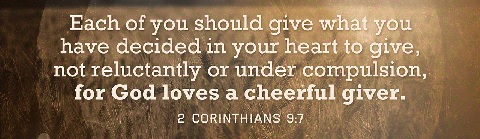
I have no problem with giving. In fact, we are to give but we are not to tithe. Giving is done out of love, it is done out of caring. It has no set amount and is not an obligation for us to fulfill.

cheerfulgiving

If people decide to attend a church building and be part of the religious institution that is OK as long as they know that it is not God’s house and tithing is no longer required. If the pastor would just be honest and tell the people that they are part of an organization that meets in a building and it needs their support. They have bills to pay, salaries to meet, utilities to pay and expenses that have to be paid if they are going to run the organization.

What upsets me is when the pastor tries to guilt the members into giving their money because they are giving to God, or they are told they are robbing God by not giving their ten percent. They are told to bring the tithe into the storehouse so that others can be helped, then most of the money goes to pay the expenses of the organization. Just be honest and tell them there are expenses that need to be paid and if you are part of this group you need to help pay the bills.

I could go along with that much better. I could go along with being told we need to financially support the organization to pay the bills. Beyond that we are free to give what we feel is right and directly to people who need it without going through the organization who takes its cut.

So, for those who are still in the institutional church give your money as financial support of the organization. There is nothing wrong with that, but do not think you are giving to God. Do not let the pastor guilt you into giving because you are robbing from God. The old covenant has been fulfilled and we now live by grace in the new covenant where tithing is no longer needed.

Follow your heart and give to others out of love and as you feel led. If you attend a religious organization then give your money to financially support it, but do not feel guilty or be guilted into giving money out of any obligation. You are free to give as you see fit.

Read Full Post »

by Jim Gordon

I am certainly no expert on LGBTQ issues but I am one who cares for LGBTQ people. I have seen so much abuse, hatred and discrimination by others, especially by other christian people against LGBTQ. I have seen them treated like second class citizens or worse. I have to say these things should not be.

LGBTQ is a label. We all have some type of label. There is the label of black or white, male or female, gay or straight, American or foreign, christian or atheist. We need to remember that behind the labels are human beings who were created in the image of God.

LoveOneAnotherheart

Why is it we cannot see the human being being the labels? Why do christian people, who are to be known for their love for God and for people seem to be the ones who all to often are the main offenders?

I understand the misunderstandings and the personal views. We are never going to have people agree on everything. But because we have disagreements and differences in opinions there is no cause to show hatred, discrimination and condemnation.

For those who are gay I am sure you do not quite understand how people of the opposite sex can have an attraction and romantic relationship. Just the same, those of us who are straight cannot understand how people of the same sex can have an attraction and romantic relationship. Yet because we are straight or gay and cannot understand the other, there is no reason for the hatred that is shown. There is no reason that each should not be treated fairly and with equal rights. We are all human beings.

As christians, whether gay or straight we are to be known for our love. Even in differences of opinion we are still to treat one another with kindness, love and acceptance. Even when we do not agree with the actions of others we still act in love. Put your prejudices aside, put your personal opinions aside and let the love of God flow through you to be loving and kind to everyone. God loves each of us, he created us and wants the best for each of us.

Read Full Post »

by Cindy Felkel, Guest Blogger

I see your beautiful heart. Every time I talk to you, I am amazed at the resilience and bravery I see in you. I know that I have only seen a glimpse into the hurt that you have experienced. I know that life has been harder on you than on many people. I see the jaded parts of you and I see the defiant spirit too; that refuses to give in and rises stronger every day.

I know when you hear me say that I am a Christian, it causes you to cringe. You expect me to judge you. You think that if I saw half of what you have done, I’d run away in fear and disgust. But that’s not the kind of Christian I am. That’s not the way a lot of us who really know Jesus are.

I am a Christian who has dealt with abuse and I have seen its power to cause people to run from light and hide in corners of hurt and self-protection.  I have  been afraid of being seen because of all the secrets I  was hiding. I know what it is like to lay on the floor sobbing until I couldn’t move because the hurt was so deep that I couldn’t think of a reason to get up and go on.

My story may be mild compared to what you have seen. My story may not relate to you at all.  When you hear my story, you may see me as a spoiled clueless middle-class  white woman living in a bubble or a weak woman who let religious people shame me for the lamest things. I don’t know if anything I’ve ever experienced really relates to you. But what I do know is God’s healing heart that longs to embrace you and show you just how treasured and adored you are.

That  may not be what you’ve heard from religious people who have judged you, but it is completely what Jesus taught.

I imagine that you have experienced religion telling you that your mistakes keep you from God and that you have to get your act together before you can come to him. But that’s not what Jesus taught or modeled with his life. Jesus taught about God loving us and grieving over our sins because they hurt us and keep us from seeing him.

People misuse the Greek word “wrath”  when they talk about God.  The word actually means “the strong emotion we feel when someone is doing something that hurts themselves or our relationship with them.” It is more how a mom feels when her child is playing in the street and not at all about an angry vindictive God wanting to squish us when we disappoint him. He cares about the sin in our lives because it hurts you and it keeps us from accepting his love for us.

It’s a love that none of us can fully comprehend.

It’s a love that Jesus describes in the book of Luke, when he told us three stories about missing things. In each of these stories, the missing thing represents people who don’t know God and aren’t following him. Each of these stories builds on the other and gives us more insight into God’s incredible heart for you my friend and how he longs to bring healing and hope to your story.

In the first story, Jesus tells of a shepherd who has one hundred sheep but loses one of them. The shepherd leaves the ninety-nine sheep who are together and goes after the one sheep who has wandered away. When he finds the missing sheep, he doesn’t scold her and say, “Why did you wander away, I should have let you get eaten by wolves.” He joyfully picks her up and puts her on his shoulders and carries her back home. Then he calls all of his friends and celebrates with them, because he is so happy that he has found her. Jesus says this is the same way the father feels about you, my friend.

He continues to tell another story of a woman who has ten silver coins (which were much more valuable in Jesus’ culture than silver coins today). When the woman lost one of the coins, she lit a lamp and searched feverishly until she finds the missing coin. When she finds it, she calls all of her friends and neighbors to celebrate with her because she is so thrilled that she has found the coin that was missing. This is another amazing glimpse into how much God misses you when you aren’t walking through life with him.

Then, in the final and most beautiful story, Jesus develops a picture of a young man who does everything imaginable in ancient Jewish culture to insult his father. The young man defies convention and asks his father to give him his inheritance while the father is still alive. This was an unheard-of slap in the face to the father. It was if the son were saying, “I wish you were dead because I’d be better off and I can handle things better than you do.”

Then the young man takes his inheritance, which was supposed to be used to further his family’s estate and heritage in Israel, and he takes it to a foreign land where he wastes it all on “wild living”: sinning, breaking the religious rules of his people.

The young man finds himself so bad off that he takes a job feeding pigs (which is a disgusting job in any culture, but for an ancient Jew, it was as rock bottom as you could get. Pigs were unclean animals that Jews were forbidden to eat. Association with them made a Jewish person ceremonially unclean).

This young man was so desperate that he longed to eat the slop that he was feeding to the pigs.

When he finally came to his senses, he realized that even the lowest servants in his father’s house were better off than him. He decided to return home, apologize for all the mistakes he had made, admit that he was no longer worthy to be called a son, and beg his father to take him back as a servant.

For the people in Jesus’ day, the story would have been shocking and the expectation would have been for the son to be punished extremely. Before Roman occupation, a son could be killed for such defiance.

But Jesus tells a different story. I think perhaps the most beautiful words in all of the Bible are “while the son was still a long way off, the father saw him and was filled with compassion for him; he ran to his son…”

Jesus painted a completely different picture of God’s heart for people who aren’t following him. He gave us a beautiful picture of God longing to have a relationship with us.  The son was still a long way off! He hadn’t made amends. He was simply on his way home and the father ran to him!!!!

This is the true picture of how God feels about you, my friend! It’s so hard to fathom that those of us who believe it constantly struggle to live it out for ourselves and towards others, but it is what Jesus taught!

The story continues and to say that the father embraced the young man and kissed him.

The young man was fully aware of all the wrong things he had done and he said to the father, “I have sinned against heaven and against you. I am no longer worthy to be called your son.”

But, the father completely restored the son to the position he was meant to be in. The father had his servants honor the son by putting the best robe on him. He gave his son a ring that showed his position of authority in the family and he put sandals on him which showed that he was not a servant.

Then the father had a huge celebration with his friends and neighbors to rejoice over his son coming home.

And that is how God sees you! Yes, he is hurt over the sin in your life because he loves you and wants the best for you. When he looks at you, he sees his beloved daughter. He wants you to know who you are. He wants to restore you to your position as his child with the full authority and honor that comes along with that.

That is the God I follow and he misses you.

Blessings my friend!

https://www.rumandcolaforthesoul.com/blog/2019/3/26/to-my-survivor-friends-who-hate-religion

Read Full Post »

By Mike Edwards

Most agree an evil or less than perfect God is not worth believing in. We all assume One who dares calls themselves God must be perfect. We mostly get our ideas of what a good God is like from either a Book such as the Bible or from thinking alone or discussing with others what we imagine a good God is like. The majority born into this world only has the latter option because they never had a Bible. It is possible God’s Spirit communicates to all somehow, with or without a Bible, due to the universal belief that we ought to treat others like we want to be treated.

Moral intuitions or imagination are often downplayed based on assumptions about the Bible.

Many of us has been taught that God inspired every word of the Bible, so that is our definitive source for knowing what God is like. Many theologians today, who respect the Bible as authoritative, are advising the final word on what God is like is through Jesus’ eyes than Old Testament prophets because of OT challenges. Even if you believe the Bible is inspired, a Book cannot be the only or final word. Literature requires interpretation. Scholars disagree what the Bible says about homosexuality, gender roles, the afterlife, etc.

Even the Bible implies we can know God without the Bible.   

The Bible says we are made in God’s image or are God’s representatives here on earth. This implies we have much in common with God or can have some understandings of God. Parent is the most common analogy to describe God in the Bible. Godly and earthly parents must have traits in common. The Bible says to be perfect like God (Mt. 5:48). The Bible doesn’t spell out what total perfection is but assumes we know. When two plausible interpretations exist, chose the view of God that seems more loving humanly-speaking.

Does anything go just because the Bible isn’t the definite source for who God is?  

The truth is there is agreement on most moral matters such as murdering, lying, stealing, or not treating others like we want to be treated. It is universally accepted that it is morally wrong to behead people for their beliefs unless you are a terrorist. You can’t debate with a terrorist because their source is inspired by God thus the supposed truth. Terrorists won’t admit their interpretation is debatable, or they can’t prove every word by a prophet was inspired by God. We will always have to work with one another about what we think God is really like, and stop claiming we are right and others are wrong.  

How do we proceed when there are differences?  

Assumed certainty covers up what we all know – there will always be disagreement whether about God, politics, or marriage. You handle differences in any arena like you would in a partnership. Don’t assume you are always right. Don’t violate anyone’s physical or emotional rights. Find common grounds. Learn to live together happily incompatible. Not taking these steps means you think you are morally superior. 

What do you imagine a good God is like?   

Chances are you are right, especially if told something about God that suggests you treat others better than God. God is Perfect Love. This is very good news if told something about God you heard you knew couldn’t possibly be true. The other good news if you are already a God-follower, you don’t have to convince others what God is like. Let God do their own work. My views of God have changed from what I was taught growing up. My views now match more what I knew deep down to be true about love. Turns out that God is understandable and not some mystery.

Read Full Post »

by Rocky Glenn

Two of the most common questions asked when others learn you’ve made the conscious decision to live the Christian life outside the walls and confines of a traditional church building are “Who do you fellowship with?” or “Where do you find community?”  The problem is the questions themselves are indicative of how conditioned we’ve become in the institutional church to speaking our own language and see the world through the lenses of our stained glass windows.    The two terms are rarely heard outside the context of church.  For example, have you ever invited a coworker to dinner or for a drink by asking them if they wanted to fellowship?  When you’re sitting in the stands at the high school football game do you often lean over to the guy sitting next to you and explain how happy you are the two of you can experience community together?  While each of these examples, by definition, constitute the term used, we don’t speak in such a manner on a normal basis and to do so would actually be quite silly.  To fellowship with another is to have a friendly association over shared interests.  Community is defined as a group of people having a particular characteristic in common.

Recently Jim Gordon and I had the opportunity to speak with Mike Adams on The UnSunday Show to discuss our journeys outside the traditional church and exactly how community looks now.  For the three of us simply recording the podcast together was an example of both fellowship and community.  This post is simply a small introduction to our conversation and to share the opportunity for that conversation to be heard.

I hope you enjoy!

Leaving Religion, Finding Ekklesia: A Conversation with Rocky Glenn and Jim Gordon

Rocky

Read Full Post »

by Shannon Glenn, Guest Blogger

In the world of fandoms, “the feels” refers to the intense emotion we experience when remembering a powerful scene in a book, TV show, or movie. The most recent example I can think of is how everyone took a shot to “the feels” when we watched everyone fade to dust after Thanos snapped his fingers at the end of Avengers: Infinity War. I think most of us who had invested so much in all of our beloved Marvel characters felt like we had lost actual loved ones. I could not speak of Loki without tearing up for at least a week! In many situations these characters feel more real to us than some of the people we deal with on a daily basis.

As a child, I have very distinct memories of experiencing “the feels” of almost everyone around me. I cried when they cried, and I wanted to help everyone. Though it seemed odd strangers would often tell me their life story. I simply attributed it to being a good listener. I thought everyone was like me, but I found out quickly few people have this gift. Everyone loves to be around someone who has this gift, at least for a while. Life with humans reveals we often have a heavy price to pay when we love first and ask questions later.

The first time I heard the word Empath was based on a character named Counselor Deanna Troi on Star Trek the Next Generation. I saw myself in her. I would know if someone felt afraid or could sense if they were being dishonest, but at the time I did not know to trust myself.  Often people would look at me crazy when I would walk away from a conversation and indicate a person was lying. I would say things like, “You can’t trust them. I just know it’s a bad idea,” or “They are furious at me and did not show it.” Anytime those around me or I would discount those nudges, we would pay the price. I have a trail of broken relationships (which I likely should never have invested in) because those I loved and followed did not listen to my warnings. I’ve learned the hard way to trust my instincts.

Life in the American Fundamentalist Christian Bubble does not make room for empaths. I was told it was simply “new age hooey” so I learned to bury my gift and hide a part of myself.  I do not believe my gift, and I do now believe it is a gift, was given to be stifled because it does not fit in the ribbon wrapped box of American Christianity. The case can be made that Jesus himself was an empath as He was moved with compassion to restore the crippled, heal the lame, open blind eyes, and raise the dead.  He even confronted the religious leaders as He perceived their thoughts revealing true motives and intentions. These things can’t be explained away with the simple explanation of He was God. Scripture says He was moved and He perceived which indicates He identified and understood their situation, position, and intention.

After walking away from the church system a few years ago, I have been able to fully embrace being an empath. I believe this gift was given for a reason, and I use it to help those around me. However, I’ve now learned I must set up healthy boundaries which I never had before. It is not necessary to always reveal what you may know as it’s the equivalent to tipping your poker hand, and all things tend to be revealed in the right time. After a lifetime of hurt feelings and broken friendships, I am moving forward. I recently listened to the song “Walk On” by U2 which I had always loved. However, this time it really spoke to me. “I know it aches, how your heart it breaks you can only take so much” just echoed in my mind. I have been learning to walk on for many years and suspect I will do so for years to come.  I will continue to embrace the feels because it’s what makes me who I am. Sometimes I will hurt, sometimes I will laugh, but finally I will be able to feel them without doubting myself or my instincts and that is a freedom worth walking toward.

Peace and Love!

Shannon

You can check out more of Shannon’s writing at Life of a Prodigal or click below for other posts she has contributed to Confessions of a Recovering Churchboy.


Read Full Post »

by Rocky Glenn

This week marks the three year anniversary of my blogged Confessions.  When I began sharing my thoughts in 2016, I had no plan, imagination, or notion I would still be doing so three years later or any clue all of the twists, turns, bumps, hills, and surprises which lay ahead.  I never truly intended to take the path I have now followed and never imagined I would oppose and disagree with so much I once held dear.  I labeled myself a churchboy as the most accurate description of the life I lived and was leaving behind: a life of performance, a life of striving to achieve a standard often unspoken yet expected, a life of constantly comparing myself to others to ensure my efforts exceeded any they may put forth to please God.  The churchboy moniker was not intended to identify one who attends church, to me it was simply a name to identify what I had become . . . a modern day religious expert concerned more with complying to rules and traditions rather than living with a humble and loving heart.   Last year at this time, I took time to expound on my definition in What Is A Churchboy?  This year I want to take a look at a different part of the blog title.

Capture

I’ve often heard those who have overcome addictions refer to themselves as a recovering addict.  Even when interviewed after they’ve been clean or sober for twenty, thirty years or even longer, many still use the term.  Per the definition above from Merriam-Webster, recovering is being in the process of overcoming a disorder or shortcoming.  Does this mean they are still fighting the sames urges, battles, and temptations just as strongly as they once were?  Is it indicative of a lack of growth or progress in their battle to put their demons behind them?  Quite the contrary.  They are not living in a defeated or pessimistic state of mind.  It’s a point of humility, a reminder of who they once were, where they came from, the hills they’ve climbed and the valleys they’ve walked.  It keeps the awareness alive in their mind of the possibility of slipping back into addiction and serves as a connecting point to others battling the same addictions which once held them captive.  The term recovering sums up in a word the oft quoted phrase, “There but for the grace of God goes I.”

Being a recovering churchboy is a similar journey.  Having been set free from a prison of religion, it’s easy to slip back into “religious” habits as the pendulum swings to the opposite extreme of what I once believed.  If someone doesn’t value the freedom I’ve found but instead chooses to criticize, condemn, or attack these new-found freedoms and beliefs, the churchboy inside would seek to condemn them and lash out at them for being wrong and not truly understanding the gospel.  As one who is now willing to admit vast uncertainty about many issues I once claimed absolute certainty on, I bristle when encountering others who remind me of my former self.  It’s not always easy to avoid being just as harsh and critical as before of those displaying the same close-minded, smug, self-righteous attitude I once carried.  Once again, the churchboy inside seeks to commend himself for now being more acceptable, more open, and more loving than he once was all the while refusing to be accepting, open, and loving with those who disagree with him.  The long held churchboy tendencies to only associate with those who share similar beliefs and exclude all who disagree seek to rise to the surface but as one podcast host shared recently, “Exclusive inclusiveness is still exclusiveness.”

No one who has overcome an addiction desires to ever again become enslaved to the addiction which once held them captive.  To lessen the likelihood of this happening, it often requires a complete change of life which could include anything from new hobbies or friends to help pass the time all the way to relocating to a new city.  Likewise, I have no desire to return to the holier than thou, judgmental life of a churchboy.   The key to overcoming the churchboy life also requires change.  Our change comes through repentance.  Repentance is a word thrown in Christian circles quite often to imply a time of great sorrow and remorse accompanied with tears and confession of shortcomings and sins committed.  To define it in such a manner is short sighted and inaccurate.  According to Thayer’s Greek Lexicon, it means a change of mind and according to Strong’s definition it means a reversal of one’s decision.  For churchboys to recover it requires a change of mind to understand the Father’s unconditional love which exists regardless of anything the churchboy may or may not do.  According to Paul, the sole reason for God’s kindness was to bring us to that change of mind.  Our decisions are reversed when we stop striving to meet God’s standards through our accomplishments and squash the comparisons of others to ourselves.  True peace comes in realizing if God has offered me his love and kindness with no requirements and no strings attached, he has done the same for everyone.  Waking up to this knowledge should truly allow us to love our neighbor as ourselves just as God loves us which fully embraces the idea of recovering.

I am beyond grateful for the freedom I have discovered in God’s love and for the ability to share the journey over these last three years.  Do I have everything figured out?  No!  Am I confident what I now believe is what I will always believe?  No!  Is it okay to live with uncertainty and live a life of perfect imperfection secure in God’s love?  Absolutely!

Thank for you taking the time to share the past three years with me and I look forward to sharing many more with you.  I will forever be a recovering churchboy.

Rocky

Read Full Post »

« Newer Posts - Older Posts »