Feeds:
Posts
Comments

Posts Tagged ‘Love of God’

By Mike Edwards

We must first accept something to be questionable when rational people have a different opinion than yours, whether it be scientific or biblical truths. Many have insisted on a literal Hell according to the Bible and suggested you must repent and have faith in Jesus to go to Heaven or then you go to Hell. But many who respect the Bible don’t believe the Bible confirms a literal Hell. See here.  The Bible may not say as much about Heaven as one may think. See here. Is it more comforting to believe what our leaders are teaching than to question and be uncertainty about such matters as the afterlife?

Leaders insist on certainty 

We hear all the time we need to get back to biblical truths. The problem is leaders and churches don’t agree on moral issues according to the Bible when it comes to Hell, gays, women, those of other religions, etc. There is is less certainty according to the Bible than acknowledged. We are told God and the Bible condemns gays. Many scholars are convinced the Bible doesn’t condemn monogamous same sex relationships. See here. The truth is leaders must stop being so damn certain despite what anxiety or challenges that may cause themselves or others! 

Followers expect certainty

Certainty rather than uncertainty comforts individuals psychologically. One may believe the seemingly certain narrative because unknowing can create anxiety. Who doesn’t want to know Heaven is real when actually the Bible says very little about heaven after death but about heaven here on earth. Besides, disagreeing with church leadership and others can lead to isolation and loneliness. It doesn’t matter if those who proclaim certainty have good intentions or believe their ideas are right about God. They may be wrong!

What are the consequences of avoiding uncertainty?

When only one side is presented, control and power grow intentionally or unintentionally. It should be intuitive denying diverse opinions is unloving and controlling. Most don’t except such behaviors in their personal relationships. Having good intentions by believing you are right for the whole doesn’t matter when certainty isn’t obvious. A refusal to openly discuss or defend one’s views suggests an unhealthy dependency on “certainty.”  

Is there any Truth? 

Certain absolutes are universal and obvious to all rational beings. Does any reading not believe physical or sexual abuse is wrong? No reasonable God or non-God person doesn’t respect the golden rule in relationships. If one insists they are right and you are wrong, the discussion may need to end. Not all laws are necessarily universal truths such as length of punishment for certain crimes, but at least in a democratic society laws are voted on. Chaos results if the law isn’t followed, though laws can be changed through representation or vote.

How do we deal with uncertainty? 

Leaders must be empowered to be open-minded than certain. I left the institutional church due to dogmatism, then constantly be divisive. We can try to engage with those who insist on certainty when it doesn’t exist, but in time one may need to move on. We can stop labeling those who disagree with our biblical interpretations as heretics. We can stop calling those who disagree with our views of science as conspiracists. Imagine how different as a people we would be if religious and political folks were open to discussions for the common goal of pursing the greater good!

Why Do So Many Believe Something To Be True That Is Debatable?

MikeEdwardsprofilepic125

Mike Edwards has been writing for Done with Religion for some time and has been a great addition to the site. Mike also has his own site where he writes that can be found at What God May Really Be Like  He can be contacted by email at: medwar2@gmail.com


Read Full Post »

by Mike Edwarads

Some suggest God doesn’t cause suffering, but allows it to bring about a greater good. The problem is that greater good doesn’t always come about. A surgeon may have to break open your chest to save your life, but what purpose is served from rape, torture, betrayal, murder, deception, corruption, incest, and genocide as if part of some grand plan?  From this twisted perspective, evil is good! God never wills or desire suffering. God desires to always bring joy to all. 

God’s love cannot be controlling 

We must come to some understanding why a loving God doesn’t stop a lot of suffering. A perfect God’s love must be uncontrolling just as it can’t be manipulative. Perfect power is uncontrolling. Ask older kids about their parents! A God who supposedly can prevent suffering but doesn’t is no different than a parent who stands by and watches their child suffer. Keep in mind God doesn’t have hands and feet but is a Spirit. Evil and suffering in the world may be because God cannot intervene single-handedly without being controlling. God can’t interfere in suffering without human help.    

Why did God bother creating freedom? 

It is not logically possible for God to create freedom unless there is the possibility of love or hate.  I don’t know of any human parent who brings children into the world not desiring their children freely reciprocate their love as opposed to being forced. Without freedom we could accuse God of not creating the very best world where only true, authentic relationships can develop. Freedom allows human to develop qualities of moral character that cannot be created initially.  Freedom cannot guarantee a pain free universe. 

God not interfering may be the most compassionate

If I try to force my rebellious son to do right presently, he may further rebel or stay away forever. Not stopping my son may be the only hope I have that he eventually freely chooses good and experience joy from that. If I am patient and allow time for possible moral development, then he may freely choose to trust I have his best interest in mind. God didn’t create suffering to foster dependency; God created freedom out of love. Controlling love can have negative consequences.

Possible explanation for lack of healings 

Lots of prayers asking for healing are obviously not answered. If God can control disease and other evils, we are left to assume God’s love is infrequent. Miracles don’t happen because some people are less sinful or beg better at the feet of an arbitrary God. Conditions in our body may not always be right. Various biological and environmental factors are involved such as cells, organs, etc. If God doesn’t deny human freedom, it may not be a stretch to say God has to account for natural freedom as well. Miracles can happen when God’s uncontrolling love aligns with countless factors known and not known. God surely intervenes by all means when circumstances will allow.

Where is God?

An uncontrolling God may not always be comforting, but controlling love is an oxymoron. God has to be true to their loving nature. God is always doing all they can to stop suffering, but seeking God’s influence in our lives can be powerful. My seeking to influence others for good with God’s help is how I can best impact this world for good. A world seeking God’s guidance is unimaginable.

MikeEdwardsprofilepic125

Mike Edwards has been writing for Done with Religion for some time and has been a great addition to the site. Mike also has his own site where he writes that can be found at What God May Really Be Like  He can be contacted by email at: medwar2@gmail.com

Read Full Post »

by Jim Gordon

We are nearing another election season here in the USA. Each time election time comes around, I get aggravated seeing churches endorse candidates and allow politicians to come to their service and talk or be recognized. This is just another sign to me that the modern-day Christian church is off base and involved in things they should not be. There is separation of church and state for a reason.

I am not saying we as individuals should not be informed and that we should not vote. Each person should take the time to know what the candidates stand for, and then get out and vote for the ones they feel will do the best job. Yet, that does not mean churches need to be the ones to endorse candidates and issues.

The Church (“Church” meaning each individual believer) is here to love one another and show the love of God to all we come in contact with. The church (“church” meaning organized religion/building) is just another big business today. It is time the church stops allowing politicians to come in and be recognized as another way to get their name in front of voters. The “church” needs to stop being just another big corporation in America, and be there to encourage the “Church” to start being what God intended, a people sharing the love of God with everyone.

Another reason the church should not be involved with politics is, unfortunately, politics in general is a major divider between people. Most people who are Republican think the other party is a danger to our country, while those who are Democrat feel the same about the other party.

Rather than work together for the good of the country, there is more time spent on overcoming the power of the opposite party. I see more fights and arguments over political views. I see friends and even families separated because of their differing political ideas. Sadly, politics is certainly something that divides and brings out the worst in people.

Obviously, no specific politician or political party will be the answer to all our problems. It will take politicians and political parties working together for the common good of the people of this country. Finding such politicians will be up to the people who will get out and vote for politicians who are willing to do what is necessary for the good of us all, and not just a specific political party.

In all of this, I feel the job of the church is to focus on spreading the love of God to all people and not get bogged down in the game of politics which can cause further division among the people.

Jim Gordon and his wife left the institutional church after spending over fifty years within the system. Jim wanted a way to express his thoughts and concerns about the religious system and why he and his wife decided to leave the institution but not their faith in God. Jim can be contacted by email at: jimgordon731@gmail.com

Read Full Post »

By Mike Edwards

It is popular in religious circles to insist God is all-powerful and all-controlling. I suppose this is to protect God’s reputation or one’s understanding of biblical claims. But if God’s power can be all-controlling, this seems to make God responsible for evils such as rape, sexual abuse, starvation, etc. by doing nothing to intervene. There are certain things even an all-loving God can’t do. 

Is everything that happens really a part of God’s plan? 

It is said “everything that happens is part of God’s plan” to supposedly protect God’s almightiness. But love cannot insist on its own way. (I Cor 13:5) A perfect God’s love must be uncontrolling. Perfect power is uncontrolling. Ask older kids about their parents! A God who supposedly can prevent evil but doesn’t is no different than a parent who stands by and watches their child suffer. Evil and suffering in the world may be because God cannot intervene single-handedly. It isn’t that God has the power to do something and doesn’t. God can’t change people or circumstances without individual or plural human cooperation.

Is lack of healing really due to lack of faith or bad behavior? 

Lots of prayers asking for healing are obviously not answered. If God can control disease and other evils, we are left to assume God’s love is infrequent. Miracles don’t happen because some people are less sinful or beg better at the feet of an arbitrary God. Conditions in our body may not always be right. Various biological and environmental factors are involved such as cells, organs, etc. If God doesn’t deny human freedom, it may not be a stretch to say God has to account for natural freedom as well. Miracles can happen when God’s uncontrolling love aligns with countless factors known and not known. God surely intervenes by all means when circumstances will allow.

Can we make sense why God allows freedom? 

It is not logically possible for God to create freedom without the possibility of moral evil. God clearly values ongoing freedom because of all the suffering allowed in the world. I don’t know of any human parent who brings children into the world not desiring their children freely reciprocate their love as opposed to being forced. Without freedom we could accuse God of not creating the very best world where only true, authentic relationships can develop. Freedom allows human to develop qualities of moral character that cannot be created initially. The guarantee of a pain free universe cannot involve freedom.

Is God interfering the most compassionate?

God not interfering in suffering on earth may be compassionate. If I force my rebellious son somehow to do right presently, he may further rebel or stay away forever. If I am patience and allow time for possible moral development (time on earth), then he may freely choose to trust I have his best interest in mind. God didn’t create suffering to foster dependency; God created freedom in the beginning because they love us. Controlling love may have consequences.  

I do not wish to suggest physical evils such as disasters of nature, diseases, or accidents can always be traced directly to a human’s freedom to inflict pain upon themselves or others. It does seem human accumulated mismanagement of the earth over thousands of years has brought some destruction through hurricanes, tornadoes, floods, droughts, and earthquakes. Does our current divide among our political leaders keep solutions from developing that allows the most human flourishing? Human mismanagement hardly explains all the causes of natural disasters. Claiming natural disasters are always God’s judgment is nonsense.

What good is God then?

God seeks to influence us to do all the good we can, in all the places we can, at all the times we can, to all the people we can, as long as we can. It matters what you believe a loving God is like (see here), but God’s influence in our lives can lead to making wiser choices by having a moral compass in life. God is tireless in working through individual lives to change the world. It isn’t that you didn’t beg enough or behave enough. God through their influence has made me a better man, husband, father, and friend or at least better than if on my own. All we have to lose is selfishness and a lousy legacy.

MikeEdwardsprofilepic125

Mike Edwards has been writing for Done with Religion for some time and has been a great addition to the site. Mike also has his own site where he writes that can be found at What God May Really Be Like  He can be contacted by email at: medwar2@gmail.com

Read Full Post »

by Jim Gordon

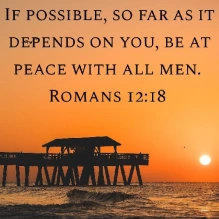
Romans 12:18 – If possible, so far as it depends on you, be at peace with all men. That almost sounds like an impossibility in our world today. To be at peace with all men, including believers and non-believers, those who accept God and those who do not accept that there is a God. Live at peace with those who believe in a similar way we do and those who believe in a variety of different ways than us.

With all the different thoughts and ideas, the different denominations, interpretations and beliefs, all the different religions, how could it be possible to be at peace with everyone?

The dictionary says of peace: freedom from disquieting or oppressive thoughts or emotions; harmony in personal relations.

I think this is what God is saying, that we are to live in harmony with our fellow human beings, not allowing any oppressive thoughts or emotions to take control of our feelings towards others. In other words, we live in love. Just because someone does not interpret the Bible the same way we do, or go to the same church we do, or does not go to church at all, we should realize that as believers we are all wanting to please God and do what we feel led to do out of love. We should respect the fact that God is working in different ways in people. Just because people see things differently does not mean it is not of God.

In regard to non-believers, we should not be condemning them or forcing our beliefs on them. We need to let them see the love of God, yet they do not need someone beating them down or twisting their arms to get them to believe like us. We are to love them as they are and allow them the freedom to make their own choices in spiritual matters.

If we believers could just understand that we are responsible for ourselves in the way we live for God. We are not responsible to force our beliefs on others. We are to allow God to work in our lives and follow God on the path the Spirit has for us. Our responsibility is to love God and love everyone we come in contact with, accept them for who they are and let the Holy Spirit work in all our lives. Living in this manner would accomplished much more in showing the love of Christ to those we have contact with each day.

Jim Gordon and his wife left the institutional church after spending over fifty years within the system. Jim wanted a way to express his thoughts and concerns about the religious system and why he and his wife decided to leave the institution but not their faith in God. Jim can be contacted by email at: jimgordon731@gmail.com

Read Full Post »

By Mike Edwards

The U.S.  is obviously divided as a nation politically – immigration, climate control, economics, energy policy, vaccine mandates, abortion. In the Christian church you have those “done” with the Institution (building) but not God. I suggested previously the main reason for such division is the fear of uncertainty which leads to claiming certainty. See here. In politics we don’t have disagreements but conspiracists. In religion we don’t have disagreements but heretics.

Why might we fear uncertainty?

Certainty rather than uncertainty comforts individuals psychologically. One may believe the seemingly certain narrative – vaccine benefits outweigh the risks – because unknowing can create anxiety. Disagreeing with the popular science narrative can lead to being ostracized. Disagreeing with church leadership can lead to isolation and loneliness. It doesn’t matter if those who proclaim certainty have good intentions or believe their ideas are best for society. They may be wrong! When universal agreement doesn’t exist – such as the evil of sexual abuse – it should be inherently obvious that one must be allowed to form their own opinions since uncertainty exists.

What are the consequences of avoiding uncertainty?

We can’t read the hearts of those who proclaim certainty and thwart disagreement. But when only one side is presented, control and power grow intentionally or unintentionally. It should be intuitive denying diverse opinions is unloving and controlling. Most don’t except such behaviors in their personal relationships. As mentioned, believing you are right for the whole doesn’t matter when certainty isn’t obvious. A refusal to openly discuss or defend one’s views, even to avoid anxiety, is a denial of personal choice and suggests an unhealthy dependency on “certainty.”

What principles can guide us during uncertainty?

We must be guided by core principles such as freedom and love. You want your views accepted? Accept the views of others. You want to be supported to make your own decisions freely when there is uncertainty? Respect the rights of others to do the same. Taking the vaccine or not is one’s own health decision. Stop labeling opposing political views as anti-science. Stop labeling those who disagree with your biblical interpretations as heretics. Can you imagine how different our nation would be if religious and political folks were open to discussions for the common goal of pursing the greater good? When policy must be made for a whole, a voting democratic society surely is more humane and less dangerous than an authoritarian government style.

Why Can’t We Disagree As A Nation And People?

MikeEdwardsprofilepic125

Mike Edwards has been writing for Done with Religion for some time and has been a great addition to the site. Mike also has his own site where he writes that can be found at What God May Really Be Like  He can be contacted by email at: medwar2@gmail.com
Read Full Post »

by Jim Gordon

Those of us who are living outside the walls of religion and institutional church have found a freedom we sometimes cannot explain. At least we cannot explain it in a way that people who still attend a church building seem to understand.

The problem is those who still attend the traditional church do not accept the fact that everyone is different and sees things in various ways. They usually want to stay away from us or talk about how we have backslidden and fallen away from God because we do not do what we have traditionally been taught was godly.

Nothing could be farther from the truth. We are worshipping and loving God just as much as before, only in a different way. We have not left the Church (Ekklesia) but we have left the building (church). Jesus is building His Church out of ‘living stones’ and not with brick and mortar.

My wife and I left the church because we felt the system was not the way God intended and we became unsatisfied with the way things were going. Yet, we never left the true Church which is made up of all of those who are believers.

Each of us has an equally important part to play in the body, yet no one is the head over anyone else. Each of us are functioning parts of the body and we are all needed and important. Of course, only Jesus is the head of his Church, not a pastor.

Those of us who have left the traditional church are often told we need to attend because we should not forsake the assembling of ourselves together. Yet this verse does not mean we have to be in an organized, pre-planned service led by a pastor and a worship leader. It is saying we need our brothers and sisters in Christ. Whether we meet on a Monday at a café, Tuesday in a home, Thursday at a bar or Friday in a park makes no difference. Jesus said for where two or three gather together in my name there I am in their midst.

For us true and meaningful fellowship happens each and every day when God brings us together with a brother or sister, or when we meet up with another couple for dinner. It also may be a time of one-on-one fellowship online with a brother or sister hundreds of miles away yet bonded closely through the Spirit.

We are so conditioned to think of the church building and its scheduled events as the main way of fellowship and learning. We are told in the Bible that when we come together each of us should have a word, or a song, or a praise, but how often does that actually happen within the institutional church? Being outside the walls, my wife and I have found this to be the norm. We all talk, we encourage one another, learn about each other, pray for one another and we support and care for each other. Fellowship is everyone having a part to play and everyone being open and talking about who God is to them. It seems that sitting quietly in a church service does not fulfill what God intended fellowship to be among his children.

A vitally important thing to remember for those of us who have left the church organization is that we should not have a feeling of ‘us vs them’. We need to keep in mind that those who attend church are doing so because they love God and feel they are doing the right thing. We are all children of God, whether we are in the institutional church or out of it. We are all various parts of the Church that Jesus is building and we each need to follow the leading of the Spirit for ourselves.

As people of God, we are to love God and love others. We cannot do that in our own strength but by the power of the Spirit within us. Sadly, it often seems we have a problem loving our brothers and sisters in Christ and an even greater problem loving those who see things differently.

I pray that all of us can keep in mind that we are children of God, saved by grace and living in His kingdom now. Whether we are ‘in church’ or outside the walls, let us focus on our love of God and for one another. The world needs to see the love of God in action among those who follow God. They do not need to see arguing, fighting and the disrespect that is sadly, so familiar among Christians today.

Jim Gordon and his wife left the institutional church after spending over fifty years within the system. Jim wanted a way to express his thoughts and concerns about the religious system and why he and his wife decided to leave the institution but not their faith in God. Jim can be contacted by email at: jimgordon731@gmail.com

Read Full Post »

By Mike Edwards

A majority of people believe in God, but may not have a closer relationship with God because what they believe about God. No one can be certain what an invisible, inaudible God is like. I do know that only a perfect, loving God is worth believing in. Show me the perfect parent, or one close to it, and I suspect that is what God is like. A reason some may believe otherwise is because of what they think a Book says about God. God may be more like you expected!

Is God really that Authoritative? 

Abraham questioned and negotiated with God (Gen. 18). God listened and considered Abraham’s concern. An Authoritative God would have said: “I am God so shut your mouth.” In Exodus, Moses balked when God asked Moses to return to Egypt and liberate the Jewish people. God didn’t say “Do not question my plan or authority!” God was adaptive in working with Moses. The Apostle Paul says love is patient, kind, and does not insist on its own way (I Cor 13). Love puts up with us, has faith in us, and places hope in us. See John Sanders: It Matters If Your God Is Nurturing Or Authoritative!

Is God really that Judgmental? 

Did God create us to remind God how great they are, or we can go to Hell? Doesn’t sound like a God I can get close to. Worse is if you believe Hell is a place for unending torture where pain serves no lasting purpose. Humans wouldn’t even create such a place to torture their enemies after death.  I think the Bible agrees. See here.  Call me a fool! If my kids hated my guts or ignored me and had a genuine change of heart in this life or the afterlife, I am ready to begin a relationship. So is God! 

Is God pissed and views you as a scum bag? 

Do you not give a damn how others feel or how your actions impact others? Color me God then. Your behaviors disgust me. Does God really view us as evil from birth and has to put on Jesus-colored glasses to even look at us? Such an idea could only come from one’s interpretation of a Book. But I could point to verses such as Isaiah 54:10: “…my unfailing love for you will not be shaken…says the Lord, who has compassion on you.” A loving God can only love how an earthly parent ought to love their child. 

Maybe God is kind and relatable like the parent you always wished for 

God’s love surely is the same as supreme parents – other-directed not self-consumed. Love gets excited when we do well and make a difference in the lives of others. Love anticipates, hopes for my success, believes in me. God is pulling for me, even when failing, because I do the same for my children. We doubt God but God still loves. God may worry but still hopes. We are dependent on our children for intimate relationships. God is dependent on us. An all-powerful God would only give us uncontrolled freedom if seeking a partnership and friendship with us.

Our view of God matters!

A belief in a benevolent God makes us kinder. We often treat others the way we think God treats us. How has God’s threats of punishment helped you break away from bad habits or behaviors you long to change? Grace or authoritativeness doesn’t guarantee change, but I believe we best change because of God’s or friends’ love and acceptance. If we think God is hard to please and pissed off about sin rather than what sin is doing to us, we may stop going to God when failing. God desires perfection for our own sake but surely celebrates our victories along the way. Our image of God can dictate our beliefs about God. Imagine what you believe a perfect God is like in your life and the lives of others. You may discover God is more like what you assume a loving God is like.

What Kind Of God Do You Believe In?

MikeEdwardsprofilepic125

Mike Edwards has been writing for Done with Religion for some time and has been a great addition to the site. Mike also has his own site where he writes that can be found at What God May Really Be Like  He can be contacted by email at: medwar2@gmail.com

Read Full Post »

And Everyone Else is Wrong

by Jim Gordon

If you are around a lot of people or are on social media very often, you will see many people are ready to argue in order to prove their way of thinking, especially in regard to spiritual matters.

Some atheists complain about Christians believing in a fairy in the sky, some people get mad over the transgender debate, gays are treated like second-class citizens and some of them are hateful toward Christians. Many Christians fight with other Christians over doctrine and some can be very judgmental and condemning of atheists and the LGBT community. It seems each group is trying to prove why they are right and the other group is wrong and many times they do it in ways that are not so nice.

Why do so many people spend so much time arguing and defending personal views when we cannot prove any of it? Seriously, none of us can prove beyond a doubt our thoughts and views on spiritual things or life after death. We cannot prove God exists and we cannot prove he does not exist. There are so many varying doctrines, interpretations of the bible and denominations among Christianity that it is not surprising we do not know who is right or wrong?

If we really think about it no matter what your religion, what your faith or belief, what your lifestyle, if you are atheist, Christian, gay, agnostic, transgender, if you have a scientific view or creationist view none of us can prove our way of thought in regard to spiritual matters. It is our personal view and it is good to have those views, but we should not be trying to prove our way and push it onto others expecting them to see things our way.

Each group is passionate about the way they see things and there is nothing wrong with that. The problem is expecting everyone to agree and go along with our way of thinking.

We are not all going to agree on things, yet we should be able to be accepting of others. Being accepting does not mean we always agree with one another or approve of everything people do, but we should be able to be kind and show respect to everyone even in our differences. Being judgmental, condemning, or poking fun at one another is certainly not being loving and kind.

It all boils down to no matter what route we take in life, what we think about life after death, what we think about God or spiritual life, none of us can prove our way of thinking, at least not until death. Once we die, if there is life after death and I believe there is, we will know for sure at that point. Until that time, we can only follow our way of thinking or believing and we should be respectful of others and the way they think.

Those of us who are followers of Jesus should especially be loving and kind because Christ told us to love God and love one another. He did not say we should only love those who believe like us. He did not say to be judgmental, condemning or to exclude anyone.

When reading about Jesus in the gospels we see a person who loved people and was accepting of everyone. He did not condemn nor judge and I believe he was God in human form showing us that God loves us all.

I believe God provides grace for everyone, but he gives us all freedom to choose what to believe and whether to accept it or not. I believe we should offer the same option to our fellow human beings no matter what label is put on them.

Jim Gordon and his wife left the institutional church after spending over fifty years within the system. Jim wanted a way to express his thoughts and concerns about the religious system and why he and his wife decided to leave the institution but not their faith in God. Jim can be contacted by email at: jimgordon731@gmail.com

Read Full Post »

By Mike Edwards

Do you not give a damn how others feel or how your actions impact others? Color me God then. You are a wretched soul and your behaviors disgust me. I doubt though that is you because you wouldn’t be reading a spiritual blog. Church folks are familiar with hymns that describes us humans as “filthy rags” in the eyes of God. Does God really view us as evil from birth and has to put on Jesus-colored glasses to even look at us?

Does the Bible really claim God is pissed and views you as scum?

Some of us were taught at church that a loving God thinks we are sinners from the day we were born (Doctrine of Original Sin). See here.  Such a view could only come from a book such as the Bible. Anyone can point to verses to defend their view of God. Google to find verses that describes God a wrathful and revengeful God. But I could point to Isaiah 54:10: “…my unfailing love for you will not be shaken nor my covenant of peace be removed, says the Lord, who has compassion on you.” Jesus says He judges no one. (Jn. 8:15). This doesn’t sound like a “pissed” Jesus. I am convinced a loving God can only love how an earthly parent ought to love their child.

Did God create us to be better lovers than God? 

It is only intuitive a Creator loves how their creations ought to love one another. Even the Bible implies perfect human love and God’s love are the same: “Be perfect, therefore as your heavenly Parent is perfect” (Mt. 5:48). “Follow God’s example…” (Eph. 5:1). If I discover my child is bullying someone at school, I detest the behavior not them. If we find out our kid is using drugs, do we hate them or what the drugs are doing to them? I don’t sense the Bible as a whole describes God as loving us but we don’t really deserve it. God, like human parents hates unloving actions.

Views of God shape our attitudes toward God toward others 

If we think God is hard to please and pissed off about sin rather than what sin is doing to us, we may stop going to God when failing. God desires perfection for our own sake but surely celebrates our victories along the way. Our image of God can dictate our actions. If God can do Hell, we may think we should emulate God in our attempts to judge and punish. If God punishes us forever (Hell) for sins briefly while here on earth, aren’t we teaching others to fear God rather than experience God relationally like they would a human parent?  I am not convinced such a Hell is biblical. See here. Imagine what you believe a perfect God is like in your life and the lives of others. You may be right!

Is God Pissed At You For Being A Sinner?

MikeEdwardsprofilepic125

Mike Edwards has been writing for Done with Religion for some time and has been a great addition to the site. Mike also has his own site where he writes that can be found at What God May Really Be Like  He can be contacted by email at: medwar2@gmail.com

Read Full Post »

« Newer Posts - Older Posts »