Feeds:
Posts
Comments

Archive for the ‘Acceptance’ Category

by Rocky Glenn

My thoughts going into Easter this past weekend were a mixed bag of criticism, questions, and self-analyzation.  Although this wasn’t the first year we have not actively participated in any church based Easter activities, ghosts of special sermons, carefully selected worship songs, newly purchased clothes, and orders of service timed to the minute haunted my mind.  I have actively, willingly, and intentionally played a role in times past of ensuring Easter Sunday morning service is meticulously planned and flawlessly executed.  Every effort was made to make the right impression on the countless visitors we were certain would be in attendance.  After all, if the plan was executed perfectly it would draw people to join our congregation and our attendance would increase showing how great of a place we were.  Heck, if we performed well enough, visitors might even make a decision to follow Christ!  Oh yeah, I guess we were actually celebrating Christ’s resurrection as well, but, despite being repeatedly mentioned throughout the course of the service, it never seemed to be the real focal point.  There was more concern taken over the timing of every agenda item and every detail of cleanliness and structure rather than celebrating the day for what it was to represent.  It was the biggest Sunday of the year and was treated as such.  It’s the institutional church’s Super Bowl!

Late last week I had a conversation with a long time friend via text and we discussed the subject.  Having walked together through many different courses of life, and many changes in beliefs for each of us, I knew he was someone safe to talk to and would not return any judgment if I shared my true feelings.  I mentioned my disdain for what it has become and how I referred it to as the Evangelical Church’s Super Bowl.  The response I received was a simple, “It’s pretty much all Christians’ Super Bowl,” and he went on to explain it should be a cause of celebration.  He mentioned the resurrection should truly be the one thing in the world we have reason to celebrate and the manner in which we do so should inform people of the power of the resurrection.  I pointed out my problem is it’s the one day of the year we talk about the resurrection and we then live the rest of the year forgetting  it.  We celebrate and look forward to the day itself and gloss over the event.  The next response I received was significant and gently reminded me there were three fingers pointing back at me on the same hand with which I was pointing at others, “Most people are very inconsistent.  I know I am to an extent . . . I say that to seem somehow piously humble, I mean it. I’m an inconsistent mess sometimes.”  The conversation which followed took us everywhere from the prodigal son and his older brother to being focused solely on our own salvation to the true purpose of our faith being faith itself and not our eternal destination.

As I reflected back on the conversation over the next two days, I believe he hit the heart of the matter with the word inconsistent.  If we are all honest with ourselves, we are all just a giant bundle of inconsistencies. Paul stated this in his letter to Rome as simply, “I don’t really understand myself, for I want to do what is right, but I don’t do it. Instead, I do what I hate.”  To live a human life is to live a life of inconsistencies.  Inconsistencies appear in both our actions and beliefs and become glaringly obvious when the two do not align with one another.  What we believe as absolutes today are the very things we may question tomorrow.  Theologies and beliefs I would have once defended I now despise and detest.  Though I lived a life once grounded in rules, regulations, and expectations, I strive now to live with an open minded letting Love be my guide.  Yet, in the very same breath with which I proclaim to live in Love I often find myself judging and looking harshly at those who choose to remain in the path I traveled for many years.  Despite striving to live freely in grace and seeking to show grace to others, my back still stiffens as my blood pressure raises when I’m cornered about why I walked away from the life I once lived.  I find it difficult to not respond in anger when being accused of leaving my faith and when I am judged as sliding down a slippery slope to damnation.  The churchboy I lived as would never openly admit to living such a life of inconsistencies no matter how true it would have been.  His life was all about maintaining the perfect image of what he believed a Christian should look like.  I would like to believe the churchboy I once was is dead, but as I shared recently I am forever recovering.  

Brennan Manning admitted his inconsistencies like this:

“When I get honest, I admit I am a bundle of paradoxes. I believe and I doubt, I hope and get discouraged, I love and I hate, I feel bad about feeling good, I feel guilty about not feeling guilty. I am trusting and suspicious. I am honest and I still play games. Aristotle said I am a rational animal; I say I am an angel with an incredible capacity for beer.
To live by grace means to acknowledge my whole life story, the light side and the dark. In admitting my shadow side I learn who I am and what God’s grace means.”

I’m at a point in my journey where I can truly recite Brennan’s words as my own.    Brennan captured what I now believe a Christian truly is as he concluded his statement above with the words of Thomas Merton, “A saint is not someone who is good but who experiences the goodness of God.”  This goodness of God is found in returning to Paul’s letter just a few sentences after his admission shared above, “Oh, what a miserable person I am! Who will free me from this life that is dominated by sin and death? Thank God! The answer is in Jesus Christ our Lord.”

Paul’s words bring us back full circle and return us to Jesus and his resurrection which is where our discussion began.  In pondering and reflecting on Easter, I found I was not alone in the process.  One friend spent the week on social media questioning if our obsession with and promotion of holy days had gotten in our way of enjoying the blessing we have in Jesus Christ each and every day.  On Easter Day itself, he gracefully summed up the week with the following sentences:

There is nothing wrong when we celebrate a certain day as “holy” when it is an option you choose in your own conscience before God.

At the same time, there is not a single instance in the grace portion of your and my bible where a holy day is presumed true and where celebrating a certain day is ever mandated.

Whenever and wherever a mandate to observe a holy day is present, it is a violation of God’s grace who cleansed our consciences and who liberated our minds and our consciences to enjoy him free of manmade ritual and tradition.

A life of grace is a life free of manmade mandates of ritual and tradition.  It all comes down to your own conscience before God.  To share grace with others is to refuse to view them through your own personal mandates which arise as result of that conscience between you and God.

Inconsistencies will arrive and plague us as long as we live but as Paul, Brennan, and Thomas all point out, it’s through Jesus we overcome them.  His consistency overcomes our inconsistencies just as His perfection overcomes our imperfection.

Rocky


Read Full Post »

by Jim Gordon

So often when I mention that my wife and I have left the organized church, people assume something happened to hurt us or make us mad or we were abused in some way. Just to be clear on this subject neither one of us have ever been abused or hurt by the church. Neither one of us are mad about some event or some person at church. I know there are people who have had bad experiences which sometimes includes abuse and I think that is terrible. Fortunately for us that is not the case.

Today we seem to hear much about sexual abuse and the catholic church although this can happen in any church system. We hear of people in power within the system taking advantage of their members for various reasons. Fortunately this is not the norm in most churches but is a real and terrible thing that happens way to often.

I actually had some very good times while within the church system. I made many good friends, learned about God and his love for me and had many fun and enjoyable experiences with the people who were part of the church system.

It is certainly not out of abuse or being hurt that my wife and I decided to leave the system. After nearly sixty years in the organization and after the last fifteen of those years feeling that something is not right with the system, we made the decision to leave and follow Christ outside the walls of religion. To be clear, this was our decision and we certainly do not expect everyone to agree or do the same thing. Many people are part of the organized church who truly love God and want to serve Him. After all, the religious system we know as church is all we know.

We believe the Church is a community of people and not a building nor a service held one day each week with paid professionals leading the service. We believe the Church is each of us who follow Christ and see him as the head. We are the temple of the Holy Spirit and each of us are equally functioning members making up his body.

WhatisChurch

We believe forsaking not the assembling of yourselves means we need one another. We live each day having fellowship with those God brings our way no matter where it happens. We never truly found real fellowship when we sat in an organized service for an hour looking at the back of the head of the person in front of us. We believe true fellowship is not just sitting together with other people in a room but it is daily loving, encouraging and praying for one another and meeting the needs of those we are able to help.

The temple in the Old Testament was only a shadow of what was to come in the New Testament. God now lives in us as his temple and he is our leader rather than another human being we call pastor. The only mediator between God and man was Jesus. He repaired the separation between God and man and we now have direct access to the Father without anyone in between. There is no hierarchy in the Church. Each of us are equally important parts of the body and able to teach, encourage, build up and pray for one another. It is truly a priesthood of all believers and not a one person show. Those with specific gifts for helping the Church are not better or more spiritual than the rest. They are brothers and sisters who walk along beside those who need encouragement. They are those who have learned a spiritual lesson and are there to help those who are still learning. They are servants among the body of Christ who are there to help and encourage.

So when I say that we have left the church it is only the building and organization I am talking about. We left not because we were mad, hurt or abused. We left because we believe the religious system most people call church is flawed and far from what God is building. He is building a group of people who will daily follow Him outside the walls of religion and organizations of men, loving God with all their heart, soul, strength and mind, loving their neighbor and accepting all they meet along the way.

Read Full Post »

By Mike Edwards

I don’t have to convince anyone that God does or doesn’t exist. God can speak to the hearts of individuals on their own. That billions are convinced there is a loving God cannot be declared definitely irrational or delusional. It is not irrational either to ask if God is real, why doesn’t God clinch the argument by making their Presence obvious? I would encourage those who believe in a relational God to not stand in the way of others and speak for God declaring any beliefs are required by God to consider a relationship.

God doesn’t require any belief!  

I am convinced God only wishes for all to consider the possibility of a loving God who desires to help you in your journey of becoming the person deep down you want to become. Loving, human parents don’t require certain beliefs from their children before hoping they will consider if they love them. Are we better lovers than God? 

You certainly don’t have to believe in magical trees and talking snakes.

No one was there with Adam or Eve to know literally what took place. Genesis isn’t necessarily a scientific explanation about Creation but about a relationship with the Creator. Flood stories appeared in ancient literature before Genesis. The global flood story could describe a regional flood in hyperbolic terms to convey moral, spiritual food for thought. God doesn’t require literal belief in any event in the Bible or else! Now if God physically appears raising your friend from the dead, you may want to consider!

You don’t have to believe Jesus resurrected from the dead.

I know the above statement is extremely offensive to many, but I care more about those who want to believe in a God but struggle with certain requirements as opposed to those who are already convinced a loving God is real. Jesus told followers He was coming back from the dead and they didn’t believe Him. And they supposedly witnessed miracles beforehand to have less doubts such a claim was possible.

I would like to think more of us if we witness a man or woman coming back from the grave after being killed that we would think their message such as claiming to be the son of God would be believed. But, none of us lived during biblical times so we will not have such an opportunity. I happen to believe the historical evidence is credible that Jesus rose from the grave, but God can handle doubts or skepticism.

You don’t have to believe that Jesus was the Son of God.

Many insist that Jesus was both God and man. Some can’t logically wrap their heads around Jesus being both man and God. Exactly how does one do that chromosomally? Isn’t it logically impossible to be God and not God? Some may be willing to accept that Jesus was an extraordinary man who epitomized who God was. Why can’t we begin there as a discussion as to what teachings and actions of Jesus seem to represent what a loving God is like?

Doesn’t God at least require the Law of Love?

I have written before that the only belief God requires is love. I would say that differently now. God doesn’t demand love but only seeks to encourage unselfish love which leads to personal freedom. God know what we know – the road traveled of learning, reflecting, and freely choosing convictions over time is what leads to genuine, lasting love.

Didn’t Jesus require belief for eternal life?

When Jesus was asked directly by a religious expert how to have eternal life, Jesus didn’t talk about escaping torture after death. Please see HERE that the Bible says nothing about the traditional understanding of Hell. Jesus replied to simply love God and your neighbor (Lk.10:25-37). Jesus’ focus wasn’t on quantity of life after death but about a life worth living here on earth. Jesus’ message wasn’t about requiring certain beliefs but avoiding consequences in life here on earth through destructive choices. This is the message of any loving parent!

What beliefs about God are worth insisting upon to others?  

There is no belief about God you should impose upon others. You could be wrong. God is big enough to prove themselves to those interested. You don’t even have to insist God is loving. A tyrannical God isn’t worth believe in. I surely am not as perfect or loving of a parent as God is, but even I don’t require my children accept any of my beliefs or else. Even I understand controlling through fear than proving my love doesn’t lead to true change and intimacy.


Read Full Post »

By Mike Edwards

Only terrorists believe a good God encourages beheadings for unbelief. Millions of rational people don’t believe God condemns gays even according to the Bible. Claiming the Bible is not inerrant disturbs many, but the problem is that often personal interpretations are implied to be the Truth. Biblical scholars who believe the Bible is authoritative disagree on meanings of passages, and we can’t ask writers for clarification. Opposing sides often demonize one another by declaring their view of God according to the Bible is right. This matter is critical because understandings of God shape attitudes toward God and impact lives.

Did you know scholars disagree about women and gays according to the Bible?

Many only condemn gays or restrict women’s spiritual roles because of the Bible, but two plausible interpretations exist on most major issues when speaking of God’s character. Many defend that the Bible teaches that God proclaims women cannot be in authority over men in roles such as a priest or pastor. Scholars who respect Scriptures also proclaim the Bible teaches roles are based on gifts not gender. See here Our view impacts half the human population. Biblical scholars disagree if the Bible condemns monogamous same-sex relationships. Millions of lives are impacted.

How might a Creator convey what like since any Book about God is subject to interpretation?

Is it possible a universal, inborn desire to treat others like we want to be treated is one way a Creator would communicate what is good versus evil? After all, half the people born in this world didn’t possess a Bible. I don’t know any God or non-God person that doesn’t advocate the golden rule being a valuable guide in relationships. How would we want to be treated if in that person’s shoes? Which view is most loving from a human perspective?

Many claim God is a mystery sometimes because their interpretation of Scriptures suggest God appears evil from a human perspective. Such interpreters, who would agree humans were created in God’s image, are using their moral intuitions and implying God and human love are the same. It is certain that we don’t always know what perfect love is, but the mystery card hinders discussions about God’s true character.

Shouldn’t we choose views of God with fewer negative costs?

We may not benefit from the most gifted leading if women are prohibited from leadership roles. As important, women can feel disrespected and confused why a supposedly loving God would choose according to gender than gifts. Many recognize as bigotry if we used such criteria in business or other roles. Finally, putting men in leadership position over women can encourage dominance on the man’s part, which can be conducive for abuse and other atrocities women face at the hands of men. It can be argued that the Bible suggest women don’t need male leadership; women need men with the heart of a servant (Eph. 5:28-29).

It doesn’t make moral sense why God would condemn gays when they can no more chose who they love than straight can. Ask them! Scientific knowledge available suggests sexual orientation isn’t a choice. Why would anyone choose to be gay based on the condemnation and bigotry they face? Parents often only condemn their gay children because of their supposed correct interpretation of a Book. We know the psychological harm done when one must hide their sexuality because of bigotry and hostility. We must be guided by love – how should I treat others if I had the same non-choices?

For Bible folks when two debatable interpretations in Scriptures exist… 

Err on the side that portrays God as the most loving to the human mind. I am only aware of two reasons to think God condemns gays. One, you believe the Bible teaches God condemns gays. That is disputable. Secondly, you don’t think gayness is natural. You aren’t gay so how do you know. Let gay people speak for themselves. Love gays like you would want to be love if gay. Please don’t compare gay love to pedophile love which is not consensual. Love others like they want to be loved because you could be wrong.


Read Full Post »

By Mike Edwards

One would think Christians wouldn’t be judgmental. After all, we are guided by the principle of loving others as we want to be loved. Jesus certainly didn’t seem judgmental. He hung out with all kinds of people who didn’t necessarily have His same beliefs. Jesus did get His dander up with religious folks because they were misrepresenting God. We may be doing God a favor if Christians questioned their own leadership and stop trying to force their beliefs on the rest of the world. I am not suggesting we shouldn’t stand up when children are abused, women are violated. That requires judging. It should though not be in our nature to unload on others because their beliefs aren’t ours.

Spoiler Alert – One’s view of the Bible may be one main reason Christians are so judgmental.

Some Christians may be judgmental as a defense mechanism.

Christians are only human. I can’t quite explain it but it does seem those most judgmental may be a way to prevent looking in the mirror and judging themselves for unloving behaviors. I suppose some play offense to avoid playing defense and looking inwardly. The is something one can only answer for themselves if they noticed being so judgmental despite being a God-follower.

Are Christians judgmental because of examples of Leadership?  

Catholics, Methodists, Etc. establish creeds that are implied one should believe in. Try challenging the doctrines and see where that gets you! One creed may be Jesus came to forgive our sins. Theologians don’t agree if the Cross was to influence a lifestyle toward love or pay a price for God’s sake. So, God never did or couldn’t forgive sins until Jesus died? If God was so concerned about beliefs such as the Trinity, Angels, the Bible, Judgment, the Virgin Mary, wouldn’t there be more agreement what all these creeds. If Religions only had the Creed of Love, maybe Christians would be more united and less judgmental.

It gets worse how Christians judge!

Doctrine differences are one thing because only those who grew up in church care about those matters. Christians though condemn same-sex relationships, women are denied equal or authoritative roles as men, and it is said only Christians can go to heaven so all other religions can go to Hell. Good people often only condemn same-sex relationships because they are convinced a Book inspired by God condemns them. Biblical scholars who respect Scriptures don’t all agree the Bible condemns same-sex relationships. Shouldn’t we take the less judgmental stance toward others since we could be wrong?

Would you naturally assume if not for a Book:

God condemns gays

God prohibits women from serving as pastors or priests

God encourages wives being submissive to husbands differently than husbands to their wives

God judges based on religion when the religion the majority adhere to depends where born

Every view above is debated among biblical scholars. We can listen to what God’s Spirit is telling us also or at least have an open-discussion rather than hide behind a Book like terrorists do! I am convinced this would lead to Christians being less judging.

Read Full Post »

by Jim Gordon

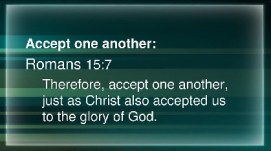
It is sad that Christianity is divided into so many different groups. We all have a little different interpretation of the bible and a little different understanding of doctrine. Obviously we are not going to agree on everything, but we certainly should be able to love one another and accept each other even when we differ on these things.

It is hard to understand why this happens when God tells us we are to be one as Jesus and the Father are one. Yet, we understand that we are human and it is easy to lose sight of our first love. If we could only stay focused on Christ, listening for his voice and the guidance of the Spirit, loving God and loving others as God intended, then we could look past our differences and accept one another.

acceptOneAnotherNew2019The problem seems to be that we are unwilling to see any other viewpoint other than our own. There are those such as my wife and I that do not attend an organized church. There are those who attend a church every time the doors are open. Some attend a house church, some meet with fellow believers at cafe’s, parks or restaurants and others meet in their homes over dinner. We should accept these differences and love one another rather than argue over who is right and who is wrong.

There really is not a right or wrong way to assemble together and we need to stop expecting everyone to do things exactly the same way. We should respect others views and focus on loving them rather than expecting them to see things our way.

Things will not change until we start focusing on what is common in our lives rather than the differences. The common focus should be on Christ, the head of the body. After that we should focus on loving others rather than arguing about the differences in interpretation.

We also need to keep in mind that we are all constantly changing as God brings new truth to us. We are all learning and changing as we are ready to accept new truths. The interpretations I had five years ago are completely different from some of the interpretations I have now. I am sure in another five years they will change again as God leads me into more truth.

Sometimes we are afraid to accept others interpretations because we feel if we do not hold to our way of thinking we are compromising and not standing up for what we believe. We do not have to give up how we interpret the bible, but neither should we think everyone else is wrong. Besides, we really are not responsible for convicting people of sin,  leading them into truth or even saving them. That is the job of the Holy Spirit. We are told to love God and love others.

When we realize we are each equally important functioning parts of the body, and Christ is the head, we can start to change how we feel about those who do not see things exactly the way we do. We can begin to accept our brothers and sisters in Christ just as they are as we realize we are walking as one together with God.

Read Full Post »

by Cindy Felkel, Guest Blogger

Religion Seeks to Manipulate People

I sat through the Sunday morning service in disbelief. The preacher presented his plan for a huge building project to the congregation. Everyone was all caught up in his dream. His incredibly expensive, massive building project, dream, that was supposed to be supported by our tiny working-class congregation.

The sermon he preached was about when Jesus called Simon Peter to be his disciple. The preacher talked about how Peter caught the biggest catch of fish in his life and just left it to rot on the beach so he could follow Jesus. I wanted to stand up and shout about how illogical and emotionally manipulative the pastor was being, but I settled for exchanging eye rolls with my husband, followed by the heavy despairing sigh of “this is what church does”.

It makes no sense to think the other fishermen just cut Peter out of the profit, after all, it was Peter’s boat. But the pastor’s twist on the story fit his agenda. Thinking Peter left wealth on the beach to rot seems extreme and calls religious followers to pious extremes like digging deep to support this pastor’s vision. It makes us feel good about ourselves to think we are doing something similarly extreme to please God. It just isn’t what the story is actually about.

The real story is much harder to wrap our brains around and it’s much more freeing!

Peter Was A Religious Follower of Jesus Before he Became a Disciple

Before the catch of fish, the first encounter that is recorded between Jesus and Peter is when Jesus went to Simon Peter’s house. In the ancient world, going to someone’s house was a huge deal, it was a sign of acceptance. The people you ate with were the people you were associated with.

While Jesus and Peter were hanging out at his house. Jesus started healing people. He healed Simon’s mother in law who immediately got up and started waiting on everyone, because there was a crowd of people in the house to see Jesus. Peter was using providing for all of them.

The story goes on to say that Jesus stayed up all night healing people of various sickness and casting out demons. Peter had a front row seat to all of this.  He was obviously impressed with Jesus. At this point in the story, he was already serving Jesus by having him in his home and letting people visit Jesus there.

In the second part of the story, Jesus walks up to Peter after Peter had been up all night, fishing. He was washing his nets. He had worked all night and caught nothing. He was tired, discouraged and still had a lot of work to do before he could go home and rest. Jesus asked Peter to take him out in his boat so he could preach to the crowd of people on the shore.  Peter shows a tremendous amount of devotion to Jesus by taking him out in the boat and staying with him while he preached.

HOW IMPRESSED WAS SIMON PETER?

Chew on this for a minute: I’ve never heard any preacher that I’d stay up for after working through the night. Why? Because I can hear preachers whenever I want. America is inundated with preachers. I have gone to church most of my life. However, my exposure to religious teachers is probably nothing compared to how much Peter heard. His whole culture was built on the Rabbi system. So, he was surrounded by religious teachers and wannabe teachers. And generally, hard-working men who are tired, don’t want to hear someone preach…I can’t say how much Peter’s heart was in this particular act of service, I can just tell you, it was indeed an act of service.

THE OVERWHELMING TRUTH OF JESUS’ LOVE

After Jesus finished preaching, he told Peter to take the boat out into deep water and fish some more.

I love Peter’s reaction of explaining the obvious to Jesus: He basically said, “So, yeah, about that. See all my fishing partners over there, washing their nets? That’s what we do after we’ve been fishing all night, you know, when fish are feeding! (I imagine him speaking loudly, so everyone would know that it was Jesus’ idea.) I will do this because you told me to.”

Then Peter went out, threw his nets out and caught so many fish that he had to call to his partners (the ones who took care of the fish later in the story!)  for help. His fishing business partners brought another boat out and they filled both boats so full of fish that they were about to sink.

When they got to shore, Peter looked at the huge, miraculous catch of fish and then fell to his knees in front of Jesus.  Peter, freaked out. He said, “Get away from me. I’m unclean.

unbelievable-runandcoleforthesoul

Before this, Peter had witnessed miracles. He hung out with Jesus. He served Jesus, He obeyed Jesus. He seemed to be ready to follow Jesus.  Peter witnessed multiple demons come out of people and declare that Jesus was the Messiah only to be silenced by Jesus. That had to be more impressive than a big catch of fish.

So, what happened? Why did Peter react in such an extreme way? Why did he fall at Jesus’ feet and beg him to get away from him?


THE OPPOSITE OF WHAT RELIGIOUS LEADERS TEACH:

In order to understand why Peter was so completely freaked out by the catch of fish, you have to consider what Jesus actually did for Peter.

Before he called these fishermen to follow him, Jesus provided for their needs. The story clearly indicates that they had partners working with them. James’ and John’s father was one of the people working with them. Obviously, the partners took the fish and sold them. The huge catch of fish was a blessing for Peter, James, and John. It freed them to follow Jesus.

BUT WHY DID PETER TELL JESUS TO GET AWAY FROM HIM?

Because when Jesus provided for Peter personally, it changed everything.  Jesus entered into Peter’s life and cared about his needs. Religion finds it easy to follow Jesus when he is fixing everyone else. It’s easy to want to serve him when he’s making the world better. It’s comfortable to follow rules. Religion gives us security.

But for some reason, truly letting God love us is scary! As soon as we realize we have right standing with GOD, we know we don’t deserve it. The second we realize that he actually cares about us. He cares about you, as an individual, reading my blog, looking for freedom from religion. He isn’t a celebrity to entertain, or a deity to control, he is GOD and he wants to walk through your life with you.  That is a truth that we can’t handle. If you begin to glimpse it, there can be no response except an overwhelming sense of how much you don’t deserve it.

But that is the beauty we find when we free ourselves from religion and start to see who Jesus really is. He loves us so much that in Ephesians 3:17-19, Paul prays for believers to have POWER to comprehend this truth.

I pray that you, being rooted and established in love, may have power, together with all the Lord’s holy people, to grasp how wide and long and high and deep is the love of Christ,and to know this love that surpasses knowledge—that you may be filled to the measure of all the fullness of God.

When we truly see who Jesus is and how much he cares for us, as individuals, it’s overwhelming. If we actually understand it, there is no response possible except: I don’t deserve this!

MAKING IT PERSONAL…

I still get uncomfortable with the reality that Jesus is with me and wanting the best for me in everything I do. I constantly battle my own religious tendencies to try to gain control in this world. I want safety, comfort, and fame. But when in those moments when I  grasp just a little, that Jesus is with me, I am overwhelmed with how much I don’t deserve his presence and I’m extremely grateful that he gives it anyway. The more I see this, the more it frees me from my religion and the more it makes me want to know God’s love and share it with others.

MY PRAYER FOR YOU…

I’m praying for everyone who reads this that you understand a bit of how overwhelming Jesus’ love for us is; that you understand why Peter said, “Lord, get away! I don’t deserve your care.” I pray that you allow this love to heal your heartaches and give you purpose, joy, and peace. I hope it frees you from the control of religion. I pray that you grow in this love every day. I pray that we all represent this love well.

Blessings,

Cindy (rumandcolaforthesoul.com)

Read Full Post »

By Mike Edwards

It doesn’t matter if you believe the biblical writers/editors didn’t always understood God perfectly, or whether you believe God inspired every word of the Bible. Literature requires interpretation of a writer’s meaning and application to personal circumstances. The greatest sin among Bible people may be the sin of biblical certainty.  Scholars who respect the authority of Scriptures don’t agree on major concerns. Some believe the Bible teaches God elects certain people to go to heaven while damning others; others believe the Bible teaches God eventually saves all to enter Heaven and the traditional understanding of Hell isn’t biblical.

Does the Bible really declare some are in danger of going to a fiery pit such as Hell after death?

If such a place exists why did Paul, who wrote the majority of the New Testament, never once warn this dire fate? Why didn’t Noah who had to warn of tragic consequences for evil inform people at least once of the danger of Hell? It is questioned by scholars whether there is any Hebrew or Greek word translated as Hell that pictures what our word Hell suggests.

Does the Bible really teach that God proclaims leadership roles are based on gender than gifts?

When the Bible says: “Women should remain silent in the churches” (I Cor. 14:34), maybe the writer would encourage men to be silent in certain situations for the sake of peace. Why did the Apostle Paul say practically in the same breath that women could prophesy just like men during worship (I Cor. 11:5)? Is prophecy not speaking?

Does the Bible really teach God condemns monogamous gay relationships?

It is not natural to think a loving God condemns gays who can no more choose who they have feelings for then straights can. Scholars who respect the authority of Scriptures don’t agree God condemns same-sex relationships which don’t violate anyone’s rights. It doesn’t matter if it doesn’t feel natural to you. You aren’t gay! How we think we ought to treat gays is how God thinks about gays. Take the more loving road? Don’t push people away from God when you could be wrong.

Does the Bible really say that God is coming again to destroy the word in the future?

Why did Jesus tell his audience that supposed predictions about the world ending would happen in their lifetime: “Truly I tell you, this generation will certainly not pass way until all these things have happened” (Mt. 24:34)?” If Jesus is coming again down from the sky why did the disciples ask Jesus: “what will be the sign of your coming and of the end of the age” (Mt. 24:3)? Only non-visible, spiritual comings are missed.

Does the Bible really teach God only lets certain people get into Heaven?

Why does the Bible say: “For as in Adam all died, so in Christ all will be made alive” (I Cor. 15:22)? That would only exclude those who have never died, but last chance I checked all have or will die. The Bible clearly teaches forgiveness is unlimited (i.e. Mt. 18:21-22), but is that not true of God? Might there be second chances after death where one wishes to spend eternity?

I can’t claim because the Bible says so but personally, I am convinced Hell doesn’t exist; God wants women to pursue any role their gifts allow; God doesn’t condemn gays; God isn’t going to destroy the world; and we don’t know if there may be second chances after death when one meets their Creator and all misconceptions are done away with.

When our views of God are stumbling blocks for others, let’s admit we could be wrong. Let God work in the hearts of individuals to reveal what God is really like!

Read Full Post »


By Mike Edwards

I hope this brief review encourages you to read Karen Keen’s valuable insights for how we must treat same-sex relationships regardless if you a Bible person or not. I am convinced you will not find a more distinct, readable, non-judgmental, insightful book on same-sex relationships and the Bible. Keen doesn’t simply offer her interpretation of debatable biblical passages; her insights take the discussion to another level. Scholars who respect Scriptures don’t agree so interpretations only of difficult passages don’t move us forward.

Science isn’t conclusive why we have desires for the same or opposite sex. Sexual choices aren’t always the result of some trauma or rebellion in our lives. Keen points us to resources for such considerations in Chapter 7. Why would a loving God condemn gays if they can no more choose who they love than straights can? Please read this book and consider if the biblical writers had in mind loving monogamous same-sex relationships. If you believe same-sex relationships are condemned in the Bible, such relationships seem clearly motivated by lust not love. If this is even a remote interpretative possibility, we mustn’t dogmatically say the Bible and thus God condemns loving, same-sex relationships.

No one can accuse Keen of not having a high view of the Bible. Many God-folks only condemn same-sex relationships because of the Bible. Intuitively, that may not be their moral inclination but they do so out of supposed devotion to God and the Bible. If Keen’s below insights are a possibility after reading her book, we must seriously consider that the Bible doesn’t condemn faithful, same-sex relationships:

Chapter 3 challenges us to seriously consider if biblical passages typically used to clobber same-sex relationships condemn same-sex relationships because of unrestrained lust rather than faithful love. We must consider if biblical writers had in mind certain procreation expectations and gender norms that no longer exist today. Many passages are assumed to condemn same-sex relationship because of the creation account and the differentiation of the sexes, but it is also possible the context of many passages emphasize the importance of faithfulness not gender.

Chapter 4 and 5 offer convincing arguments that “God’s law is made for humankind, not humankind for God’s law (Mk. 2:27)” [p.65]. Laws are not written just as rules to keep blindly but to guide us in loving others. Keen provides examples where even Old Testament writers updated previous laws given by God to make relevant to their circumstances.  In Chapter 5 we see where Jesus puts love in action over law. Jesus didn’t necessarily dismiss the Sabbath (Lk. 4:16), but Jesus did teach more important than keeping the Sabbath is helping someone in need. If our actions don’t convey loving gays, we aren’t keeping God’s law.

Chapter 6 challenges readers it is not enough to consider if the Bible doesn’t condemn same-sex faithful relationships, but whether it doesn’t condemn same-sex marriages as well. Who are we to deny the hope and joys of marriage if God doesn’t? The Apostle Paul who wrote most of the New Testament doesn’t encourage celibate life as some holy grail. It is hard to deny most of us wish to enjoy the pleasure of marital sex and have a hard time being faithful otherwise. If celibacy and singlehood isn’t a command for opposite-sex relationships, why do we think God condemns same-sex marriages if the Bible doesn’t condemn or consider same-sex, faithful relationships?

I will end with Karen Keen’s hope and mine: “I firmly believe it is possible to imagine a new response to the gay community – and do so with faithfulness to God’s Word.” (114)


Read Full Post »

By Mike Edwards

The Synchroblog is where bloggers write on spiritual topics – often different perspectives. This month we were challenged to write on How Churches Can Work Toward Unity and Peace. Links to other articles will be put at end of this Post November 28

Our country is obviously divided but since when does love always require agreeing. Marriages couldn’t last if they had to always agree. Churches usually desire to lead by example in promoting peace but they must “walk the talk.” Helping the less fortunate can be accomplished by a gathering of people focused on loving others as themselves. Unity by all gatherings who believe in such love surely could accomplish even greater good.

Keep in mind Church in the Bible isn’t a building but individuals.

In the Bible “Church” was not a building or a place attended once a week. Jesus referred to His followers as being the Church and to encourage and care for one another.  The Bible doesn’t tell the Church to go to church.  Jesus said “Where two or more are gathered in His name” God would be present. Jesus did not specify where they must gather, what they must do or how they must do it. Simply find environments to encourage and be encouraged to radically love as Jesus did.

When are churches with the same message going to unite over the Bible?  

Churches will remain divided, despite a common message of love, when insisting on their version of “because the Bible says so.” Books, since literature, require interpretation. Even biblical scholars who respect Scriptures disagree what the Bible says about divorce, gender roles, homosexuality, hell, etc. Terrorists justify killing infidels because they worship a Book at the expense of common moral sense inborn in us.

Atrocities such as slavery, condemning gays, denying women equal roles as men, etc. have been justified because the Bible supposedly says so. Let’s listen and express ideas openly in love which may lead to new understandings. The overall message of the Bible seems clear – love others unselfishly. Churches can unite by not declaring the certainty or morality of their opinions according to the Bible. For elaboration see: http://what-god-may-really-be-like.com/rethinking-the-bible/

When are churches going to unite over titles?  

New Testament followers of Jesus did not refer to themselves as Baptists, Methodists, Protestants, Catholics, or even Christians. Paul warned of the harm of divisions among followers: “I follow Paul; another, I follow Apollos; another, I follow Cephas; still another I follow Christ” (I Cor. 1:12). If we got rid of titles people might seek more WHO we follow than what we believe in.

Less titles means more money to help the less fortunate. If anyone deserved to be paid in spreading Jesus’ message it was the Apostle Paul who wrote most of the NT. But, Paul was a tentmaker (Acts 18:3). How much more money could be used to feed the poor if salaries didn’t have to be paid and elaborate buildings didn’t have to be erected? 

When are churches going to unite by listening not preaching?

Going to church typically involves sitting and observing than participating. The implication is that some are more spiritual and smarter about God than others! God speaks to individuals not just preachers. When you don’t agree with those in authority, you are seen as divisive. This hardly inspires unity despite differences of opinions. Churches understand going to a church doesn’t inspires connection. That is why they organize community groups outside their buildings. AA seems closer to God’s wish for gatherings for encouragement (Heb. 10:24-25).

So, how can churches unite around the message they exist for?  

I have my doubts buildings called churches will change. They would have to change their view of the Bible. They would have to drop their non-unifying titles. Thus, there would be less of a need to spend on constructions to remain separate. Their teachings methods would have to demonstrate that God speaks to all and not a few. This would create genuine intimacy thus greater inspiration. All churches supposedly exist to encourage loving others like you want to be loved. When will they unite around such a message leading to greater peace?

Here is the list of other writers and authors who contributed to this month’s Synchroblog. Go read them all to see what others think about church unity.

Read Full Post »

« Newer Posts - Older Posts »