Feeds:
Posts
Comments

Posts Tagged ‘Bible’

By Mike Edwards

I am talking to the hand! I admit beliefs about God impacts how God-followers treat others. I blog ad nauseum that I think it is important to realize God isn’t a sexist, homophobe, hellish sadist, angry egomaniac, etc. Such beliefs are important but so what if they don’t lead to certain actions. I love my new beliefs about God, but I hate to admit talking/writing is easier than doing.

God doesn’t judge us on beliefs even according to the Bible.

I can’t find where Jesus in the Gospels talked about saying the sinner’s prayer or demanding his listeners accept certain beliefs before following Him. Jesus wanted us not so much to adhere to certain beliefs as much as He simply wanted us to seek God’s help in living out His message in the lives of others. It’s hard to find fault with any of Jesus’ message. God isn’t offended or waiting to check off certain beliefs we better have before engaging in a relationship.

If certain beliefs are required by God, then doubt would be unacceptable.

Can you imagine a loving parent saying “if you doubt me you are toast?” We only want our children to not doubt our wisdom because we believe we have their best interest in mind. But, I rather my kid question or challenge me whether I really care about them. Please doubt me than ignore me! If my wisdom is so valuable then I would have no problem trying to prove my love rather than first requiring certain beliefs. Doubt or challenge God all you want! 

The only thing God may be dogmatic about is taking action.

One main belief irrational is that we shouldn’t love others like we want to be loved. Word to extremists – a loving God who created freedom clearly desires their children freely reciprocate their love as opposed to being forced. Not even God can force true love. A loving God couldn’t possibly want to control or expect certain beliefs or else!

How am I acting?

The encouragement and support I feel from God make me a better man, partner, father, and friend. Deep down I want to treat others like I want to be treated. I sense God’s help when successful and support to not give up when failing. I still find it easier though to write about God than act like God, but I am going to die trying.

Read Full Post »

by Jim Gordon

Is it me, or do you find that some of the teachings we have grown up with in modern day religion may be wrong? It could be a simple misinterpretation or it could be people purposefully trying to force others into their way of thinking.

Do you ever grow tired of reading all the different views and opinions, interpretations and doctrines? Do you get aggravated when people argue over their beliefs, yet God has told us to love one another?

It can get pretty discouraging seeing all the postings on Facebook and other social media where people argue, and sometimes heatedly, over their views and interpretations. Sometimes they are basic views we have grown up accepting as gospel truth, yet now we question whether they are gospel or man’s wrong interpretation.

No matter how you interpret the scriptures, no matter how much you believe your way of thinking on spiritual matters, someone else will have a completely different view. Even those who are followers of Christ cannot agree on everything. We all have a different view on the bible and spiritual matters.

I wonder why we cannot accept each other no matter what our interpretation. Truthfully, none of us can prove most of what we believe, whether it is faith in God, heaven, hell, satan and a number of other topics. It is all by faith that we believe what we believe. We cannot prove or disprove anything.

I think we should ask the Spirit daily for His guidance into truth. Hold to what you believe, but be open enough to change when God (not some other person) gives a clearer view of the truth. When someone has a different way of looking at things, accept them. You do not have to agree with them. Who knows, they might be right. Friendly discussion of each others views can be helpful.

I do not think any of us can say without a doubt who is completely right or wrong in our interpretations. We should seek God for truth through the Spirit and let everyone have their right to do the same. Quit fighting and arguing over who is right and who is wrong.

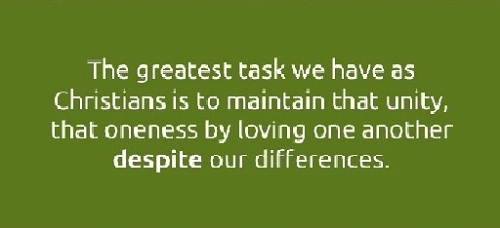
We should remember that unity comes only in Christ. It is not through religion, doctrines, denominations or bible versions but through Christ alone. Unity through Christ looks beyond religion, doctrines, denominations, race, sexual orientation and nationality.

God is love and he lives within us. By allowing his love to flow out of us we can look beyond our differences and accept one another even when we disagree.

One thought comes to mind in all this, ‘Jesus loves me this I know, for the bible tells me so’. The most basic and simple song we learned long ago seems to be the one thing on which we can all agree.

Read Full Post »

By Mike Edwards

It is only natural to think a Creator would love us and others how we were seemingly created to love others. It matters what we think God is like because our understanding determines the depth of our relationship with God and others. Those who believe in God typically suggest we should strive to be perfect like God. An atheist would say the only kind of God worth believing in is a perfect God. Such language assumes we know perfect from imperfect, good from evil.

Those who declare God is mysterious even believe human and godly perfection are the same.

God is claimed to be a mystery sometimes because one’s interpretation of Scriptures makes God appeal evil from a human perspective. Isn’t this because we all have an inborn intuition that God and human perfect love are the same? It’s nonsensical to suggest evil is sometimes good in God’s eyes. Even the Bible assumes we can know what perfect love is, because the Bible tells us to be perfect like God (Mt. 5:48). We must question our interpretations when God’s love seemingly is not the same as perfect human love.

But, we don’t all agree what perfection is! 

Most agree all should strive to treat others like we want to be treated. We seem to know how we “ought” to treat others. Now, there is disagreement. Should we show tough love to a loved one struggling with addiction or believe their regret of actions and give another chance? Certainty in how we should always act or know what God would do is an illusion. Certainty has led to forcing “supposed” truths onto others. Uncertainty, unless obviously immoral such as sexual abuse, allows different opinions to stand side by side as we continually evaluate the most loving approach. 

Something isn’t immoral because we think the Bible says so.  

Many believe the Bible or Quran are revelations from God about what God is like. But, scholars and laypeople disagree on meanings of passages since literature requires interpretation. Certainty about God according to one’s interpretation is an illusion. Terrorists and extremists defend their beliefs because of a supposed inspired Book, but interpretations aren’t inspired. The world may be an amazingly different place if God-followers didn’t say “because the Bible says so.” 

Human perfection is our best starting point for knowing what God is truly like.

Common moral sense is not the enemy. Don’t let your interpretation of a Book override the golden rule with others of a different gender, color, or sexuality. Don’t condemn others because of your interpretation, whether you believe a Book is infallible or not. You can hardly ever go wrong treating others like you wish to be treated if in their shoes. Actions of love are always more important than any beliefs. What do you imagine a good God is like? You may be right!

Read Full Post »

by Jim Gordon

Romans 12:18 – If possible, so far as it depends on you be at peace with all men.

To be at peace with all people, including believers and non-believers seems almost impossible in our world today. We have so many different thoughts and ideas, different denominations, interpretations and beliefs and all the different religions. It makes you wonder how it is possible to be at peace with everyone?

The dictionary describes peace as freedom from disquieting or oppressive thoughts or emotions; harmony in personal relations.

I have been thinking recently about how some christian people act towards those who see things differently. I do not know why we can be so mean at times. We feel we have to prove our point to others and stand our ground when it comes to doctrine and interpretation of the bible. I am not sure why we feel it is our job to be the morality police. Why do we feel the need to force our views, beliefs and interpretations on others?

Rather than base our lives on following doctrine and interpretation, we are to follow the example of Jesus. He said to love God and love one another. There is no way to be at peace with others without loving them. We cannot love others without the Spirit of love living within us.

I think what God is saying about being at peace with all is that we are to live in harmony with others, not allowing any oppressive thoughts or emotions to take control of our feelings toward them. In other words, we live in love. Just because someone does not interpret the bible the same way we do or go to the same church we do or does not go to church at all, we should realize that in regard to other believers, we are all wanting to love God and do what is pleasing to God. We are to accept one another in love and respect the fact that God is working in different ways in people. Just because it is not what we are used to does not mean it is not of God.

In regard to non-believers, we do not need to condemn them or force our beliefs on them. We are to let them see the love of God by the way we treat others. They do not need someone beating them down or twisting their arms to get them to believe like us. We are to love them as they are and let the Spirit do any work that needs to be done in their lives just as the Spirit does in our lives.

If we believers could understand that we are responsible for ourselves in the way we live for God. We are not responsible to live the way others do or the way others think we should. We are to allow our Father to work in our lives the way He wants and follow Him on the path He has for us.

Our responsibility is to love God and love others, accept them for who they are and pray that the Holy Spirit will teach us and guide us in the way we are to go. We are not responsible to force others to see things the way we see things. We are to love one another and accept one another as they are. Only by living in love can we live at peace with all.

Read Full Post »

By Mike Edwards

I understand many may not think about or find all that relevant whether God knows the future or not. It may sound sacrilegious or odd to suggest an all-powerful God doesn’t know the future. But, even an all-powerful God may not being able to do the impossible such as change the past, force true love, or know an undetermined future until it happens.

It matters if God can know possible future suffering.  

A woman asks God for wisdom in marrying their partner. All think it is a match made in heaven, but the husband becomes abusive and the children suffer. It is hard to imagine God wouldn’t warn if God knew this was going to happen. Much of suffering is the result of current and future human free decisions. God and parents risk creating knowing this can lead to great joy or great pain. Not even an all-powerful God can create free will necessary for genuine relationships and guarantee life without death, violence, suffering, and struggle.

Decisions and our relationship with God are less complicated if the future is open.  

The greatest freedom perhaps in believing God doesn’t know the future is realizing God isn’t failing to communicate or we may disappoint God with decisions. God isn’t hiding a “known” future for important decisions. We already know the mind of God when it comes to moral decisions; otherwise, God supports us in making decisions that make our lives and the lives of others better. There isn’t one correct decision to make in a free world. Joy and good can be achieved by taking any number of paths and avoiding immoral paths. God wants us to feel free without strings attached, unlike what we may feel from human parents when making decisions.

It matters relationally if freedom is real.

Most agree love must be freely chosen, or we are simply robots than humans. How am I truly free to make decisions if the future has already supposedly happened? A determined future contradicts that God created us with the freedom to make our own choices. We don’t have to rationalize God created freedom but somehow future decisions are predetermined.

A God who doesn’t knows the future is more relatable. When the Bible says God grieves with us in our suffering, we can know God agonizes with us each step of the way and deters any suffering possible without violating freedoms. God is not aloof as if simply gazing into a future crystal ball. God’s uncontrolling nature doesn’t mean God isn’t active in making for a better world. God constantly seeks to inspire us to shun evil and strive for a better world.

What about the Bible or prophecy? 

Hundreds of biblical passages could be cited to defend either God does or doesn’t know the future. The Bible speaks about God sometimes regretting certain decisions (i.e. Gen. 6:6). If God knew the outcome of certain decisions by knowing the future, why would God make such regrettable decisions? Does God really know what decisions are made ahead of time but pretending otherwise? The Bible often speaks as if God thought the future was open, thus undetermined and unknown.

Prophecies aren’t peering into the future but can serve as warnings. Jesus predicted Peter would deny Him three times but Jesus also prayed Peter’s faith would not fail (Lk. 22: 32-34). Predictions by God can be conditional. A professor may observe a student and warn they will fail their class but hoping the student avoids such failure. Keep in mind the future is not totally unpredictable for humans much less God. A skilled physician can predict the death of a seemingly healthy individual because of symptoms that escaped the untrained eye. Remember, God’s Spirit is present everywhere, thus God’s knowledge is unimaginably extensive.

God is loving not controlling.

God can’t control the future if God is to act uncontrolling and respect freedom. God can’t make someone truly love others and not harm others. If God can create, God can fulfill a promise to provide eternal life after life here on earth for those who desire to be with their Creator. Meanwhile, God seeks to partner with us to make for a better world.

MORE POSTS IN SERIES: I DOUBT GOD REALLY ……

Why I Doubt God Is An Excluder Of Religions

Why I Doubt Heaven Is Closed To Anyone After Death

Why I Doubt Hell Is Real

Why I Doubt God Is A Homophobe

Why I Doubt God Is A Sexist

Why I Doubt God Is A Mysterious, Moral Hypocrite

Why I Doubt God Is A Blood-Thirsty Child (Jesus) Killer

Why I Doubt God Expects Every Word Of The Bible To Be Viewed As Inspired

Why I Doubt God Is An End-Of-The-World Doomsayer

Why I Doubt God Is An Angry Egomaniac

Why I Doubt God Is A “Hidden Agenda” Proselytizer

Why I Doubt the god of Extremists Or Terrorists

Why I Doubt God Is A Prayer Genie

Why I Doubt God Controls Evil And Suffering

Read Full Post »

By Mike Edwards

Beliefs about God can lead to many tuning out God. Our relationship with God cannot exceed our understanding of God. I suggest HERE how we can decide what God is really like. One’s interpretation of a Book may be the only reason to think human and godly perfection are different. Why would a Creator not love us and others how we were seemingly created to love others?

God can’t be a controlling lover.  

Controlling love is an oxymoron. Besides, not even an all-powerful God can give us free will and not give us free will at the same time. Genuine freedom must involve the right to do as much harm in proportion to how much good one can do. It isn’t that God has the power to do something and doesn’t. It’s that God can’t. God can’t control evil here on earth if God respects freedom. 

Is God to blame for suffering?  

A good God surely doesn’t cause or want us to suffer. Praying doesn’t make God more caring. God is already doing all they can in a free world. Jesus’ prayer to avoid the Cross may be the best model in times of suffering. Jesus asked God to intervene but God if you are unable please stay close to me. Pretending God can simply heal without accounting for freedom can makes one’s suffering worse. Why did God heal them and not me? Did I not pray enough? Did I not beg enough? Did I not behave enough or have the right attitude? It isn’t that we didn’t pray enough with the right words and behaviors so God will answer. God is already doing all God can.

Why bother to even pray then?  

Maybe prayer is more talking and sharing with God then asking for things and for God to override freedom. Maybe prayer is meant to help us not feel alone in a chaotic world. Prayer is more talking to gain support than manipulating for gain. God is always available to talk about anything on our heart, but we best leave running the universe to a loving God who has the interest of all in mind. 

Don’t miracles prove God can control what God wants?

One must admit miracles aren’t that frequent. The Old Testament reveals amazing miracles don’t always lead to inspired living. Jesus’ miracles turned heads but Jesus’ suffering turned hearts of billions of followers. We can pray for others but God is already doing all they can. Are we? Miracles can happen as many can attest to, but miracles don’t happen because people grovel at the feet of an arbitrary God who has to be begged to love more. Miracles happen when God’s uncontrolling love aligns with countless factors known and not known.

Prayer is not a substitute for action.

It is easier sometimes to pray for someone than take supportive actions which is the most common way that God answers prayers. Rather than praying your friend’s spouse stop drinking, which is harming their family, see if your friend would rather you say something to their spouse. When you know two friends are in conflict, speak to the one wrongly denying any wrongdoing. God always desire our permission to use our lives to help others.

The Bible says you can ask for anything you want in God’s name! 

Our interpretations much account for what a loving, uncontrolling God can do. Passages such as Mathew 7:7 are lifted out of context to support the false prosperity gospel: “Ask and it will be given to you; seek and you will find; knock and the door will be opened to you.” Isn’t this passage in context simply saying that if we parents give good gifts despite our imperfections, will not God as our perfect Parent always give good gifts. First-century readers didn’t assume this was a blank check for any request. The Apostle Paul expects followers would face persecution for their beliefs (2 Tim. 3:12), thus God obviously is not a blank check.

How can we pray?

We might replace the word “praying” in the Bible with “talking.” We can talk to God for many reasons including pursuing a closer relationship with our Creator to be more like God, for self-examination, for sharing our concerns, and not feeling alone in a chaotic world. We tell our children associating with the right people leads to making wiser choices. Maybe prayer is to motivate us to be more loving like God toward others. God is not a Genie in a bottle who can singlehandedly all by themselves make things instantly happen. God is surely doing all they can to influence for good and seeks our help to change the world for good.

See Mark Karris, Divine Echoes: Reconciling Prayer With the Uncontrolling Love Of God

 MORE POSTS IN SERIES: I DOUBT GOD REALLY ……

Why I Doubt God Is An Excluder Of Religions

Why I Doubt Heaven Is Closed To Anyone After Death

Why I Doubt Hell Is Real

Why I Doubt God Is A Homophobe

Why I Doubt God Is A Sexist

Why I Doubt God Is A Mysterious, Moral Hypocrite

Why I Doubt God Is A Blood-Thirsty Child (Jesus) Killer

Why I Doubt God Expects Every Word Of The Bible To Be Viewed As Inspired

Why I Doubt God Is An End-Of-The-World Doomsayer

Why I Doubt God Is An Angry Egomaniac

Why I Doubt God Is A “Hidden Agenda” Proselytizer

Why I Doubt the god of Extremists Or Terrorists

Read Full Post »

by Jim Gordon

Growing up in the church system I was always taught that the pastor was the authority on anything spiritual. After all, they had been ‘called’ and had gone to college to be taught everything about God and the bible.

I remember how impressed I was by pastors. If I had a question about the bible I could make an appointment and go in and talk with the pastor. I figured he would have all the answers.

As I got a little older, I became infatuated with some of the big named evangelist. I would listen to them, send them money and if at all possible, go to their crusades. I can remember thinking if I could only be like them. They were super-spiritual and knew all about God and had the answers to all spiritual questions.

I really thought that was the way to learn about God, by going to church, reading the bible and getting all the wisdom of the pastors and evangelists.

Fortunately, I got to a point where I realized the pastors and evangelists were no different than me. They did not have all the answers and they were not super-spiritual like I had always imagined. I came to understand that people are people. None are closer to God or more special to God than another. Yes, some are more knowledgeable due to more time reading and studying but no one is higher up or more important in God’s eyes.

Now days I really do not care much what men and women say, it is just their opinion. They are humans like the rest of us. We can certainly discuss things and get insight from one another, but God loves each of us the same. The Spirit within us can guide and teach us without the help of any human being. If we believe the Spirit lives within us, why are we more interested in what another human says? Why not learn how to hear the voice of the Spirit from within rather than the thoughts and traditions of men?

Read Full Post »

by Jim Gordon

We hear the word fundamentalism often in the christian world. I actually grew up as a fundamentalist but never realized that was what I was because I never put much thought into all the different terms and labels. I just loved God and went to church because that was the way I thought we lived the christian life.

When I looked up the word fundamentalism in the dictionary I found the following definitions: 1. a conservative movement in theology among nineteenth and twentieth-century Christians. Fundamentalists believe that the statements in the Bible are literally true. 2. in Christianity the belief that every word of the Bible is divinely inspired and therefore true. 3. a religious movement characterized by a strict belief in the literal interpretation of religious texts, especially within American Protestantism and Islam; the beliefs held by those in this movement; strict adherence to any set of basic ideas or principles.

Now that I know what fundamentalist means, I no longer believe I would be considered one. My views, beliefs and interpretations have changed so much over the years, especially since leaving the organized church. For some reason I never felt comfortable asking questions while in the organization. I just took what the pastor said as gospel truth and never questioned anything. Being outside the walls of religion I can let all those questions come out and seek truth from the Spirit of God rather than from a pastor.

I believe fundamentalism leads more to separation, condemnation and being judgmental. It seems to me being so set on specific doctrines, beliefs and interpretations can prevent us from asking questions, learning, accepting and loving others.

Are my thoughts a popular way of looking at the christian life? Of course not! I grew up in the organized church from a very young age and spent nearly sixty years in it. I also used to think everything depended on my works such as attending church, tithing, doing good works, reading the bible and believing it was perfect, completely literal and the only way God spoke to us today. There are many people still doing all this and they sincerely love God and think this is the way we are to serve God. Yet being outside of this setting I have seen what is for me a better way. A way of depending on the Spirit within to teach and guide us. A way that loves and accepts others even when they do not see things the same.

Today the term fundamentalist christian seems to have more of a meaning of being hateful and not being accepting of others views. Completely different from what Jesus taught and what God is like.

Jesus was not a fundamentalist, he was not even a christian. Jesus was the personification of the Father who is a God of love. Even those writings from the old testament where men wrote from their beliefs, ideas, interpretations and what they thought about God were shown to be wrong when Jesus arrived. He showed us that God is not a god of vengeance, hatred and murder but a God who loves all of us.

We are to love God and love one another. Loving our neighbor does not mean just loving those who live next door, or loving those who believe like we believe. Our neighbor is everyone else in the world. Seems to me most fundamentalist reject those who see things differently and prefer to stay away from those who do not believe the same.

I would rather be known as a follower of Jesus rather than a fundamentalist christian. The way of the law and following rules and set doctrines of men have come to an end. The way of loving one another because of the grace of Christ is the new covenant way. I have actually become quite tired of using labels at all. We are all human beings who are loved by God. We should all be treated with love, respect, acceptance and have the same rights as everyone else. God did not create some people better than others, we are all created in the likeness of God and are loved by God.

There are so many topics and beliefs I grew up learning in the fundamentalist church that I no longer accept. I certainly have not lost my belief in or love for God, yet the many interpretations that were taught by men and women in the institution I now find wrong and not like Christ.

Rather than adhere to a set of rules and institutional-taught beliefs we are to submit to the guidance of the Holy Spirit who lives within us. Learn to hear the voice of the Spirit and let your life be a daily communication of the love of God to others.

Read Full Post »

By Mike Edwards

I am convinced there are beliefs claimed about God that lead to many tuning out God. I have written HERE how we can decide what God is really like. Our relationship with God cannot exceed our understanding of God. Why would a Creator not love us and others how we are seemingly created to love others? What if you discovered all this crazy talk about the world ending with the Battle of Armageddon isn’t in the Bible?

  • People talking about Jesus coming and such predictions never coming to past make God-folks seem slightly loony. Too, certain end-time views can lead to passive living and not taking care of the world for the next generation. God surely prefers focusing on making a difference than escaping. I have to admit though being lifted up in the sky (i.e. rapture) doesn’t exactly thrill me because of my fear of heights!
  • There are many different views of the end-times in the Bible by scholars. I would suggest since we can’t know for sure that we ought to live lives as if it mattered for the next generation. One should ask if the Bible teaches God is coming again to destroy the word in the future, why did Jesus tell his audience that supposed predictions about the world ending would happen in their lifetime: “Truly I tell you, this generation will certainly not pass way until all these things have happened” (Mt. 24:34)?
  • If Jesus is coming again down from the sky, which is supposedly an idea from the Bible, why did the disciples ask Jesus: “what will be the sign of your coming and of the end of the age” (Mt. 24:3)? Only non-visible, spiritual comings are missed.
  • Maybe the end-times were not an earth ending event. As Jesus was sitting on the Mount of Olives, the disciples came to him privately. “Tell us,” they said, “when will this happen, and what will be the sign of your coming and of the end of the age?” (Mt. 24:3) In the first century the temple and Jerusalem was destroyed and millions of lives were lost. Biblical Judaism ceased to exist. This could have been the end of the age that Jesus warned of. Biblical writers go on to say God no longer dwells in temples but people’s hearts.
  • End-times talk is often associated with the talk of hell and heaven. Jesus didn’t say much about heaven as one may think. When Jesus spoke about eternal life, He spoke of it not in terms of something after death but a quality of life that begins here on earth to avoid future regrets. See here. 
  • Why doesn’t the Bible say more about heaven? A solely heavenly focus can lead to passive earthly living, similar to focusing on Jesus’ coming rather than making a difference in the world we live in currently.

But, what about the Book of Revelation?

Revelation was written to people in the writer’s era warning about their near future; it is not a letter written to predict a distant future. Self-destruction is predicted if looking to nations then our Creator for solutions. Words “antichrist” or “rapture” are not found in Revelation. Many simply use such words from other books in the Bible to weave into their story advocating for an end to the world. Revelation doesn’t require a violent end by God but encourages its readers living in such a way that can lead to peace in our future here on earth. See insights on Revelation: https://thinkingpacifism.net/2019/06/27/revelation-for-post-christians-peaceable-revelation-1/#more-8468

 Why I Doubt God Is An Excluder Of Religions

Why I Doubt Heaven Is Closed To Anyone After Death

Why I Doubt Hell Is Real

Why I Doubt God Is A Homophobe

Why I Doubt God Is A Sexist

Why I Doubt God Is A Mysterious, Moral Hypocrite

Why I Doubt God Is A Blood-Thirsty Child (Jesus) Killer

Why I Doubt God Expects Every Word Of The Bible To Be Viewed As Inspired


Read Full Post »

By Mike Edwards

I am convinced there are beliefs claimed about God that lead to many tuning out God. Our relationship with God cannot exceed our understanding of God. I have written HERE how we can decide what God is really like. One’s interpretation of a Book may be the only reason to think human and godly perfection are different. When the Bible is said to be infallible or inspired by God, most assume every word penned comes from God. Why would a Creator not love us and others how we were seemingly created to love others?

The infallibility of the Bible is a non-starter.  

We don’t have the original manuscripts. If infallibility was critical, why didn’t God find a way to preserve the original texts if God controlled the writers’ thoughts. The most common defense for arguing the Bible is inspired is to claim the biblical writers made such a claim. Such logic would not lead those same people to accept the Quran being infallible because it claims to be. God didn’t necessarily have in mind that recordings wouldn’t be questioned. Another view of the Bible is accepting as a document recording experiences of beginnings with God and Israel culminating with the life of Jesus that we don’t possess in any other documents. Such writings can keep us talking and reflecting what God is really like.

Did God really inspire genocide or marrying one’s rapist?  

Did God really approve a woman being required to marry her rapist. Laws proclaimed by Moses supposedly came from God. Deut. 22: 28-29 says: If a man happens to meet a virgin…and rapes her…He must marry the young women, for he has violated her. The idea of a woman ever having to marry her rapist as a good thing hardly inspires many about God. I am convinced only humans thought this was a good law at that time, not God.

Did God really inspire acts or language of genocide? I Samuel 15:3 says God told Israel: “Now go, attack the Amalekites… put to death men and women, children and infants, cattle and sheep, camels and donkeys.” Only evil dictators approve of such actions or talk during war. Hundreds of passages in the Old Testament advocate violence in God’s name. It isn’t irrational to ask if a good God would inspire or approve such thoughts or language.

An inspired Book leads down the slippery slope of inspired interpretations.

Most admit literature requires interpretation, thus why biblical scholars often disagree about the meaning of the same passage. It is seldom voiced one’s view about God according to their interpretation could be wrong. Such an admission would encourage different views standing side by side as we continually evaluate the most loving approach, rather than forcing opinions on others in the name of God.

An inspired Book has led to justifying violence in the name of God.

The possibility of an infallible or inspired Book has led down the slippery slope of assuming God’s views on morality only come from a Book such as the Bible or Koran.  Not questioning if writers always understood God perfectly has led to justifying slavery, killing infidels, and other atrocities in the name of God. Interpretations must be questioned by our moral consciences.

An inspired Book leads to declaring God mysterious, thus less knowable or relatable.

God is said to be a mystery beyond human comprehension because one’s interpretation clashes with common human moral sense. When assuming the writers understood God perfectly, we often search for ways to rationalize our interpretations. How can one understand a God who created us to know and hate evil, if their evil in our eyes is supposedly good sometimes?

People may be rejecting God for the wrong reasons.

Two plausible interpretations exist on most major issues when speaking of God’s character. Many defend that the Bible teaches that God proclaims women cannot be in authority over men in roles such as a priest or pastor. Women can rightly feel disrespected and confused why a supposedly loving God would put men in leadership position over women which has encouraged dominance on the man’s part leading to atrocities women face at the hands of men. People condemn gays, despite their heart saying otherwise, because God supposedly rejects same gender loving relationships according to a Book.

It is dangerous to value right beliefs or interpretations at the expense of loving others.

Those not growing up in church don’t understand all the fuss. Who thinks literature subject to interpretation should be read so dogmatically? A fallible Book can lead to listening to different opinions as we continually evaluate the most loving approach. God doesn’t get enough credit for communicating through our moral senses how we ought to treat others. The Bible wouldn’t be God’s main communication anyway, because the majority born into this world never had a copy.

Many Christians are rightly accused to be judgmental when they in the name of God condemn gays, prohibits women from serving as pastors or priests, and judge others based on religion when the religion the majority adhere to depends where born. Their heart often tells them differently. There is likely more harm done when declaring certainty than uncertainty about God. It prevents conversations looking for areas we agree, respecting the opinions or others, and committing to growing in understanding.

Dangers In Not Questioning But Assuming The Bible Is Entirely Inspired By God


Series:

Why I Doubt God Is An Excluder Of Religions

Why I Doubt Heaven Is Closed To Anyone After Death

Why I Doubt Hell Is Real

Why I Doubt God Is A Homophobe

Why I Doubt God Is A Sexist

Why I Doubt God Is A Mysterious, Moral Hypocrite

Why I Doubt God Is A Blood-Thirsty Child (Jesus) Killer


Read Full Post »

« Newer Posts - Older Posts »