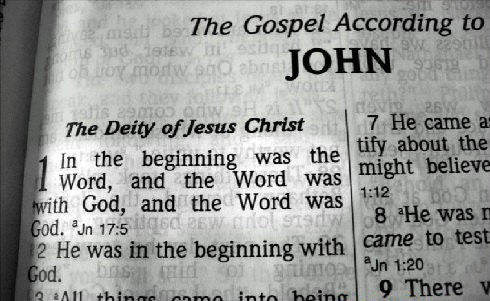
— John 1:1 In the beginning was the Word, and the Word was with God and the Word was God. — John 1:14 And the Word became flesh and dwelt among us and we saw His glory, glory as of the only begotten from the Father, full of grace and truth. — John 5:39-40 You study the scriptures diligently because you think that in them you have eternal life. These are the very scriptures that testify about me, yet you refuse to come to me to have life.
The Word is not just written words in a book. The Word mentioned here is Jesus, the Living Word.
So many of us focus on which version of the bible is the true word of God. These verses state that the true Word is alive and living within us. The true Word is not a book at all.
If we were never again able to read from the bible or hear it read to us, we still have the Living Word of God within us to teach us and guide us.
It is good to read our bibles no matter what translation we prefer because the written word is given by inspiration of God and is profitable for doctrine, for reproof, for correction, for instruction in righteousness. Yet the bible is not God and is not part of the trinity of God. It is not Father, Son and Holy Bible.
We need to remember that the bible was written by humans who were inspired to tell how they related to God, how they understood God, how they interacted with God and what they thought God was saying to them. The true Word of God is Jesus who lives within each of us through the Holy Spirit.
We can read the words on the pages of the bible and learn about grace and the love of God, but it is the Living Word within us by the Holy Spirit that brings to life and power the words we read. Jesus, who is the living, inerrant Word of God has final authority over any written words which we call the bible.
I have written on this topic ad nauseum. Issues not addressed in this Post see here. Many scholars acknowledge the Bible has numerous contradictions which is reason enough to question the Bible’s inspiration since God is assumed to be perfect. Does God take pleasure in destroying (Deut. 28:63), or does God take no pleasure in the death of the wicked (Ezek. 33:11)? Does God punish children for the sins of parents (Ex. 34:7; Num. 14:18), or does God never punish children for what parents do (Ezek. 18:20)? Questioning the Bible may lead to knowing God better.
Why wouldn’t we question since we can’t prove the Bible is inspired by God?
Circular logic is used to argue the Bible is inspired by claiming the biblical writers make such a claim. Besides, the passage most commonly used to defend inspiration is – “All Scriptures is God-breathed and is useful for teaching, rebuking, correcting and training in righteousness” (2 Tim. 3:16) – is subject to different interpretations. God-breathe could literally mean God-spirited, meaning God uses writings to touch our spirit. Humans are said to be God-breathed and we aren’t infallible. Also, this passage can only refer to the Old Testament since the New Testament and Jesus’ words hadn’t been collected.
Questioning avoids the slippery slope of inspired interpretations.
It doesn’t matter if you believe the biblical writers/editors always understood God perfectly because the Bible is literature which requires interpretation of a writer’s meaning and application to personal circumstances. Biblical scholars who respect the authority of Scriptures interpret differently what God thinks about divorce, gender roles, homosexuality, and the afterlife which impacts ever person every born. Infallible Books, as opposed to fallible Books, often lead down the slippery slope of justifying interpretations as if infallible.
Questioning avoids justification of violence and other immoralities in God’s name.
The idea of an infallible or inspired Book has led to assuming God’s views on morality only come from a Book such as the Bible. Terrorists kill infidels in the name of God. Extremists don’t question putting men in authoritative positions over women. One country only recently loosen restrictions on women’s ability to travel without male guardian permission. WHAT! Such ideas could only come from a supposed infallible Book about God. Imagine if terrorists or extremists had to question if God didn’t endorse words in a Book. A fallible Book may actually lead to less violence and violation of rights.
We must question if God really condemns women, gays, and other religions!
How could a loving God favor men over women in leadership roles which has encouraged centuries of domestic abuse and other atrocities women face? How could a loving God condemn gays, who have to hide their sexuality because of bigotry and hostility, when gays can no more choose who they are attracted to than straights can? How could a loving God approve only Christians go to heaven, when the majority of people born into this world rebel or adhere to the religion where born. Is God a God of chance?
Jesus as the final authority on God isn’t the solution.
Even if we argue all of Scriptures must be understood through the life and death of Jesus, since Jesus was God, this doesn’t solve knowing what God would do. We still have to interpret Jesus according to a Book. Rational people don’t agree on God and violence according to Jesus. When Jesus said love your enemies, does this mean He would say never to kill to love innocent victims when no other option seems to exist? We can’t always know when Jesus spoke about certain subjects without stating exceptions or used hyperbole for emphasis. It is better to question than go down the slippery slope of an inspired Book by God.
It is claimed we can’t know God if not through the Bible.
Only a perfect or good God is worth believing in! Who doesn’t know a good God hates beheading people because they don’t share your beliefs unless a supposed infallible Book supposedly speaks for God? God doesn’t get enough credit for communicating through our moral intuitions. Criminals often don’t defend their actions; instead, they deny committing such crimes. A Book couldn’t be God’s only type of communication because a copy of the Bible and knowledge of Jesus hasn’t been available to the majority of people born into this world. Problems often begin when we stray from common moral sense and insist on our understanding from an inspired Book. How can we decide what God is really like? See HERE
Is certainty really better than uncertainty about the Bible?
Total certainty is an illusion because even if God is Truth, we still have to discern what is Truth. Biblical scholars can’t agree if God desires preachers or priests be women or gay? It is suggested viewing the Bible as “inspired imperfection,” or we should view all of the Bible through Jesus’ eyes. As mentioned, even if Jesus was God in person His words still require interpretation. Uncertainty, not certainly about God, protects against imposing beliefs on others which is not God’s nature. Different opinions, expressed without physical or verbal aggression, can stand side by side as we continually evaluate the most loving approach.
What good is the Bible if we don’t know what passages are inspired by God?
I believe the Bible has God’s blessing. There is so much wisdom to be gained from interacting with it. The viewpoint that God didn’t inspire the Bible, or at least admitting one’s interpretation isn’t inspired, could lead to less violence in God’s name and forcing other immoral opinions on others. The Bible can be viewed as recorded experiences of beginnings with God and Israel culminating with the life of Jesus that we don’t possess in other documents. Question biblical texts by writers that give qualities to God morally questionable. Aren’t we created in God’s image?
God never intended a Book to take the place of a relationship with God and others. Even the Bible tells us the Word of God isn’t a Book but Spirit who lives in us (Jn. 14:16-17). As long as we read the Bible with a questioning spirit motivated by love rather than blind obedience, the Bible allows God’s spirit to influence making unselfish decisions for a better world. Certainty has only gotten us more violence, sexism, homophobia, etc. Discuss different views of God by defending our reasoning, respecting the opinions of others, and committing to growing in understanding.
How do you make any sense of history, art or literature without knowing the stories and iconography of your own culture and all the world’s main religions? – Polly Toynbee
When we Westerners create our icons, we do delve into the human figures throughout our history. There is something to say about the way an icon moves us to heal and liberate ourselves and the people around us. An icon can also have the opposite affect: Imprison and damage our way of being and others. We can see from human history, not all icons were worthwhile. In the end, it’s all about how we interpret the figure that we wish to iconize and how we put that vision into practice.
The origins of iconography take place within Christianity; with the images of Jesus and the saints after him. Western culture has taken this them and has made it into a more “secular” phenomenon. We see this with past presidents, sports figures, social activists, etc. Some religious practitioners (fundamentalists mostly) find this to be disturbing due to the reasoning of making humans out to be “gods”.
How can we bring out these secular beings into the space of Jesus (they would say)? Aren’t we making icons into idols, then? I would say: Hell no! Here is why: By making humans into icons we begin to step into the reality of the incarnation of Christ. We experience that we all can make some type of change through healing and liberation. Its what Jesus did by being his true human self.
Let’s take the tragic death of Kobe Bryant for example. We have seen Kobe do some amazing things on and off the court. He became a great father, husband, activist, and friend. By his example and iconic status, others followed in his footsteps and made a difference. Is this not Christ-like? Others do not see it that way. This is from a tweet from an individual who did not see it this way:
“Kobe dies & the world goes crazy; the son of God dies for wicked humanity & very very few care”
Without going into too much of a critique with this quote, I would just like to point out how this individual missed the point of the significance of Kobe Bryant’s death and the death of Jesus’. When we come to the realization that all deaths from the beginning to the end of time, from the ages of ages, have always been connected to the death of Jesus, we see that all deaths carry the importance of resurrection. This doesn’t always need to be the physical resurrection (although important) but also the symbolic resurrection, that helps all to wipe of the ashes of our current sadness and rise to a new transformed existence.
This is what the ancient church attested to the iconography of saints. It was the correlations that death has been trampled by death, and that Jesus resurrection involved the whole creation. The point of icons is not to idolize them, but to participate in their healing and liberating life. We are not these perfect beings that have no flaws and scars! To think an icon is any different from us is to fail to see the point of being an icon in the first place. To think that to see one as some sort of icon is a way to be irresponsible for ourselves and how we act in the world, is being bamboozled. When we depend solely on an icon, without seeing that icon in our enemies, we will never bring about a world of peace and love. It is why icons exist, to enable us to see the least of these as God. The Universal Spirit is calling us to the oneness of it all. Maybe we can beckon to Her call and embrace the unity of a curative icon…
Modern man has been in search of a new language of form to satisfy new longings and aspirations – longings for mental appeasement, aspirations to unity, harmony, serenity – an end to his alienation from nature. All these arts of remote times or strange cultures either give or suggest to the modern artist forms which he can adapt to his needs, the elements of a new iconography- Herbert Read
One may only believe God required a violent death of an innocent victim, much less God’s own child, because an inspired Book by God supposedly makes such a claim. How is it forgiveness if payback is required? How does an innocent person suffering really atone for another person’s sins? Even imperfect human parents don’t only forgive a child by punishing another child.
Freedom created by God is a farce if Jesus had to die!
If Jesus had to die, then Judas had no choice but to betray Jesus. If God predetermined that Jesus had to die so God could forgive our sins, those who killed Jesus where not free to choose otherwise. Crucifiers were not free to come to their senses that one simply claiming to be the Son of God doesn’t deserve to die a gruesome death on a Cross.
Child sacrifice was an abomination to God in the Bible.
Interpretations suggesting God requires child sacrifice must be wrong. In the Old Testament God through prophets declared child sacrifice was an abomination (Lev. 20:2-5; Jer. 32:35). Did God break the Ten Commandments “Thou shall not murder?” Old Testament passages interpreted as Messianic prophecies could be conditional – Jesus will be killed if people don’t turn from evil.
God and Jesus forgave others before the Cross.
In the OT before Jesus was born, God often forgave the Israelites. In the New Testament Jesus is recorded as forgiving others before dying on the Cross (Mt. 9:2; Lk. 7:48, etc.).
God requiring violence opposes God’s non-violent nature.
Most agree Jesus’ message was one of non-violence, though sometimes violence may be necessary to protect victims. Turn the check, go the extra mile, etc. are familiar sayings (Mt. 5:38-42). The Bible also encouraging striving to be perfect by imitating God (Mt. 5:48, Eph. 5:1). Believing God requires violence often leads to humans justifying violence in the name of God. The Cross actually reveals our ugly violent nature not God’s.
Why did Jesus die?
There are many possible explanations why Jesus died other than God killed Him so God could forgive. We may still be talking about Jesus because He was willing to die, rather than power over others, for a message He believed in. God has always sought change through influence than coercion. Jesus sought to inspire that an unselfish life empowered by our Creator is worth living. It was Jesus’s willingness to die, not His miracles, that has changed billions of lives.
There is so much violence throughout the world. Evil is alive and well even in churches, synagogues, and mosques. Must God-followers always lay down their arms according to Jesus’ words and example? Would non-violent reactions end wars and evil, or does evil end when all individuals and nations decide to stop victimizing others.
More and more God-followers are rightly advocating for a loving than wrathful God. Many suggest since Jesus is God Himself, we should follow His words if we think they contradict an Old Testament prophet’s understanding of God. Progressives, for lack of a better word, would likely agree the Bible was not written so we can simply turn to a page to get an answer for our problem. I might give my kids different advice though dealing with similar circumstances. Should you confront, divorce, etc.? It depends! Seek God and the wisdom of others who are slow to be certain.
Quoting Jesus doesn’t settle it!
Progressives accept that the Bible, since literature, requires interpretation. Love isn’t dogmatically claiming my interpretation is right and yours is wrong. One interpretation of Jesus according to the Bible is that His example and the Cross mandate we must not respond violently. But, should we always respond as Jesus did on the way to the Cross? The Apostle Paul didn’t. When in danger, Paul threaten God on others and appealed for government protection (Acts 23).
Some biblical scholars, who respect the authority of Scriptures, suggest Jesus advising to “turn the other cheek” (Mt 5:39) was illustrating how we might respond to insults, not that we can never respond to violence against us or others. Does this and other passages rule out individuals or nations defending and killing if necessary when being attacked or even under the threat of attack? Depends! Jesus didn’t condemn a Roman soldier’s faith for serving his nation (Lk.7:1-9).
Can we at least agree …….
Research is sited to suggest non-violent responses can deter further violence. We should always strive to not respond to violence with violence if there is another way. We don’t seem to agree that when violence seems unavoidable, that we can be grateful for those who protect us when people cannot be “talked or exampled” from violence. When we dogmatically claim God never advocates violence, we imply people are not being Christ-like when they must kill when serving their military, police force, or family. We don’t know what God would always do!
What would God do in your situation?
Can you have a security plan as a church or family that would use violence? That is a personal decision between you and God. You have to decide for yourself if to attend a certain church or go elsewhere. Personally, I hope I am God-loving enough to not respond to a situation with violence when other options exist. Jesus’ example encourages non-violence but sometimes self or government protection is necessary because evil is still very real. I am convinced we can love our enemies and love the innocent by protecting them from harm. The Bible doesn’t settle whether God would never advocate responding to evil with violence!
We don’t want the Christian tradition to become an antique shop just preserving old things. We want to build on old things and allow them to be useful in different ages, vocabularies, and cultures. We want our faith to be ever new, so that it can speak to souls alive and in need right now! – Richard Rohr
During the holiday season, we can see the old ways of tradition booming forth within each culture context. In most Western societies, the Christmas tradition rings loudest with its songs, lights, decorations and food. Not to take way the amazing traditions of Hanukkah, Kwanza, Winter Solstice, Yule, etc. What I am doing here is simply pointing out a renewed since of presence within the Christmas tradition. It’s easy to see the beauty within the holiday of Christmas and forget how much it has evolved since it’s beginnings.
In many instances, the Christmas holiday borrows from other ancient traditions to capture the currents cultures needs and desires. For example, the lights on the Christmas tree. Early Christians adopted this custom from early Celtics due to its symbolism of keeping “the evil spirits at bay”. Christians repurposed this custom into a symbol of resurrection to the “tree of paradise”. Both customs bring with it a truth of protection and new beginnings. Thus, the reason early Christians adopted the custom.
Also, even with the issues the Santa Clause brings (consumerism, greed, etc.), he did stem from a real Christian figure in Saint Nicholas as well as the folklore character known as Woden. Both figures brought gifts to the ones in need (which is a great symbol of what God does for her creation). I think the actual historic figure in this (Saint Nicholas) should be the one we tell our kids about. Here is what the real deal good old Saint Nicholas was about:
He used his entire inheritance to help the poor, sick, and children in need. He gave in secret, expecting nothing in return. Nicholas saved young women from slavery, protected sailors, spared innocents from execution, provided grain in a famine, and rescued a kidnaped boy.
All of this really points to numerous amounts of diverse traditions from ancient times that are still bringing about new ways of life in this holiday season. See, when we discover that the old ways were new once in time, we discover that the old ways always can become the new ways if we allow them to be renewed. I think we get to caught up in the tug between old vs. new that it ends up always being this dualistic battle instead of being a beautiful complementation.
We must let go of the idea that we must have this ageism divide between the old and new. To become unified (John 17:23) we will have to be more open to both sides of the old and new paradigm. Of course, when we see a tradition that brings harm to and individual or group, we have to cease the practice of that particular tradition and let it go. This can be hard for both sides. There will always be a time where regardless of how new or old a practice is, death and resurrection is going to be needed for a new type of design.
Jesus brings this same type of idea up when he said: “Every disciple of the kingdom is like a householder who draws out from his storage room, things both old and new”. —Matthew 13:52. It’s when come to the reality of the responsibilities of someone who is for the abundant life of all (not just some who have the same type of beliefs), regardless if it holds to the old or new ways. This is no easy feat. Fear has to die and love has to reign. It’ll be difficult but I believe it’s something that needs to be done if we ever want a world that brings life instead of death…
Oh, my ways are strange ways and new ways and old ways, And deep ways and steep ways and high ways and low, I’m at home and at ease on a track that I know not, And restless and loston a road that I know.- Henry Lawson
A God who bothers to creates surely wants us to know what God is like. Atheists and believers agree. The only kind of God worth believing in is a perfect God. A Book can’t be the only way to know God because even scholars, who respect the authority of Scriptures, don’t agree on whether Hell really exist or God condemns gays. Most believe we ought to treat others like we want to be treated. We can only know what such love is through our own moral notions.
God and human perfect must be the same.
If God exist most would agree with the Bible’s exhortation that we should strive to: “Be perfect, therefore as your heavenly Parent is perfect” (Mt. 5:48). It is intuitive that human and godly perfection are one in the same. We may not always know what perfect love entails but at least we always know the question we ought to ask ourselves – am I loving others perfectly? It is only natural to think a Creator would love us and others how we were seemingly created to love others.
We cannot know definitively what God’s perfect love is according to the Bible.
Literature always requires interpretation, thus why scholars disagree on the meaning of the same biblical passages. You are currently interpreting whether I am saying none of the Bible is inspired or that every word of the Bible may not be inspired by God. It is normal to question interpretations. Interpretations that don’t seemingly lead to loving your neighbor more may be amiss because they are contrary to our moral intuitions and understandings of perfection. We cannot avoid using our moral brains when reading ancient literature.
We cannot know definitely what God is like according to Jesus.
It is argued, because of the challenges understanding God and violence in the Old Testament, that Jesus is our final destination for fully understanding God. Jesus claimed to be God and His moral legacy seems undeniable. God-followers though don’t always agree what Jesus taught because of transmission, translation, and interpretation. People who love Jesus with all their heart don’t agree if Jesus’ teachings allow or rule out war when evil is rampant and victims can be saved. It is an illusion to claim we can know God would do because the Bible or Jesus says so.
Uncertainty can be a good thing.
Even if God is Truth we still have to discern what is Truth. Many leave the institutional church because of the lack of honest, open dialogue. Certainty has led to forcing “supposed” truths onto others. But c’mon! We don’t have to make laws against murder, sexual abuse, etc. Admitting uncertainty, unless beheading people for beliefs, allows different opinions to stand side by side as we continually evaluate the most loving approach. Problems often begin when we stray from common moral sense and insist on our understanding from a Book.
God surely is not a mystery but understandable.
The idea of a mysterious God may only come from one’s understanding of a Book about God. Biblical interpreters will often play the mystery card when their view suggests God’s morals are not the same as human morals. They understand some rationalization is needed when views of God are incompatible with human ideas of a loving God. If God isn’t understandable, why does the Bible ask us to imitate God (Eph. 5:1)? We may not be able to comprehend all plausible moral reasons how suffering and a good God can co-exist, but that doesn’t make God a mystery.
God surely isn’t a moral hypocrite humanly-speaking.
An evil God isn’t worth believing in. Language breaks down if we say God’s evil sometimes is mysteriously good. The Bible encourages us to be perfect like God, but we can’t be like God if God’s love isn’t what we know love to be. A Creator surely loves us and others how we were seemingly created to love others. God is neither mysterious or a moral hypocrite humanly-speaking.
So, for example how does God really feel about gays?
Many only condemn gays because they are convinced the Bible does. I have written here to please reconsider that the Bible doesn’t condemn gays, even if you believe every word is inspired by God. Some condemn gays because it doesn’t seem natural to them. Why would God condemn gays when they can no more choose who they are attracted to than straights can? We know the psychological harm done when one must hide their sexuality because of bigotry and hostility. Loving others like you want to be loved is true, human, godly love! See Here
Human perfection is our best starting point for knowing what God is truly like.
We often think of God according to what we have been taught. We may imagine God, most often referred to Father, is like our earthly father or parent. We may think God is like what is claimed by others according to the Bible. Our understandings about God shape our attitudes toward God. The more you respect your earthly parents or God, the closer you are to them. We can’t claim with certainty, which may not be a bad thing, what God would do in every situation but human perfection is our best starting point for discussion.
I am convinced there are beliefs claimed about God that lead to many tuning out God. Our relationship with God cannot exceed our understanding of God. I have written HERE how we can decide what God is really like. One’s understanding of a Book may be the only reason to think human and godly perfection are different. Why would a Creator not love us and others how we were seemingly created to love others?
It can be confusing by the way we talk about the Cross. A death doesn’t magically heal the pain we have caused God or others. The most healing we can hope for is when there is confession and forgiveness. A partner can never undo their betrayal, but taking responsibility and not blaming others can be a start toward healing. Many growing up in church may not have a problem with the idea of a child being sacrificed to appease God, but an outsider using common moral sense has to wonder why a God who truly loves requires blood before forgiving.
Requiring a debt be paid isn’t really forgiveness.
If you owe a monetary debt and you are required to pay it off, how is that forgiveness of a debt? God can’t both forgive a debt and require repayment. Demanding the blood of an innocent party doesn’t legally resolve another person’s guilt. My going to jail for a friend’s wrongdoing doesn’t somehow clear my friend of their crime. Guilt is not somehow magically removed by someone else’s confession of a sin they didn’t commit.
Jesus and the Bible sometimes contradict the necessity of blood to forgive our sins.
Jesus forgave the paralyzed man before His bloody death (Mt. 9:6-9). Jesus sure seemed to accept supposedly evil people in society before His blood was spilt on the Cross. Why does the Bible talk so much about the Cross defeating evil, rather than the Cross defeated evil so God could forgive us (Gal. 1:4, I Jn. 3:8, etc.)? Jesus seemed on a mission to help us battle ongoing evil, not to pay for a once-for-all crime.
If blood was necessary for God to forgive, why did even OT writers over time begin to write that God doesn’t like animal sacrifices but contrite hearts (Ps. 51:16-17, i.e. Jer. 7:22, Amos 5:21, Micah 6:6). Even in the NT God is said to not desire or be pleased with sacrifice and offerings though offered in accordance with the law (Heb. 10:8). These passages contradict passages that supposedly teach God required Jesus’ death to forgive us.
But, don’t Bible verses also say Jesus died for our sins?
Many passages insinuate that Jesus died for us (I Pe. 3:18, Rom. 5:8, I John 3:16, etc.). They don’t say Jesus died for God’s sake. Jesus could have died because of our sins rather than for our sins. Jesus’ death actually proves violence doesn’t solve differences. Jesus’ message was acceptance and forgiveness lead to healing. If the Bible was crystal clear the purpose of Jesus’ death, why do so many theories exist as to why Jesus died?
Why did Jesus die?
It is okay to speculate why Jesus was willing to die on the Cross. Biblical scholars haven’t figured it out. Jesus jumping off the Cross or overpowering His enemies was expected or hoped for but we would have learned nothing. We may still be talking about Jesus’ message of radical love as the best path for reconciliation, because He was willing to die rather than power over others. Jesus’ desire to inspire unselfish living empowered by our Creator is what really changes the world. Jesus’ death rather than His power has inspired billions to live unselfishly.
Jesus’ death can enable us to not feel overwhelmed by guilt and truly loved by God by what God willing to do. Terrorists blow others up for a message they feel strongly about. Jesus only blew Himself up for a message He believed very strongly in. Soldiers often sacrifice their lives because they are convinced certain freedom are that important. Jesus died in hopes we may understand true freedom is found by understanding what God is really like.
God forgives if we seek God’s forgiveness – no strings attached!
God is dying to forgive you of wrong doing in hopes to inspire you to change for your interests and the interests of others. God’s love and mercy, not God’s need for punishment, is our necessary nourishment in being the person we desire to be. That doesn’t get you a free out- of-jail card for a serious crime. That doesn’t mean when forgiving a friend that has betrayed you, that you have to pretend the relationship is back to the way it was. It takes two to tango. Unfortunately, many don’t seek forgiveness from humans or feel a perfect Creator accepts us and could simply forgive us for sins we have a hard time forgiving ourselves for.
God only ask us to do what God does – freely forgive without demanding punishment first
God didn’t kill Jesus by requiring Judas betray Jesus; we killed Jesus
God does not need violence, much less an innocent victim, to be satisfied
We don’t forgive one child by punishing another child
Jesus not responding violently sought to stop the cycle of violence – violence begets violence
It can be confusing or turn others away from God by the way we talk about the Cross. A death doesn’t magically heal the pain we have caused God or others. The most healing we can hope for is when there is confession and forgiveness. A partner can never undo their betrayal, but taking responsibility and not blaming others can be a start toward healing. Many growing up in church may not have a problem with the idea of a child being sacrificed to appease God – neither did the OT gods – but an outsider using common moral sense has to wonder why a God who truly loves requires this. Does the Bible really teach God requires blood before forgiving?
Requiring a debt be paid isn’t really forgiveness.
If you owe a monetary debt and you are required to pay it off, how is that forgiveness of a debt? God can’t both forgive a debt and require repayment. Demanding the blood of an innocent party doesn’t legally resolve another person’s guilt. My going to jail for a friend’s wrongdoing doesn’t somehow clear my friend of their crime. Guilt is not somehow magically removed by someone else’s confession of a sin they didn’t commit.
We may need to rewrite John 3:16 if Penal Substitution is true.
“For God was so filled with wrath against the world, that he sent his only begotten son to take the beating that we all deserved. That if anyone would want to escape eternal suffering, and would raise their hand and repeat this prayer after me, they would escape this horrible wrath. For the son was not sent into the world to change our minds about God, but to change God’s mind about us. So now that Jesus has taken the punishment for us, God can now finally love us, and forgive us.”https://www.patheos.com/blogs/keithgiles/2018/11/for-god-so-hated-the-world/
Jesus and the Bible sometimes contradict the necessity of blood to forgive our sins.
Jesus forgave the paralyzed man before His death (Mt. 9: 6-9). Jesus sure seemed to accept supposedly evil people in society before His blood was spilt on the Cross. Why does the Bible talk so much about the Cross defeating evil, rather than the Cross defeated evil so God could forgive us (Gal. 1:4, I Jn. 3:8, etc.)? Jesus seemed on a mission to help us battle ongoing evil, not to pay for a once-for-all crime.
If blood was necessary for God to forgive, why did even OT writers over time begin to write that God doesn’t like animal sacrifices but contrite hearts (Ps. 51:16-17, i.e. Jer. 7:22, Amos 5:21, Micah 6:6). In the OT sacrifices were for unknown sins while known sins were punished not forgiven. Even in the NT God is said to not desire or be pleased with sacrifice and offerings though offered in accordance with the law (Heb. 10:8). These passages contradict passages that supposedly teach God required Jesus’ death to forgive us.
But, don’t Bible verses also say Jesus died for our sins?
Many passages insinuate that Jesus died for us because of our sins (I Pe. 3:18, Rom. 5:8, I John 3:16, etc.). They don’t say Jesus died for God’s sake. Jesus could have died because of our sins rather than for our sins. Jesus’ death actually proves violence doesn’t solve differences. Jesus’ message was acceptance and forgiveness lead to healing. If the Bible was crystal clear the purpose of Jesus’ death, why do so many theories exist as to why Jesus died?
Why did Jesus die?
It is okay to speculate why Jesus was willing to die on the Cross. Biblical scholars haven’t figured it out. Jesus jumping off the Cross or overpowering His enemies was expected or hoped for but we would have learned nothing. We may still be talking about Jesus’ message of radical love as the best path for reconciliation, because He was willing to die rather than power over others. Jesus’ desire to inspire unselfish living empowered by our Creator is what really changes the world. Jesus’ death rather than His power has inspired billions to live unselfishly.
Jesus’ death can enable us to not feel overwhelmed by guilt and truly loved by God. Terrorists blow others up for a message they feel strongly about. Jesus only blew Himself up for a message He believed very strongly in. Soldiers often sacrifice their lives because they are convinced certain freedom are that important. Jesus died in hopes we may understand true freedom is found by understanding what God is really like.
God forgives if we seek God’s forgiveness – no strings attached!
God is dying to forgive you of wrong doing in hopes to inspire you to change for your interests and the interests of others. God’s love and mercy, not God’s need for punishment, is our necessary nourishment in being the person we desire to be. That doesn’t get you a free out- of-jail card for a serious crime. That doesn’t mean when forgiving a friend that has betrayed you, that you have to pretend the relationship is back to the way it was. It takes two to tango. Unfortunately, most of us don’t seek forgiveness from humans or feel a perfect Creator accepts us and could simply forgive us for sins we have a hard time forgiving ourselves for.
It is suggested Jesus showed a better way through example and words, than the Old Testament, by dealing with enemies and relationships by non-violent means. But, would Jesus condemn a nation who sought peaceful means to resolve terrorist threats but when necessary protected themselves? Would Jesus really condemn an individual citizen who opened fire on one seeking to kill all in site in a school setting? If you would protect your own children, why not consider means to protect children in a foreign land from a dictator who enslaves them for sex and other evil acts?
It matters how we represent God when it comes to violence.
Condemning others in God’s name when we aren’t absolutely sure of God’s disapproval can drive people to unwarranted feelings of guilt with God or cause people to reject God for wrong reasons. One may think: “Why would a God who doesn’t intervene always in evil not allow me to protect myself.” Obviously, God is opposed to beheading others for their religious beliefs. When we advise God opposes all violence, implying it is wrong to protect ourselves against evil, such words condemn military individuals fighting for freedoms or private citizen forced to protect their family or others in a dangerous situation. Does God really condemn all violence?
The Bible can’t be our only source for guiding us about God.
The Bible surely wasn’t written to be an answer book as to what God would do in our unique situation. Jesus often didn’t answer questions directly. Jesus sought to change hearts which changes how we solve our problems. Imagine a world where all looked out for the interests of others and not just themselves when dealing with difficulties. Besides, literature requires interpretation and we don’t always agree what the writer meant speaking for God. Even the Bible tells us the Word of God has never been the Bible but flesh in the body of Jesus (Jn. 1:1-14). Jesus’ Spirit now lives in us to guide us in truth (Jn. 14:16-17; 16:13). Reading the Bible with a questioning spirit rather than blind obedience can lead to more accurate understandings of God.
Does Jesus really oppose all violence?
As you might suspect since the Bible must be interpreted, there is disagreement about the passage most often used to advice Jesus speaks to a new way in dealing with our enemies: “But I tell you, do not resist an evil person. If anyone slaps you on the right cheek, turn to them the other cheek also…You have heard that it was said, ‘Love your neighbor and hate your enemy.’ But I tell you, love your enemies and pray for those who persecute you (Mt. 5: 39, 43-44). I just don’t know anyone in their right mind that would advise a wife being beat by their husband to turn the other cheek or not protect themselves. It is possible the literal translation of Mt. 5:39 is “do not resist by evil means” which is more in line with Rm. 12:17: “Do not repay anyone evil for evil.”
I am opposed to pulling verses from the Bible to prove a point, but there are passages which can suggest God is not opposed to protective violence. In Acts 23 the Apostle Paul, who wrote much of the NT, defended himself quite strongly and then requested military protection from being killed by religious leaders. Jesus didn’t exactly turn the other cheek when struck while defending His innocence (Jn. 18:22-23). Parables are not meant to be taken strictly literally, but one might think if Jesus was opposed to all violence His teaching would have less violent metaphors (i.e. Mt. 13, 18, 25; Mk. 12; Luke 20). Evil is real and may require a violent response.
What we can know for certain about God and violence.
The majority may agree that God would oppose violence if more peaceful means were available to individuals or nations. More often than not violence begets violence. If we are always looking to meet violence with violence and never consider peaceful means, there will never be room for changes of heart and forgiveness. But, if you think niceness always begets niceness and a soft answer always turns away wrath, you may be leaving a slew of victims behind. In fact, some may only change when forcefully confronted with the pain they are causing. Though we may not know exactly what God would do in each situation, human shortcomings suggest violence should be our last option. If you are anything like me, I am quick to defend myself and confront others without consideration of other possibilities.
Lack of certainty what God or Jesus would do doesn’t have to lead to chaos.
Supposed certainty in the name of God has led to justifying genocide, sexism, homophobia, racism, and other atrocities. Being unable to declare the certainty of our opinions about God forces us to listen, think carefully, and come to an agreement. I don’t always know what God would do in personal or national situations. I do think the Bible as a whole encourages not seeking revenge and praying for ways to change hearts. I can’t say God would never advise a nation or individual to meet evil with force. Future lives may be saved. I do think the Bible as a whole encourages exhausting all peaceful ways possible. God surely desires a world where all look out for the interests of others and not just themselves when dealing with difficulties.
Helping Survivors is on a mission to help heal, educate, and empower people who have been impacted by sexual abuse, assault, or harassment. We are a passionate group of experts and advocates who believe individuals who have experienced sexual assault, abuse, or harassment deserve to know their rights and options.
If you are in crisis and need support
call the Trevor Lifeline
at 1-866-488-7386
Undue Medical Debt
Undue Medical Debt empowers donors to forgive billions in oppressive medical debt. We are dedicated to removing the burden of medical debt for individuals, families and veterans across America. Click HERE to donate now.
Doctors Without Borders help people worldwide where the need is greatest, delivering emergency medical aid to people affected by conflict, epidemics, disasters or exclusion from health care. Help support us by making a donation here:
Wishes are more than just a nice thing, they can be a game-changer for a child with a life-threatening medical condition. We grant the wishes of children with life-threatening medical conditions to enrich the human experience with hope, strength and joy. To make a donation click here:








 Done with Religion