Feeds:
Posts
Comments

Posts Tagged ‘Love of God’

by Rocky Glenn

As I sit here on the couch working on the next post in the Enjoy The Moment series, What About The Love? from Amy Grant’s 1988 Lead Me On begins to stream on Pandora.   The song gave me pause and brought to the forefront once again the issues we are facing today concerning religion and self-righteousness versus love aren’t anything new but were being spoken about thirty years ago and all the way back to Paul.  Below are the lyrics of the song followed by the words of Paul from Galatians.

“What About The Love”

I went to see my sister, she was staying with a friend
Who had turned into a preacher to save the world from sin
He said “First deny your body, Then learn to submit
Pray to be made worthy, and tithe your ten percent”
I said “Is this all there is, just the letter of the law?”
Something’s wrong.

I went to see my brother on the 32nd floor
Of a building down on Wall Street – You could hear the future’s roar
He said “Here we make decisions, and we trade commodities;
If you tell me where there’s famine, I can make you guarantees”
I said “Is this all there is, Power to be strong?”
Something’s wrong.

Something’s wrong in heaven tonight
You can almost hear them cry
Angels to the left and the right
Saying “What about the love, What about the love, What about the love?”

I went to see my neighbor, he’d been taken to a home
For the weak and the discarded who have no place to go
He said “Here I lack for nothing I am fed and I am clothed,
But at times I miss the freedom I used to know”
I said “Is this all there is When your usefulness is gone?”
Something’s wrong.

I looked into the mirror proud as I could be
And I saw my pointing finger pointing back at me
Saying “Who named you accuser? Who gave you the scales?”
I hung my head in sorrow, I could almost feel the nails
I said “This is how it is to be crucified and judged without love.”

Galatians 5:4-6 from The Message:

I suspect you would never intend this, but this is what happens. When you attempt to live by your own religious plans and projects, you are cut off from Christ, you fall out of grace. Meanwhile we expectantly wait for a satisfying relationship with the Spirit. For in Christ, neither our most conscientious religion nor disregard of religion amounts to anything. What matters is something far more interior: faith expressed in love.
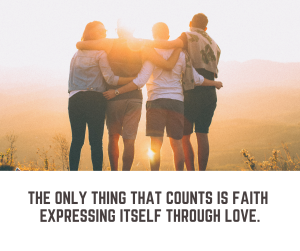
20190803_103705_0000

Rocky

More posts in the Soundtrack of a Churchboy’s Recovery series:

Read Full Post »

by Jordan Hathcock, Guest Blogger
https://welcometothetablesite.wordpress.com/2019/07/30/knowing-souls/

“So let’s get to the point, let’s roll another joint
Let’s head on down the road
There’s somewhere I gotta go
And you don’t know how it feels
No, you don’t know how it feels to be me”. – Tom Petty and The Heartbreakers

Do we really know “how it feels” to be in someone else’s shoes? Can we really comprehend the magnitude of other people’s experiences? Hard to say, really.  I know for myself; it is not easy trying to empathize and relate to others experiences and dispositions. We all attempt and often fail miserably. Often, our motives are what really play a huge part in how we engage with others and their issues. Coming from the Christian perspective, I think we are on the failing end of making a positive difference in others who are different then us.

It has become a competition in winning the souls of others, instead of building authentic relationships. Numerous of factors come into play of why this is. Not to get to long winded on this blog post, but the biggest driving force is the concept of hell. The Christian tradition has morphed into a factory of “get people of hell in the afterlife” instead of letting people experience “heaven on earth in the here and now”. Fear, greed, and the us vs. them motif is the foundation of this unfortunate state of affairs we are currently experiencing.  When you make a belief system of fear and hate into a thriving institution, the effects are direly devastating.

But, I don’t think all is lost (yes, very optimistic of me I know).  There always has been another spark and remnant that comes out of the evil empire that brings about hopeful change. I would like to quote this verse from the Christian scriptures that brings to light these two contending ideas of winning souls vs. entering in genuine relationships:

To the Jews I became as a Jew, in order to win Jews. To those under the law I became as one under the law (though I myself am not under the law) so that I might win those under the law. To those outside the law I became as one outside the law (though I am not free from God’s law but am under Christ’s law) so that I might win those outside the law. To the weak I became weak, so that I might win the weak. I have become all things to all people, that I might by all means save some.  I do it all for the sake of the gospel, so that I may share in its blessings.

The premise I take here (from the many different interpretations and commentary I have found with this scripture verse, and guess what? That’s ok!), Paul was trying to bring about blessings to those he made contact with for the sake of the gospel. It states: “I have become all things to all people…in order to save some”. It has the “winning souls” rhetoric here and to the first century readers that could have been more of a way of getting to a better way of being to escape the oncoming destruction of Jerusalem in 70 A.D (just a little side note hehe). But, I think how Paul finished up this passage is showing the real intention of “becoming all things to all people” (the true relationship builder): SO THAT I MAY SHARE IN ITS BLESSINGS! This right here is the point of entering in relationships with others.  This is what the Gospel of Christ should bring to ALL PEOPLE.

It about truly knowing people.  When Jesus says: To know God and His Son, this knowing is ginosko and this literally means “a felt knowing”, as in RELATIONAL! No matter who it is–black, white, gay, straight–experiencing the blessings of peace which produces love is what it’s all about. It is going out there and becoming friends with others (I know we can’t do this with everyone, but I think we can fucking do a better job than what we are doing now)! This is what brings us out of the hell we sometimes find ourselves in this life. The Kin-dom reality is about the here and now.  We will never develop and evolve (aka salvation) as a species until we realize that its real relationships that will get us there…

“Self-sufficiency makes God experience impossible! That’s why Jesus showed up in this world as a naked, vulnerable one, a defenseless baby lying in the place where animals eat. Talk about utter relationship! Naked vulnerability means I’m going to let you influence me; I’m going to allow you to change me. The Way of Jesus is an invitation to a Trinitarian way of living, loving, and relating—on earth as it is in the Godhead. We are intrinsically like the Trinity, living in absolute relatedness. To choose to stand outside of this Flow is the deepest and most obvious meaning of sin. We call the Flow love. We really were made for love, and outside of it we die very quickly.”

Read Full Post »

By Mike Edwards

I am convinced there are beliefs claimed about God that lead to many tuning out God. Our relationship with God cannot exceed our understanding of God. I have written HERE how we can decide what God is really like. One’s interpretation of a Book may be the only reason to think human and godly perfection are different.  Why would a Creator not love us and others how we were seemingly created to love others?

The Bible often does portray God as an angry hothead.

Many Old Testament passages just can’t be rationalized away. The story starts off by God destroying the world minus eight with a Flood. Even if it was a local as opposed to global flood, the metaphor still stinks! There were surely a few people innocent of evil so horrific to escape such actions by God. Who doesn’t think it is wrong to drown just one child in a bathtub? It gets worse by killing babies in Egypt and God supposedly ordering the Israel army to “not spare them: put to death men and women, children and infants, cattle and sheep, camels and donkeys”(I Sam. 15:3). Hundreds of passages seem to advocate evil behaviors in God’s name.

Hundreds of passages also speak of God’s love and mercy. Did the biblical writers think it sacrilegious to not portray God in controlling terms like the others gods at that time? We have every right to question if the writers’ views of God evolved over time. God can handle it. I wish the writers had clearly indicated God was angry at evil as opposed to people. God violent one minute and merciful and loving the next minute sounds like an abusive spouse or parent.

Doesn’t the Bible say “fear God” or else?  

We are often encouraged to fear God as if God thinks such fear and obligatory loves leads to a genuine relationship. God supposedly demands fear for ego reasons or as a sign of reverence. Fearing someone seldom leads to an inspiring relationship with that person. Some scholars suggest “fear God” is better phrased “respect God.” God’s request for respect (glory) is no different than a loving parent’s hope for respect because their love should have their child’s best interest in mind.  

Are humans really holier or more moral than God?

A human parent warns or gets upset with a child’s actions not in their best interest or the welfare of others, but that doesn’t lead to them wanted to annihilate their child. What God or parent doesn’t know sin has its own consequences; God doesn’t seek to pile on the anger. God doesn’t worry that their unimaginable love gives us further license to keep sinning. Acting selfish is natural and doesn’t wait for permission. God seeks to continually assure us of their love so we don’t every give up no matter how demoralized we may feel.

God couldn’t be egotistical!

If God was so worried about their reputation, God certainly would not have given us freedom to contradict their wishes. All the evil in the world suggests God isn’t controlling. God is not more concerned with restoring their honor than expressing a desire for a relationship freely chosen. Many religions today imply their god expects certain beliefs or face immediate extinction. Not the God of the Bible! And what kind of all-powerful God wants to be friends? Abraham (Jm. 2:23) and Moses (Ex. 33:11) are called God’s friend, and Jesus called the disciples His friends (Jn. 15:15). God is our Creator and Friend.

God isn’t possessive of their glory.

What kind of parent wants to be alone in their glory? Jesus says in John 17:22 after speaking on fulfilling his mission with his disciples and then turning his attentions to all who believe: “I have given them the glory that you gave me, that they may be one as we are one.”  We cannot be God, but we can strive to be like God. God’s request for glory is not self-infatuation. Imagine a world that glorified God in all they did! There would be no evil or suffering caused by others in the world. There would be no physical or sexual abuse in the world. There would be no parents living out their dreams through their children. There would be no bigotry based on the color of your skin or the gender you were born.  There would be no locking of cars and houses. God gets a bad rap when portrayed as selfish or obsessed with themselves.

Why I Doubt God Is An Excluder Of Religions

Why I Doubt Heaven Is Closed To Anyone After Death

Why I Doubt Hell Is Real

Why I Doubt God Is A Homophobe

Why I Doubt God Is A Sexist

Why I Doubt God Is A Mysterious, Moral Hypocrite

Why I Doubt God Is A Blood-Thirsty Child (Jesus) Killer

Why I Doubt God Expects Every Word Of The Bible To Be Viewed As Inspired

Why I Doubt God Is An End-Of-The-World Doomsayer


Read Full Post »

by Jordan Hathcock, Guest Blogger
https://welcometothetablesite.wordpress.com

“With the recent rise of progressive “Christianity” in the last few years, it’s no surprise that one of the prevailing themes is social justice. Many denominations have been caught up in the movement forever. But social justice is not the gospel, and saying that it is, is heresy.”

How about that quote? Makes you feel all good and warm inside, right (NOT)? So many things to discuss with the current slam-campaign against the current “social justice” Gospel issue. What gives? Why are we seeing such a surge of warnings and statements against this idea? Look, from the perspective of the Christian tradition, the Gospel has been on the hot seat ever since Jesus presented it–all the way to Paul and Peter/James (Gentile converts vs The Jerusalem Church) and the debates of what all this good news really looks like for the participants of the faith. The same old tale of us vs. them.

We have seen the Gospel in the West, for example, being more of a system of beliefs then a way of how one lives out their life. This stems from numerous factors (both the “religious and secular”)–from the reformation and it’s revolt against the corrupted hierarchy, to the enlightenment and it’s doorway to free thinking. This opened up a whole new way of how we look at the good news of what Jesus came to proclaim. It’s no longer something just a few “religious” people get to enjoy or other “secular” individuals get to reject. We are discovering (and rediscovering) that it was always news that set the captives free (I think any human would agree that we all feel trapped at times)!

The Gospel should always be seen as a way to bridge the gap between the outcast and the conformed, the poor and rich, the black and white, the gay and straight, the man and woman, the transsexual and the heterosexual, the child and adult (Gal. 3:28-get the picture?). We cannot be bamboozled by this notion that the Gospel is just one tight net idea that once examined and believed, no other type of suggestions or behaviors can stem from it. The Gospel is a plethora of creative and innovative ways of being in the time and place we are given.

It’s not just a set of beliefs (atonement theories) to believe in, nor is it one certain type of action within ones culture (social justice). The Gospel involves those ideas and actions, for sure! But, its really just simply good news; which everyone needs nowadays. The purpose of news, which is good, is to propel oneself and his/her social environment to beneficial new heights that have not yet been reached. It’s a reality where all are unified but still diversified. It’s a group effort along with the individuals surge. It’s a little bit of this and a little bit of that (a little D Mob for you hehe).

No matter what illusions we were given with this Gospel message of Jesus, one thing is for sure: It’s good, it’s here and it can be a reality that we all can experience. We don’t have to bring the accusatory spirit when one is deciding to put this beautiful gospel into action. Let social justice be part of this beautiful gospel. Let certain beliefs that come out of this gospel be for those individuals or denominations to have (let their actions speak). Let’s all just relax and mind our own business when it comes to telling and experiencing this Gospel of the Kingdom! LOVE and be peacemakers, for fuck-sakes!? (Matthew 5:9)…

“What if Jesus was not offering his followers an ethical system to follow, but rather was inviting them to enter into a life of love that transcends ethics, a life of liberty that dwells beyond religious laws? The difference between following an ethical system and being consumed by love can be seen in the way that ethical systems seek to provide a way to work out what needs to be done so that it can be carried out. In contrast, love is never constrained, it never sits back, it always seeks to do more than what is demanded of it.” – Peter Rollins

Read Full Post »

by Rocky Glenn

It’s that time of year again.  This coming Monday my son begins his fourth and final year of band camp for his upcoming senior year of high school.  When he began his high school marching band career four years ago, I did not realize it would rekindle the love of halftime shows and band festivals I once experienced myself.  It’s not that my admiration for the art had ever really faded, but dormant memories of after school practices, Friday night football games, and Saturday competitions resurfaced for the first time in many years.  Many times over the last three years I’ve mentally been taken back to playing stand tunes, loading and unloading buses, moving equipment, and anxiously awaiting to take the field for performance.

At one competition last fall, just as a band had taken the field and was about to begin, I heard a simple phrase I do not recall ever being uttered at a band competition.  Once the PA announcer had given the command to enter the field in competition and the spectators had fallen quiet in anticipation, three little words were heard from the band director standing on the sideline, “Enjoy the moment!”

Those three words stuck in my head.  I knew from experience all the work, energy, sweat, dedication, and effort required to get to this point.  For the last three months the students had prepared and rehearsed meticulously every minute musical and visual detail yet to be revealed in the minutes to follow.  A typical marching show lasts between eight and nine minutes and is the result of over two hundred hours of practice which many times consists of repeating the same thirty seconds of the program constantly for half an hour or more.  Every second and every minute of rehearsal and each football game performance had been building to this moment and the final words of instruction are not, “Give your all!”, or “This is it!”, or “Remember . . . “, but simply, “Enjoy the moment!”

To enjoy something is to experience it with joy and find pleasure and satisfaction in it.  A moment is an exact point in time.  To enjoy the moment is to experience this point in time with joy, pleasure, and satisfaction.  Put a different way, to “enjoy the moment” is to “be here now.”  I’ve had a coworker once use that phrase as a password.  At first glance, it seemed to indicate a lack of patience, but upon closer look it serves as a reminder to be present where you are.

For the sake of storytelling and narrative of this post, it would be amazing to write from the perspective of one who has conquered this idea.  I can’t say whether anyone else in attendance, in the stands or on the field, was struck by the director’s words, but the image of that moment is etched in my memory.  As awe-inspiring as it would be to write how it was a life changing moment and I have enjoyed every moment which has come my way since that blustery Saturday afternoon last October, to do so would be false and a lie. Still yet, the words echo in my head.

In the posts and weeks ahead, I intend to take a closer a look at what it means to enjoy the moment, why we often do not enjoy the moment, and exactly how we can truly enjoy the moment.

I look forward to the posts to come and sharing my thoughts with you.

Rocky

More posts in the Enjoying the Moment series:


Read Full Post »

by Rocky Glenn

As I shared in You Are Not Alone, since my recovery from being a churchboy began, I have encountered countless others that are walking a similar path.  I’ve since learned this path has been given the term “deconstructing.”  I heard it said just a couple of days ago that deconstructing your faith has now become the fashionable or “in” thing to do.  Although I can look back over the past four to six years and say I have definitely been deconstructing my faith, in my four decades of life I have never been one to do something just because it’s considered fashionable, popular, cool, or the latest trend.  (That’s not because I refuse to follow the crowd, part of being a churchboy is being so opposite and opposed to popular culture that you aren’t accepted as part of that crowd!!)

On several occasions in the gospels, Jesus tells us that if one seeks to save or keep his life he will lose it but if he loses his life he shall save it.  Although I did not realize it at the time this journey began, losing my life is exactly what has been going on with me.  It’s been a journey of questioning what I’ve known since a child and seeking answers for why as Christians we act certain ways and do (or more specifically don’t do) certain things, at least in public where others will see!  The ironic and upside down part of all this is I thought that by living the churchboy life, I had chosen to lose my life.  After all, I played by all the rules, said all the right things, and played the part as well as any human could.  In fact, in losing my life being a churchboy, I had lost so much life if it weren’t for the fact that I was conscious and breathing, I don’t even know if you could say I was living!  Life was a constant pressure cooker of looking the right way, saying the right thing, not giving the appearance of evil, not judging that person, not saying what you think, and definitely not letting anyone know you were human!  After all, we must be perfect because our Father in heaven is perfect (Perfect Imperfection). The sad part about this is I thought that was the best life anyone could ever live.

It all changed when I learned God loved me.  Oh yeah, the churchboy knew that Jesus had died for me and I was going to heaven when I died because I had my “fire insurance” and had asked Him to forgive my sins, and He lived in my heart, but there was no way he actually loved me.  I mean, sure, He would love me if I became what He wanted me to be, but there was no way He loved me as I was.  I had more scriptures to memorize.  I had a ministry to build.  I had souls to save.  There was work for the kingdom that must be done and I was the one who must do it!  What a load of garbage!  I have lost that life, if that’s what you can really call it.

Losing that life means life now looks a lot different for me than before.  Life is now about losing those rules and lists of do’s and don’ts that religion forces upon you and tells you must stay within in order to be accepted.  Losing my life means I’ve lost the need to try to become acceptable because I know I’m already accepted.  Losing my life means I’ve lost the need to try and change to be loved because I’m already loved.  (For more on this, see He Still Loves Me.)

Matthew 16:25 says, “If you try to hang on to your life, you will lose it. But if you give up your life for my sake, you will save it.”  By living the churchboy life and trying to do it on my own, I was trying to hang on to my life and didn’t even realize it.  So, when I realized how much He truly loved me, there was nothing I could do to ever change that, and He loved me as I am and not for who He wanted me to be, I gave up my life.

How has this saved my life?  Life is now about living in His love and sharing that love with others.  At home, at work, in traffic, waiting in line at the grocery store, dealing with the server at the restaurant who has clearly had a rough day, every situation is an opportunity to share that love.  It doesn’t require a sermon.  No scripture verses or references have to be mentioned.  In fact, you don’t even have to mention God or Jesus at all.  It can be as simple as a smile, as kind as looking someone in the eye and asking how they are doing, as pleasant as a gentle answer.  Love looks a lot like generosity and kindness.  Love gives without seeking anything in return.  Love is for the benefit of others.  Saving your life in this manner produces peace, joy, and freedom that can only be described when you experience it yourself.

To tell you that I have truly mastered this and express love in every interaction and live constantly in that peace, joy, and freedom would be just another futile attempt of the churchboy in saving my life and making myself appear as something I am not, but I will strive daily to continue losing my life and finding it in His love.

Rocky

(This post originally written January 28, 2018.)


Read Full Post »

by Jim Gordon

When thinking about all that is going on today about gay rights and transgender rights, I have found that most of the time both groups are majorly discriminated against. Often it is christian people who do a lot of the discriminating.

Many christians seem to think it is best to come against these two groups as a way of showing that we are in favor of christian values and we take a stand for God. Personally, as a christian I think this is completely wrong and so against what Jesus taught and showed us in regard to how to treat people. He accepted and spent time with all kinds of people, mostly people who the religious crowd would not even talk to let alone spend time.

Why is it we think taking a stand against someone or something is the way to show true christian love and acceptance? Why is it in a world with so many diverse people and beliefs we feel the need to openly defend our way as if it is the only way?

As a christian I do believe in living for God and showing His love to everyone. That does not mean everything I do and believe is right. That does not mean other people and beliefs are wrong. No matter what we choose to believe or how we choose to live, everyone deserves to be treated with respect and accepted as is.

A good friend of mine is a firefighter and he shared a paragraph from an ethics class he recently attended. It reads: ‘Equal Services for All. Always ensure that the services you and your crew are providing are equal for everyone on the scene. Never discriminate because of race, color, religion, age, sex, or disability. If you become aware of another firefighter discriminating against someone, rectify the situation immediately and report it to your chief. Discrimination should never be tolerated’. To me this sounds more like it came from Jesus telling his followers how to treat others.

I believe that taking a stand for christian values should be positive not negative. It is not showing what we are against, being mean, condemning, unaccepting and discriminating. It is showing what we are for in Christ, being caring, kind, showing love and acceptance to everyone.

We certainly are not all going to agree on everything. We are all going to make our choices on what to believe and how to live based on what we feel is right or best for us. Yet in those differences there is no reason we cannot respect, accept and love each other knowing that God loves each and every one of us.

It is time to set aside our differences, set aside discrimination, set aside prejudices and doctrinal beliefs and show the love of God to everyone we meet.

Read Full Post »

by Norm Mitchell, Guest Blogger
https://thewildfrontier.wordpress.com/

How is it that humans, who all have the same basic needs, can disagree so fiercely about what is right and what is wrong? It amazes me how different our opinions can be on what exactly constitutes right and wrong. And of course, we all are thoroughly convinced that we are correct.

We each think that we know what is right, yet in the defense of our beliefs, we have a tendency to be awfully vicious to each other. This is not new. Humans have done this from the beginning.

To be sure, there are those few out there who have wholly committed to doing evil—to hurting others for their own profit or pleasure. But probably more evil has been done by the rest of us in the name of good or in the name of God. This concept deserves some serious consideration, but I’ll save that for another time.

On the surface, we are all concerned about what is right, what is fair, and what is just. Yet when we try to nail down exactly which actions are good and which are bad, none of us agree.

Ironically, this is what started humanity down the violent course we are on. The problem is not that some people are good and some are evil. The problem is that in our efforts to define good and evil, we conceive evil.

So in the name of being pro-life, we deprecate those who are pro-abortion. In the name of women’s rights, we vilify those who are anti-abortion. In the name of Christianity, we disparage homosexuals. And in the name of gay rights, we malign those who think that homosexuality is unhealthy. We say that we are pro-tolerance—except toward the intolerant. And we say that it is wrong to oppress others—unless they are oppressors. And we’re anti-hate—except when we hate the haters.

And so the cycle of conflict twists and seethes in a downward spiral that threatens to suck us into an inescapable vortex of our own making.

So here’s the dilemma: two diametrically opposed concepts can’t be true under the same conditions at the same time. Homosexuality, abortion, oppression, social justice—these things can’t be both right and wrong at the same time. So who is right? And does it matter?

I would say that what is right does matter—who is right does not. The endless quarreling is convincing nobody. Those who have firmly held opinions about any given issue will not change their opinion simply because someone passionately disagrees with them. The arguing is unproductive and has become a wedge that is driving us further apart. So where does that leave us? We could continue to use the legal system to coerce others to behave the way we think they should behave and pray that dirty politics is the most devastating result of our conflict. But perhaps there’s a better way.

It seems to me that, when it comes to questions of morality, the better way is to seek the highest Good—that is, to seek God above all else. When we do that, we will be moving in the right direction. Does that guarantee that we will all agree on what is right and what is wrong?

Unfortunately, no, we still will not all agree. But even in our disagreement, if we are truly seeking God, we will begin to treat each other with love. We will never bridge the gap between us until we decide to love each other. We will never understand someone else’s opposing point of view until we see them through the lens of love.

Yet too often, we place conditions on love. (I’ll love you when you see abortion the way I see it. I’ll love you when you see women’s rights the way I see them.) The love must come first. Only when we choose to love others, regardless of their opinions, will we begin to understand them.

Choosing to love others does not mean that we have to compromise our beliefs. We do not have to do or support things that we believe are wrong. But we can still reach out in love to those who do not agree with us. Will everyone behave this way? Unfortunately, no. But those who follow Christ should lead by example in this matter.

Above all, we must love each other. Love will facilitate understanding, which will, in turn, further break down barriers. When we choose to love others regardless of their opposing viewpoints, we will discover that love is the mechanism that God has provided to help us transcend our differences.

Read Full Post »

by Jim Gordon

I have been thinking about the way christians, atheists and LGBTQ treat each other. Certainly talking about this can easily upset a lot of people, especially christian people. Obviously this does not apply to everyone but the majority seem to fit.

I write from a christian perspective and I have many christian friends both LGBTQ and straight, along with several atheist friends and LGBTQ who are not christian. I do not want to sound like I am taking sides or condemning anyone.

What bothers me is the way many christian people have so much hatred and animosity toward atheists and those who are LGBTQ. When speaking about many christian people it seems they have feelings toward atheists and LGBTQ that are not very Christ-like. There are times I can hardly believe the words and actions of some christian people toward them.

Christianity is not a religion, it is people who believe in and follow Jesus. As followers of Jesus we want to live like him. Jesus was loving and kind to all people. Many people who call themselves christian are so far from following his example, especially when it comes to atheists and LGBTQ. Rather than being known for our love, some christians seem more like the pharisees of Jesus day. Pharisees were the religious leaders who Jesus would continually reprehend because they thought they were so much better than everyone else. Many christians nowadays see atheist and LGBTQ people as their enemy which is certainly not the case.

The fact is God loves all of us, and as his followers we are to do the same. Just because people do not all believe the same or act the same we all deserve to be loved and accepted as we are. God loved us as we are, even before we came to follow him. A lot of christian people tend to forget this fact.

I also see a lot of demeaning comments from several atheist and LGBTQ writers about christian people from time to time. Sometimes I wonder if it started because of the mean comments from christians, but I do not like to see such things from anyone. If we could just get past the labels people put on one another and see the human being, the person who wants the same things: acceptance, happiness and love, I think we could do much better at getting along even in our differences.

I know we are not all going to agree on things, although as christians we have the power through the spirit to love and accept all people no matter who they are or what they believe. As people of God, we are to be known for our love for one another. Many of us have a hard time loving not only those who think differently but even other christians who have different interpretations of the bible. Showing love is the way of Christ yet we seem so often to choose fighting, arguing and condemning.

We know that many will not change their mind and believe in God as we do. As christians, we want everyone to know and enjoy the love and acceptance of our Father. Yet we need to remember it is the Spirit, not us, who draws people to the Father, and it is through love rather than rule keeping and condemnation. Those who choose not to follow a christian belief still deserve our love and understanding even when we do not agree.

I think many times christian people are afraid to accept others who they feel are not of the faith because they feel it is denying their own faith. They feel accepting others in love is saying we are in agreement on everything, yet they think they should be pointing out what our differences are and leading them to a christian faith. My viewpoint is we should love and accept others as Christ did and leave any convicting or changing to the Holy Spirit. Those decisions will be between God and the individual.

Rather than condemning and avoiding those who are different than us, we should be willing to spend time getting to know, accept and understand them. We can talk and discuss our differences and learn from each other, yet without the expectation that we are going to change anyone.

Jesus told us to love God, love one another, love our neighbor and to love our enemies. He did not say we had to agree with everyone. He did not say we had to change everyone to believe like we do. We can all maintain our personal beliefs and still accept one another as human beings without the judgment and condemnation.

Read Full Post »

by Rocky Glenn

One weekend, late March of this year, we awoke to a house twelve degrees colder than the preferred temperature of our home. With assistance diagnosing the issue from a friend, we determined it was very likely time to shell out the funds to replace the furnace. While the timing of the news was unexpected, the news itself was not a complete surprise to us. When we purchased the home in 2015, the home inspector informed us of the HVAC unit’s age and advised replacing it would soon be on the horizon. We got another four years out of the system. After all, why replace something that is working and meeting your needs? It was mid-March when the heat quit working and temperatures in East Tennessee were starting to warm up. Given the fact the cooling functions would continue to operate normally, could we delay the expense for another four to six months until fall just before onset of winter? We made the attempt. The very next morning we awoke to a cooler than normal living quarters and made the trek to purchase a couple of space heaters and make our best efforts to live without the benefit of central heat. While not entirely unbearable, it was unpleasant. We watched the weather forecasts closely to see exactly what we were in store for. Temperatures were warming up with the onset of spring, but as lifetime residents of the region we were very aware they generally do not remain warm for the season until after Easter. Sure enough, freezing temperatures were coming within the next three to four days and we were all silently dreading it. Silently? I must pause here to commend my family of four. All of us were colder than we wanted to be, but never once do I recall anyone complaining, whining, or grumbling about the situation. Though it was never really a stated discussion, all of us seemingly set our mind we were going to make the best of it.  The space heaters were spread strategically throughout the home to accommodate our most common resting spots and we learned very quickly exactly how many it would take to kick the circuit breakers!!  Within seven days of the unit breathing its last, the aforementioned friend had not only secured a new furnace for our family, but it was installed and heat was restored to our home. It was only at this time did we all admit to each other how cold and frustrated we truly were during the week. The sense of relief flowed through the four of us like the warm air through the floor registers.

What’s the point of this? I’m not simply telling a story to share what happened and I’m certainly not trying to buy your sympathy or make you feel sorry for us. I am well aware heat is not necessary for survival and am not so callous as to disregard those living among us who are unable to afford the comfort of climate-controlled living. My reason for sharing this tale is to illustrate what happens when we end up in situations where our comfort is lost.

Comfort can be defined as a state of freedom from pain or constraint in which you are relaxed and do not have any unpleasant feelings.  We are all born with a natural instinct and desire to seek comfort.  From the newborn baby crying to be held to the rebellious teen seeking to break free from the constraining demands of an overbearing parent to the newlyweds seeking to establish a home and financial security for the future, we are all striving to live relaxed in our own space shielded from the pain and unpleasantness of life.  We strive for comfort in every part of who we are: our physical being, our mental being, our emotional being, and our spiritual being.  The only issue is there are times, many times, when comfort is lost and simply can’t be found.  What happens when you or those you love are faced with an unexpected death, tragedy, loss of income, or threat to your security and well-being?

A loss of comfort can be a conflicting time.  What is going on?  Why is this happening?  How can I fix it?  Often there is nothing to be done to remedy the situation, but there are times when a loss of comfort is the motivating factor to affect change.  Regarding my family’s furnace failure, I mentioned we knew four years earlier something needed to be done; however, we waited until our comfort was lost to actually do something about it.  Although the furnace is a very practical example, reluctance to relinquish the comforts we are accustomed to can cause us to remain in places maybe a little longer than what is ideal.  With the knowledge hindsight is twenty-twenty, we often look back and wonder why it took so long to take action when we knew in our hearts change was needed weeks, months, sometimes years before we were willing to move. A little more than ten years ago a career change from a job which drained me of who I was and stole my mind from my family even when I was home would have never occurred if I had not been presented with a decision from my employer which greatly threatened my comfort.  Through much discussion, tears, and prayer, the decision was made to leave the company I had been a part of for thirteen years in hopes of a better quality of family life.  Honestly, it was a decision my wife had come to months earlier, but it took the loss of my personal comfort to drop-kick me into action.  The twelve to fifteen months which followed that decision were very uncertain and uncomfortable, but I can now say I am a better man and my family is in a better place because of it.

I believe it’s in those uncertain and devastating situations we learn the true meaning of comfort.  To limit the definition of comfort as freedom from pain and unpleasantness is short sighted and shallow.  Comfort is best described as a feeling of being less worried, upset, or frightened during a time of trouble or emotional pain.  Synonymous with security, this is the kind of comfort Jesus came to bring us.  We will not prevent the ups and downs, ins and outs of life but we can experience peace when such situations arise.  John records Christ as saying, “In this world you will have trouble, but take heart cause I have overcome the world.”  Knowing He has overcome the world and knowing nothing will ever separate us from His love, we can live at peace and in true comfort despite our circumstances.  Paul describes this as a peace that passes all understanding.

Stepping out in that comfort Jesus offers is what finally gave us the ability to pursue living life outside the institutional church after years of discomfort feeling like square pegs being forced into round holes.  Much like the decision to leave a long-time employer, the departure has made me a better man, but it did and has produced more uncertainty than certainty.  The journey over the last few years has been at times lonely, at times confusing, and even painful as we have been forced to answer questions and inquiries from friends, family, and lifelong relationships which we may not yet have answered for ourselves.  We are coming face to face with our beliefs and why we believe them instead of simply accepting what’s been force fed and handed to us.  Only by living in the peace which defies understanding and realizing it was the Father who placed these desires in our hearts as our Creator have we been able to fully embrace who we truly are and continue on this path.

I have no idea what the road ahead looks like or where it may take us.  It would be foolish and naive to expect it to be free from pain or any unpleasant experiences, but I do believe as we live in Jesus we can live less worried, upset, and frightened during those times of trouble or pain.  Circumstances may affect us externally and cause a loss of external comfort, but they should never threaten our true internal comfort.  Returning our focus to Him is a choice we must make when comfort is lost.

Read Full Post »

« Newer Posts - Older Posts »